
Why Early Budget Alignment Matters
What a construction budget should include, how estimates mature with design, and how to manage cost at each design checkpoint before commitments are made.
An incomplete budget can leave the owner funding costs that the construction estimate never included. Align the whole project budget with the current scope early, separating construction work, owner costs, allowances and uncertainty while the design can still respond.
This guide covers budget contents, estimate maturity and design checkpoints; it gives no budget-allocation percentages or downloadable template. Use the following editorial record to agree what is included, what is funded separately, and who will confirm each line. To read the 2024 NAHB single-family shares, and to see which fees already sit inside construction cost, use the construction cost breakdown.
Scroll horizontally to see all columns.
| Cost category | Included or separately funded? | Record basis | Responsible person |
|---|---|---|---|
| Site, building, systems and finishes | Identify priced construction scope | Current drawings and package quotes | Name project role |
| General conditions, contractor fee, taxes and escalation | Confirm contract inclusions; avoid double counting | Contract terms and pricing dates | Name project role |
| Design, consultants, surveys and approvals | Record owner costs separately where outside the construction price | Appointments and authority requirements | Name project role |
| Land, rights-of-way and financing | Separate owner budget lines; excluded from B101 cost of work | Acquisition and financing documents | Name owner representative |
| Owner-supplied equipment and fixtures | Identify funding and interfaces outside the builder’s price | Equipment list and contract scope | Name project role |
| Allowances | Identify known scope awaiting definition or pricing | Scope description and decision needed | Name decision maker |
| Contingency for changes | Separate uncertainty from known scope; excluded from B101 cost of work | Risk record and agreed budget basis | Name budget approver |

A short worked layout
Hypothetical record, with no amounts: this illustrates categories, not a project estimate.
Scroll horizontally to see all columns.
| Example item | Classification | Basis and next decision |
|---|---|---|
| Floor finish already specified and quoted | Priced scope | Record drawing revision, quote date and inclusions |
| Fixtures required but not selected | Allowance | Describe included scope; assign selection and pricing responsibility |
| Uncertain existing conditions | Contingency | Record risk and investigation; move identified work into priced scope or an allowance |
Keep each scope item in one category so an allowance is not also counted as contingency.
Construction budget vs estimate
An estimate is a prediction of what a defined scope will cost, prepared at a point in time from the information available. The budget is the amount the owner has decided to fund. They should be reconciled at each design stage, and the difference explained.
The AIA B101–2017 owner-architect agreement reflects this distinction (sections 5.2 and 6.1–6.2): it refers to the owner’s budget for the cost of the work separately from the architect’s estimate, and states that the architect’s estimates represent professional judgement rather than a guarantee that bids will fall within the budget. B101 also defines the cost of the work to exclude the architect’s compensation, land, rights-of-way, financing, and contingencies for changes, so an estimate of the cost of the work is not the whole project budget.
How estimates mature as the design develops
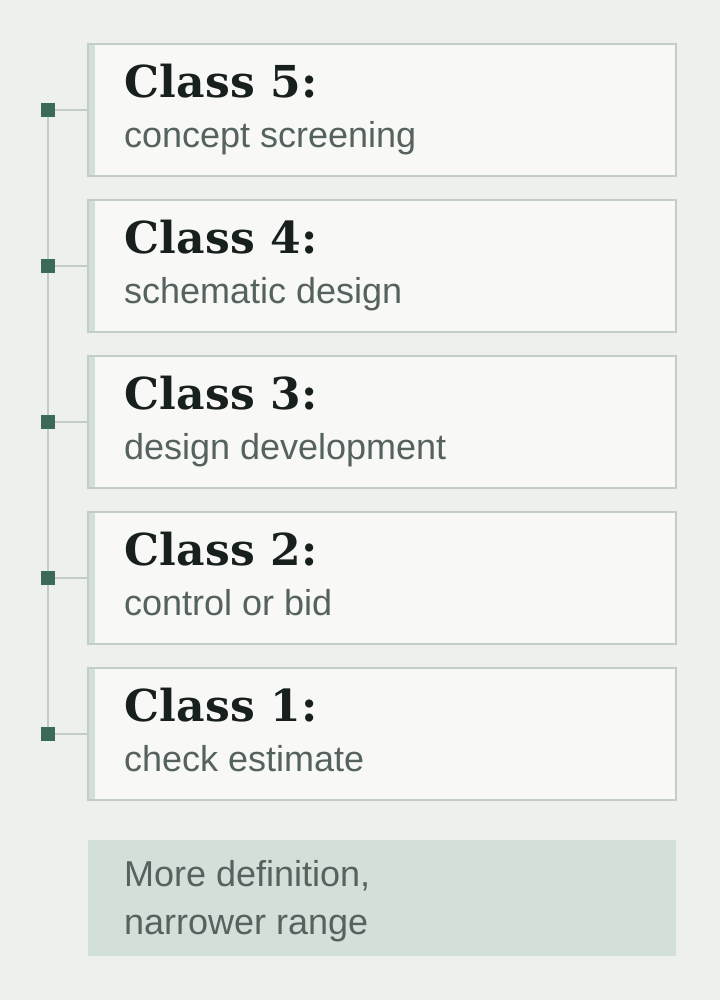
AACE International’s Recommended Practice 56R-08, Cost Estimate Classification System as Applied for the Building and General Construction Industries (revised August 2020), defines five estimate classes. The primary characteristic of each class is the maturity of project definition; other features, such as estimating method and expected accuracy, follow from it.
Scroll horizontally to see all columns.
| AACE class | Typical end use (56R-08) | Project definition, % of complete |
|---|---|---|
| Class 5 | Functional area or concept screening | 0% to 2% |
| Class 4 | Schematic design or concept study | 1% to 15% |
| Class 3 | Design development, budget authorisation, feasibility | 10% to 40% |
| Class 2 | Control or bid/tender | 30% to 75% |
| Class 1 | Check estimate or pre-bid/tender, change order | 65% to 100% |
The same table gives typical accuracy ranges at an 80% confidence interval, narrowing from about -20% to -30% on the low side and +30% to +50% on the high side for Class 5, to about -3% to -5% and +3% to +10% for Class 1. AACE stresses that these are typical ranges after appropriate contingency, that a specific project can fall outside them, and that the maturity of the defining deliverables determines the class, not the percentage.
For an owner, the practical lesson is to ask what class an estimate is before treating it as a budget. A concept-stage figure supports a go or no-go decision; it should not be presented as a contract price.
Managing cost during design
Cost management during design works when each design stage ends with a cost check and a decision. The AIA B101–2017 phase structure gives natural checkpoints: the architect submits an estimate of the cost of the work in schematic design and updates it in design development and construction documents.
- Concept: confirm the brief against a Class 5 or Class 4 order-of-magnitude estimate and agree the contingency approach.
- Schematic design: reconcile the first design estimate with the budget; adjust scope, quality, or funding before proceeding.
- Design development: update the estimate as systems and materials are chosen; test long-lead and high-cost items.
- Construction documents: update the estimate again and close or price remaining allowances before bidding or setting a guaranteed maximum price.
Review alternatives while the design can still respond. SAVE International’s Value Methodology Standard Reference (September 25, 2020) describes evaluating ideas against function, performance, quality, schedule, cost and risk; removing cost alone is not the same evaluation.
Keep the budget basis current
Record area, quality, site conditions, exclusions, design stage, pricing dates, taxes, fees and programme. When a decision changes scope, update the estimate, reconcile it with available funds, and record the change. For a design-build proposal, compare the cost components and inclusions before treating its price as the whole project budget.
Use the Preconstruction Risk Checklist to assign responsibility for remaining scope and pricing decisions.
Sources
- AACE International RP 56R-08, public sample, August 7, 2020 revision: Table 1, printed p. 3, and accuracy qualifications, pp. 3–4. These are estimate-classification ranges, not project guarantees.
- AIA B101–2017, official summary; publisher-hosted B101–2017 comparative reference, sections 5.2 and 6.1–6.2; the reference displays Rhode Island amendments and is not an executable standard form. Phase estimates: 3.2.6, 3.3.2 and 3.4.4.
- SAVE International, Value Methodology Standard Reference, revision September 25, 2020, from the VM Guide, Appendix C. This replaces the older 1997/1998 reference used here.
Public-source guidance and an editorial example; sources checked October 8, 2026. Check the clauses and inclusions of your actual agreements.
Related guides

Construction Budget Guide: Class the Estimate First
A construction budget fails when a screening figure is treated as authorization. On a base of 100, the wider Class 5 ends are 50 and 200. The wider Class 3 ends are 80 and 130.
Read guide
Construction Cost Breakdown: Reading the NAHB Residential Survey
Read the NAHB 2024 survey by denominator: sales price versus construction cost, fees already inside site work, and a blank cell for the quote.
Read guide