
Pre Construction Meeting: Agenda and Log
A pre construction meeting agenda and action log: topic, responsible person, record, deadline, and what is still open.
Open items from a pre construction meeting turn into rework when the only record is someone’s memory. Use the meeting, once a construction contract exists, to name a person, a record, a deadline and the conditions still open on each topic. This worksheet is an independent guide from SEI Design Build, which does not administer meetings or draft contracts.
A pre construction meeting is the session held after a construction contract exists and before, or as, the work starts. Leave with five fields on every open item: the topic, the person responsible, the record that will hold the answer, the deadline, and what is still undecided. A pre-bid meeting comes earlier, while firms are still preparing prices and no construction contract is in place to administer. A household and a builder talking through a vision, a budget and floor plans are in a design conversation. The agenda headings below come from one public university manual revised June 19, 2020. That owner’s contract and payment rules stay with that owner. Print the action log and fill it in the room. Authorization to start comes from the contract and the relevant authorities. Read what preconstruction covers for the phase, and the preconstruction risk checklist for items beyond this meeting.
This guide is part of the project planning collection.
Which meeting were you invited to?
Match the invitation to the stage of the project before you write questions. The same search phrase covers a bid meeting, a post-award coordination meeting and an early design conversation, and each one ends with a different record.
The three meetings above use similar names and leave different records. Read the invitation for bid, proposal, award or notice to proceed before you choose questions.
Scroll horizontally to see all columns.
| Meeting | When it happens | What you leave with |
|---|---|---|
| Pre-bid or pre-proposal | Firms can still submit or revise a price. No construction contract has been awarded. | Questions about the bid documents, and how answers will reach every bidder. |
| Pre construction coordination | A construction contract already exists, before or as work starts. | One row per open item: topic, person, record, deadline, still open. |
| Early design conversation | A household and a builder are still describing the home. | Notes on scope, the budget limit and who answers later questions. |
Northwest Missouri State University’s Capital Programs manual is written for the middle row. Revised June 19, 2020, its printed agenda on page 3 includes a review of the contract, payment applications, substantial completion and closeout. Those headings have a contract to point at, so the document is a post-award meeting. Page 2 says the manual does not alter the contract terms, and that the contract documents govern if the manual and those documents disagree.
A pre-bid meeting has no awarded contract, payment process or closeout to review. Ask how any answer will be issued to all bidders, and keep the questions on the documents you are pricing. Attendance is not permission to start work.
Some pages use the same phrase for a sit-down about vision, budget and floor plans before anyone has agreed to build. Treat that as a design conversation. The five-column log still gives the notes a person and a date. Shop drawings, payment applications and substantial completion belong to the post-award meeting, once a contract names them.
Common mistake: Taking contract-administration questions into a meeting that is still a bid walk-through.
What should the agenda cover?
Use your own contract as the text of the meeting, and use one public owner’s agenda as a list of topics to consider. The university manual’s page 3 agenda, revised June 19, 2020, lists twelve items in this order:
- Introduction and attendance record
- Review of the contract
- Lines of communication and coordination
- General requirements
- Submittals and shop drawings
- Changes in the work
- Application and certification for payment
- Substantial completion
- Closeout requirements
- Designer comments and technical review
- Contractor questions and comments
- Project site visit
On that campus, the owner’s project manager starts the introductions and the designer circulates the sign-in sheet. The communication section says verbal requests can speed coordination, and that communication which changes the work must be written down on forms that owner provides. The same section says the designer will hold monthly progress meetings with the people the project needs. Those sentences describe that owner’s administration. Payment timing, participation goals and safety-training penalties elsewhere in the manual are requirements for that public owner. Leave them there.
The four groups are an editorial sorting of the twelve headings, so a smaller project can see which cluster a topic belongs to. They are not a shorter form of that university’s contract.
For your own agenda, write four clusters and fill them from the documents in the room:
- People: who is present, who is absent, and who receives the record.
- Documents: the contract, drawings, specifications and addenda, each named by title and date.
- Working rules to read back from your contract: who is allowed to answer a question, how a change to the work is written, how submittals are reviewed, and which payment process the contract already names.
- Finish and site: what your contract says about substantial completion and closeout, whether this agenda includes a site visit, and which areas were actually walked.
If a heading is not in your contract, record it as still open or strike it. Do not borrow the university’s clause to fill the gap.
What should you ask before you leave?
Ask questions that fill a cell. A question that produces no person, no record, no deadline and no open condition can wait for the next meeting.
- Who is in the room, and who still needs the notes?
- Which documents is this meeting about, including addenda, by title and date?
- Who receives a question, and who is allowed to answer it?
- What has to be in writing before the work changes, and what is that form called in this contract?
- Which submittals come first, and who reviews them?
- If the agenda includes a site visit, which areas were walked, and which were not?
- What is still undecided, and which work has to wait while it stays open?
The university manual tells its contractor not to assume an answer the project documents do not cover. It says the procedure for those questions is in the general conditions and will be reviewed at the meeting. The manual’s opening does not reprint that procedure. On your project, ask for the procedure by the name your contract uses, and write that name in the record column.
Scroll horizontally to see all columns.
| Topic | Responsible person | Record | Deadline | Still open |
|---|---|---|---|---|
| Who attended, and who was absent | Sign-in sheet | This meeting | ||
| Documents this meeting is about, by title and date | This meeting | |||
| How a change to the work is written down | Form named in the contract | Before the change is carried out | ||
| First submittals and who reviews them | ||||
| Site visit, if the agenda includes one | Notes by the people who walked | This meeting | Areas not walked |
Print this page and write in the blank cells. The rows are prompts, not a sample project. This guide does not include a separate PDF.
What happens to an item that is still open?
An item is closed only when the record named in its row exists. “Still open” is a status you write down, with the person who owes the next step and the work that waits.
Read the diagram from the topic down. If any of the five fields is blank at the end of the meeting, the item stays open. Name the person who will fill it and the work that should not proceed from an unspoken assumption.
The university manual’s page 2 warning fits here without becoming a clause you can copy: the contractor is not to assume what the specifications or drawings do not say, and doing so is at that contractor’s own risk. Your contract decides the equivalent risk. The action log is where the team writes the assumption down so it is visible. It does not move that risk by itself.
Before the room empties, read the open rows aloud and confirm that the person named has the record and the deadline. People who were absent get the same sheet. A later progress meeting, which that university holds monthly, is a place to review the rows. It is not a reason to leave them blank today.
When this does not apply
Use a different record when the meeting in front of you is one of these:
- The invitation is to a pre-bid or pre-proposal meeting. Keep the notes on the bid documents and on how answers go to every bidder.
- The conversation is a household and a builder describing a home before a construction contract exists. Capture scope, the budget limit and who decides. Leave shop drawings and closeout until a contract names them.
- You need the definition of the preconstruction phase, or a checklist for the whole phase. Those are the phase guide and the risk checklist.
- You want legal advice, a price, or a ruling on what a contract requires. This page is an editorial worksheet compiled from one public manual. It is not a contract review.
The university manual is one owner’s document, revised June 19, 2020. It is not a national agenda. Public owners also work under procurement rules that this page does not restate.
Method and sources
This page is compiled from a public university meeting manual. It is not based on an SEI project, a test or a client file, and it is not legal advice. The four agenda groups and the five-column log are our editorial organization of that manual’s printed headings. The university does not publish them in this form. No payment terms, participation goals or penalty amounts from the manual are repeated here.
- Northwest Missouri State University, Capital Programs, Pre-Construction Meeting Manual, revised June 19, 2020. Printed page 2 (the manual does not alter the contract; unanswered items follow the general conditions), page 3 (agenda), and page 4 (attendance, and written confirmation when communication changes the work). Text checked October 12, 2026.
Updated October 12, 2026.
Related reading
- What preconstruction covers: the phase this meeting sits inside, and who decides before work starts.
- A preconstruction risk checklist: owners, due dates and consequences for the whole phase, beyond a single meeting.
Related guides
What Is Preconstruction? Phase, Activities and Services
What the preconstruction phase covers, its activities and services, how design, estimates and procurement loop back, and who decides before work starts.
Read guide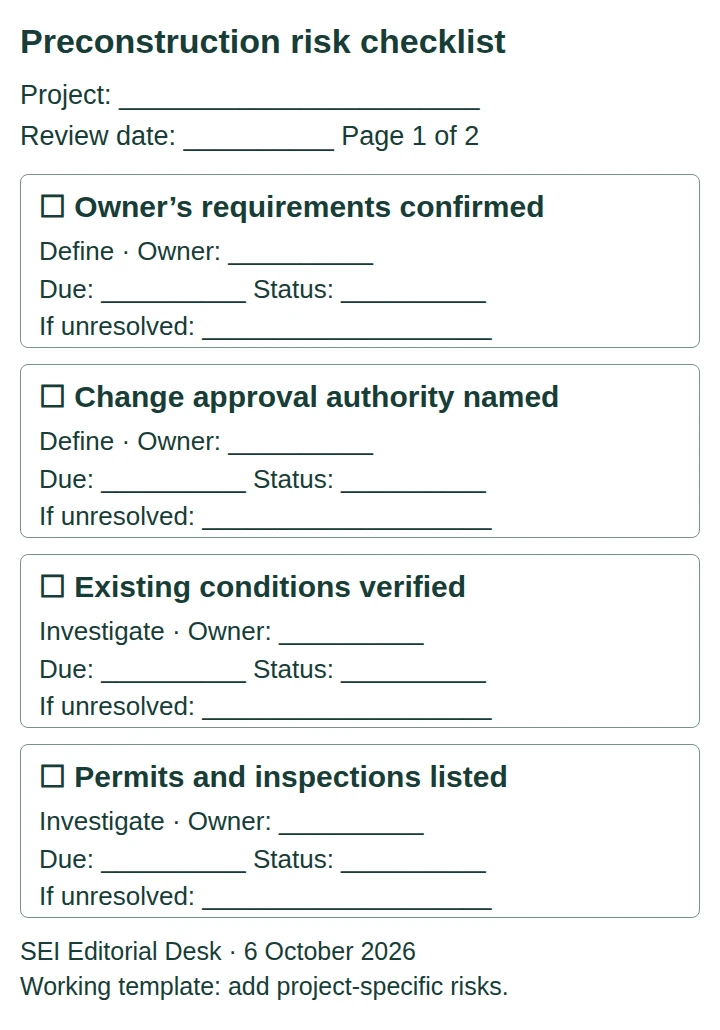
A Preconstruction Risk Checklist
A phased preconstruction checklist and planning framework for scope, approvals, existing conditions, procurement, schedule, and handover before work starts.
Read guide