
What Is Preconstruction? Phase, Activities and Services
What the preconstruction phase covers, its activities and services, how design, estimates and procurement loop back, and who decides before work starts.

If the owner’s budget, the design and the supply market are compared for the first time when bids arrive, the usual result is costly redesign and a later start. Preconstruction is the stage before construction work is authorized in which the owner, the design team and, where one is hired early, a builder define the requirements, develop and estimate the design, and plan procurement, approvals and the schedule until a defined package of work is ready and authorized to start. This guide explains the phase for owners and project teams; SEI Design Build is an independent publication and does not provide preconstruction services.
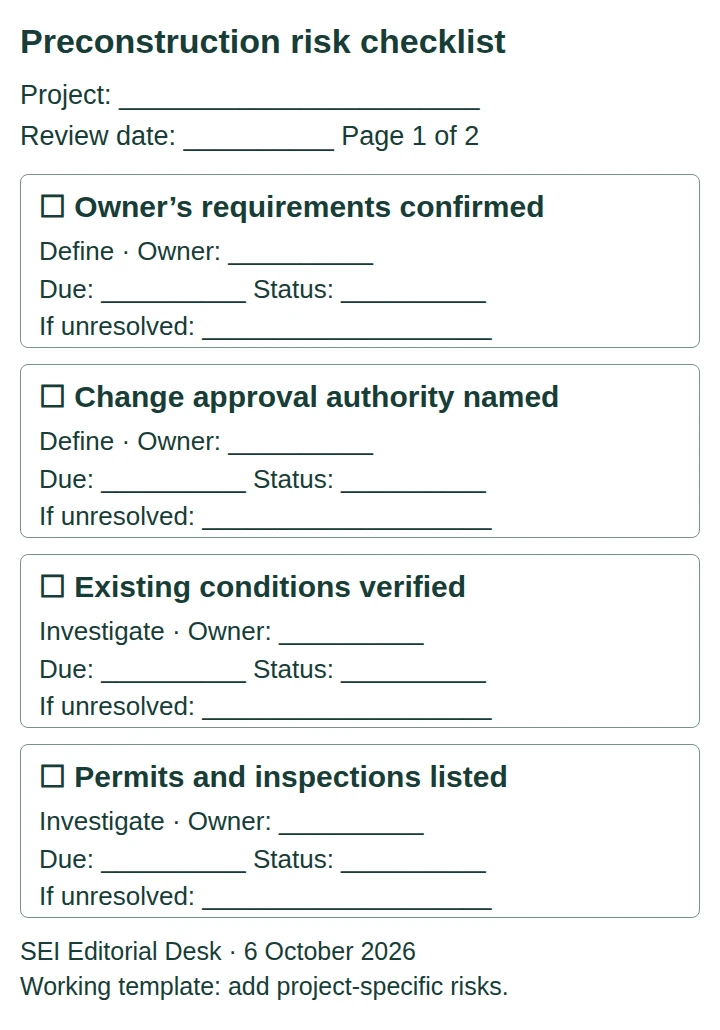
Preconstruction covers what a project has to settle before a package of work is released to build: what the owner requires, how the design meets that within the budget, which items need early ordering, which approvals apply and when the work can realistically happen. Estimates and purchasing run alongside the design, so the phase loops rather than running in a straight line. Who performs each activity depends on the delivery method and the agreements, and a builder’s “preconstruction services” contract covers only the part that builder agreed to do. This page sets out the activities, the loops between them and the decisions that close the phase, using AGC and DBIA publications as reference points. To assign owners and dates to each item, use the preconstruction risk checklist.
- The phase starts once the owner’s requirements can be evaluated and ends package by package, when a defined package is ready and the contract authorizes it. When the price becomes fixed depends on the delivery method and the agreement.
- Design and cost estimates move back and forth; AGC’s guidance for CM/GC projects has the team resolve estimate differences before the next design phase.
- Procurement lead times and approval requirements can change the design and the schedule, so they are planned while the design develops.
- An estimate, a meeting or a ticked checklist does not authorize construction. The contract and the relevant authorities do.
This guide belongs to the project planning collection, which gathers SEI’s early-stage planning guides and the printable checklist.
What does the preconstruction phase cover?
The preconstruction phase covers the project’s preparation from the point the owner’s requirements can be evaluated until a defined package of construction is ready and the contract authorizes work on it. Preconstruction services are narrower: they are the share of that work one party, usually a builder or design-builder, has agreed to perform under its contract.
The distinction matters because the project needs the work whether or not anyone is paid specifically for it. In AGC’s sample owner-contractor agreement for a guaranteed maximum price (AGC Document No. 250, 2000 edition, reproduced in the 2007 CM/GC Guidelines for Public Owners), preconstruction services are a box the parties tick: they “are / are not” included in the contractor’s work. When a builder is not engaged during design, the owner still needs estimates and construction advice. The same guidelines note that an owner can have the design team prepare its own estimate, in-house or through a cost consultant.
DBIA uses the term in the same sense for progressive design-build. Its 2017 primer says Phase One services “are also called Preliminary or Preconstruction Services”: the design-builder works with the owner and its consultants to create or confirm the basis of design and programming requirements, advances the design with budget-level estimates and negotiates a price for the next phase. The primer adds that the contract, often through an exhibit, states which Phase One work the design-builder will do, including how often it estimates. If the delivery method itself is new to you, read what design-build means for an owner first.
The end of the phase is set per package of work, by its readiness and its authorization under the contract. On a phased project, site work or long-lead purchasing can be authorized while interior design is still developing, so one project can be in preconstruction and construction at the same time. A pricing basis for authorized work is not the same as a fixed price for the project: AGC’s CM/GC guidelines say the guaranteed maximum price can be set anywhere from design development to “early in the construction phase.” Where the services and the commitments are written down depends on the contract form; the design-build contracts guide shows how the published AIA, DBIA and ConsensusDocs families handle it.
Common mistake: Reading a builder’s preconstruction services proposal as a description of the whole phase. Work it leaves out, such as the owner’s own decisions, the designer’s coordination of documents or permit applications, still has to be assigned to someone.
Takeaway: Treat preconstruction as the project’s work and preconstruction services as one party’s agreed share of it, then confirm who holds the rest.
Which activities and services does preconstruction include?
Most preconstruction work falls into seven activity groups, from the owner’s requirements through to closeout planning, and each should leave a record that someone maintains. The grouping below is our editorial one, built from AGC and DBIA descriptions. It is not an official list, and small projects often combine several groups in one document.
Scroll horizontally to see all columns.
| Activity | What it helps establish | Typical output or decision | Who usually contributes |
|---|---|---|---|
| Requirements and feasibility | What the owner needs, the budget limit and open constraints | Written program or brief; list of open feasibility questions | Owner and users; design team; builder if engaged |
| Design coordination and constructability review | Whether the documents agree with each other and can be built in the planned sequence | Review comments with recorded responses | Design team coordinates; builder or consultant advises |
| Estimating and value analysis | Whether the design fits the budget, and which alternatives change cost or value | Estimate at each design milestone; reconciliation record; option decisions | Builder or cost consultant with the design team; owner decides |
| Scheduling and approvals | When design, approvals, purchasing and site work can realistically happen | Schedule showing dependencies; list of approvals, reviews and inspections | Builder or project manager; design team; authorities decide approvals |
| Procurement and trade input | Which items need early ordering and which specialty contractors are available | Long-lead procurement schedule; prequalified trade list | Builder; specialty contractors; owner approves |
| Work-package readiness | Whether a package is defined and authorized under the contract | Written authorization on the contract’s terms; a price or GMP where one has been agreed by then; permits for that work | Owner; builder; relevant authority |
| Closeout and operations requirements | What the owner needs at handover and in use | Commissioning, records and warranty requirements written into the brief | Owner and operators; design team; builder |
The outputs are examples of what each activity should leave behind, not forms prescribed by AGC or DBIA. “Who usually contributes” changes with the delivery method and the appointments on your project.
AGC’s sample agreement shows how one builder’s share can be written down. It lists a preliminary evaluation of the owner’s program; regular meetings and advice on site use, materials, building systems, construction feasibility, procurement and installation times and the cost of alternative designs; a preliminary schedule; estimates at each design stage; a review of drawings and specifications for constructibility problems; a schedule for long-lead items; developing subcontractor interest; and help with consultants and permits. The 2007 guidelines add value analysis, a review of major building systems and periodic reviews of drawings “to advise the designer on design decisions that do not fit within the project budget or schedule.” The construction manager at risk guide covers the CM/GC arrangement those documents were written for.
Value analysis in that text means evaluating the budget and suggesting “cost-saving changes or value enhancements”, so it covers improvements as well as savings, and AGC pairs it with a review of which major systems are most cost-effective. For keeping the estimate and the design describing the same project, see early budget alignment.
Takeaway: Ask for each activity’s record by name, because an activity that leaves no record cannot be checked later.
How does the preconstruction process work, and where does it loop back?
Preconstruction runs as a set of loops. The owner’s requirements start the design, and design and estimate are compared at each milestone. Procurement lead times and approval requirements push changes back into the design and schedule. The owner then accepts, changes the scope or revises the budget. A work package is ready only after that loop settles.

Design and estimates loop first. In AGC’s guidelines, the builder and the design team prepare new estimates at the end of schematic design or early design development, and the team should “resolve any significant differences among the estimates before proceeding to the next design phase.” Resolving them “may include changes in project scope.” After that, the whole team reviews the updated estimate after every major design milestone. DBIA’s primer describes the same habit in progressive design-build: design decisions weigh cost, schedule, quality, operability and life cycle, with “ongoing, transparent cost estimates” as the design develops.
Procurement feeds back into the design. AGC’s sample agreement asks the builder to advise on “time requirements for procurement, installation and construction completion” and on “estimates of alternative designs or materials”, and to recommend a procurement schedule for long-lead items. If a specified item cannot arrive in time, the team can order it earlier, choose a different item or move the work. A substitute may need design review or revised drawings, and an earlier order or a new sequence means updating the schedule.
Approvals feed back into both design and schedule. AGC’s current project management course teaches how building codes, permits, reviews and inspections can affect a project, and its 2007 guidance has the builder consult “governing entities” when it builds the schedule. A condition attached to an approval can change the drawings, so the list of approvals belongs next to the design schedule rather than after it.
The owner’s decision closes each loop. AGC describes a project-budget clause under which the owner “will modify the scope” to help the design team and builder meet the agreed goals. When the estimate and the budget disagree, the owner changes the requirements, the budget or the priorities, and the design and estimate go round again.
Some packages leave the loop early. DBIA’s primer notes that many progressive design-build projects let the design-builder proceed on “early work” packages for discrete physical work, such as procuring long-lead items, demolition or site work, before the main construction phase is authorized, and that the contract should set how those packages are developed and authorized. Without that separate authorization, the early branch does not exist.
Common mistake: Waiting for complete drawings before the first estimate. If that estimate exceeds the budget, the owner can still raise the budget, cut scope or change the design, but the last two now mean reworking finished documents, and the schedule may have no room for it.
The preconstruction risk checklist turns these loops into items with an owner, a due date and a consequence if they stay open.
Takeaway: Put an estimate review at each major design milestone in the schedule, and record what each review changed.
Who makes the decisions before construction starts?
The owner decides scope, budget and priorities. The design team is responsible for the design documents. A builder engaged early advises on cost, sequence and whether the design can be built. Authorities decide permits and inspections. The contract decides when a package of work may start, and because contracts can move these lines, the actual agreement governs your project.
AGC’s guidelines draw the line between design and construction advice clearly for CM/GC projects. The builder “is not the designer of record”, and in constructability reviews it “does not assume the liability of the designers of record.” The architects coordinate their own drawings and specifications; the builder checks whether what is drawn can be built safely, quickly and economically; once the owner approves a change, the architect carries it through the whole set of documents. The same guidelines warn that “errors, omissions and coordination problems will exist” even with good intentions, which is one reason contingencies exist.
Design-build changes who holds the roles, not who decides the scope. DBIA calls the single contract for both design and construction “the fundamental difference between design-build and other project delivery systems”, so one entity carries design and construction responsibility. The owner still sets the requirements and approves changes to them.
Permits sit with the authority having jurisdiction. AGC’s sample agreement asks the contractor to “assist the Owner in obtaining building permits”, apart from permits the contractor must obtain directly; who applies on your project is a contract question, and whether a permit is granted is the authority’s decision.
Authorization is the last decision. Under AGC’s description of CM/GC, the builder often starts with “an agreement to provide pre-construction services only” and has no obligation to build within a guaranteed maximum price until one is agreed and added to the contract. A preconstruction estimate is a forecast that the contract may later turn into a price.
Takeaway: Before the first estimate review, write down who decides, who advises and who approves each open item.
How does the delivery method change preconstruction?
The delivery method decides when a builder joins and when the price becomes a commitment. In design-bid-build, construction advice during design usually comes from the design team or a consultant the owner hires. In construction manager at risk and progressive design-build, a builder joins during design and the price follows. In two-step design-build, competing teams propose a price at selection.
Scroll horizontally to see all columns.
| Delivery method | When the builder joins | When the construction price is committed | Where builder input during design comes from |
|---|---|---|---|
| Design-bid-build | After design, through bids | At contract award, on the bid documents | Design team, cost consultant or another owner’s advisor |
| Construction manager at risk (CM/GC) | During design, under a services agreement | When a GMP is agreed, at a point the parties choose | The construction manager, with any key trade contractors on the team during design |
| Two-step best-value design-build | At selection, on proposals | With the selected design and cost proposal | The design-builder, once selected |
| Progressive design-build | Early, mainly on qualifications | At an agreed milestone, as a fixed price or GMP | The design-builder throughout Phase One |
Sources: AGC/NASFA CM/GC Guidelines for Public Owners (2007), delivery definitions; DBIA, What Is Design-Build? and its June 10, 2026 article on qualifications-based selection. Public owners also work within procurement laws that limit which methods they can use.
In AGC’s description, design-bid-build has the owner engage a designer, solicit bids and contract on “a firm price and completion date commitment”, typically awarded on the lowest responsive and responsible bid. The design-build vs design-bid-build comparison explains why builder input reaches the design late in that sequence. For CM/GC, AGC says the point at which the guaranteed maximum price is set “can vary from very early on in the project (such as the design development stage), to very late”, and an earlier GMP usually carries more contingency because it rests on less complete drawings.
DBIA’s June 10, 2026 article on qualifications-based selection describes a federal agency selecting a design-builder “to develop the design and provide preconstruction services through a defined milestone”, after which the team proposes “a firm fixed price or guaranteed maximum price.” The progressive design-build guide covers that two-phase structure and what happens if the price is not agreed. For how each pricing basis divides cost risk once it is committed, see construction contract types.
Takeaway: Identify your delivery method first, because it tells you who will supply construction advice during design and when an estimate becomes a price.
How is preconstruction different from construction planning and closeout?
Preconstruction decides what will be built, for how much and when; construction-phase planning coordinates how the work is carried out once it is authorized; closeout hands over a working facility with its records and warranties. The phases differ in purpose, but the owner’s closeout and operations requirements must be written down during preconstruction to be delivered at the end.
Scroll horizontally to see all columns.
| Preconstruction | Construction-phase planning | Closeout and turnover | |
|---|---|---|---|
| Main question | What will be built, at what cost and when | How the authorized work is sequenced, coordinated and checked | Whether the facility works and the owner has what it needs to run it |
| Typical records | Brief, estimates, design reviews, procurement and approval lists | Look-ahead schedules, submittals, requests for information, inspection records | Commissioning results, as-built records, warranties, training |
| Who leads | Owner with the design team, and the builder if engaged | Builder, with the design team answering questions | Builder and design team, with the owner’s operators |
The boundaries overlap. AGC’s current project management course groups construction-phase planning areas with document control (submittals, requests for information and shop drawings) and with closeout and warranty management in one unit on initiating and planning. DBIA’s primer puts operability and life cycle among the factors weighed in Phase One design decisions, while testing and commissioning are services delivered later. If the owner’s maintenance staff need particular records, equipment access or training, those needs belong in the brief now; adding them during turnover usually means a change.
The checklist’s handover module lists the commissioning, training, warranty and closeout items to plan before work starts; download the printable preconstruction checklist (PDF) to record them.
Takeaway: Write the operations and closeout requirements into the brief during preconstruction, even though they are delivered at the end.
When this does not apply
The model on this page describes a typical building or renovation project with a defined owner, design team and builder. Some projects divide the work differently, and the explanation then needs adjusting rather than applying as written. None of it grants permission to start work or defines a particular contract’s scope.
Phased and fast-track projects run preconstruction and construction side by side, package by package. In that case, ask about readiness for each package, not for the project as a whole.
Terminology differs between organizations. Some guides treat site selection and feasibility studies as a separate predevelopment stage and start preconstruction once a program exists; others include feasibility. The activities are the same; check which label your contract and your team use.
Contracts and procurement rules decide the details. The AGC and DBIA documents cited here are examples: the AGC guidelines are a 2007 publication for public owners using CM/GC, and the DBIA primer dates from 2017 and covers progressive design-build only. Neither sets the scope of services, the GMP timing or the procurement method for your project. Public owners should also check the procurement statutes that apply to them. Industrial and process projects often use engineering, procurement and construction arrangements with their own phase names; EPC contracts explained covers that vocabulary.
A model also does not replace professional or regulatory judgement. Design responsibility, permit requirements and safety decisions belong to the licensed professionals and the authorities involved.
Takeaway: Use this explanation to understand the work, and use your contract and local requirements to decide who does it and when.
Frequently asked questions
Is preconstruction hyphenated?
Both forms are in use. AGC’s 2007 CM/GC guidelines use “preconstruction” in their chapter heading and “pre-construction” in the guaranteed maximum price discussion, and DBIA’s primer writes “Preconstruction Services”. Neither organization mandates one spelling. This page uses “preconstruction” throughout; follow your contract’s spelling in project documents.
What are the five most common pre-construction services?
There is no official list of five. AGC’s sample agreement names estimates, constructibility review of drawings and specifications, a schedule for long-lead procurement and developing trade contractor interest, plus consultation, scheduling and help with permits. The services a builder actually provides are those written into its agreement, so compare proposals against your own activity list.
How many stages does preconstruction planning have?
No fixed number applies across projects. Preconstruction usually follows the design stages, such as schematic design, design development and construction documents, with estimates and reviews at each. AGC’s sample agreement ties its estimates to those design stages. Phased projects repeat the cycle for each package of work.
Are preconstruction services part of the construction price?
Often they are agreed separately. AGC describes CM/GC builders starting with an agreement for preconstruction services only and agreeing a guaranteed maximum price later; DBIA describes progressive design-build Phase One services followed by a separate price proposal. How preconstruction services are paid for is set in each agreement, and this page does not publish rates.
Are estimating and tendering the same thing?
No. Estimating forecasts the cost of the design as it develops and is repeated at each milestone. Tendering, or bidding, asks contractors or trade contractors for prices on defined work and leads to a commitment. AGC’s CM/GC guidelines list them as separate preconstruction tasks: periodic estimates, and soliciting and prequalifying specialty contractors.
What should I expect at a preconstruction meeting?
Expect to confirm who maintains each planning record, how changes are approved and when open items are reviewed. The meeting is one event within the phase, not the phase itself, and it does not authorize work; SEI’s preconstruction risk checklist explains how to keep those records current.
Is there a preconstruction planning checklist I can use?
Yes. SEI’s preconstruction risk checklist groups planning items into five modules (define; investigate; price and procure; schedule and control quality; prepare handover), with space for an owner, due date, status and consequence for each. A printable PDF version is linked on that page. It is an editorial starting point, not an official approval list.
Method and sources
This explainer is compiled from public publications by the Associated General Contractors of America (AGC) and the Design-Build Institute of America (DBIA). It is not based on SEI project experience, testing or client work, and it is not legal advice. The activity table, the feedback diagram and the phase comparison are our editorial organization of those sources; AGC and DBIA do not publish them in this form. Quotations come from the documents below; older documents are cited for how they describe preconstruction services, not as current requirements.
- AGC and NASFA, CM/GC Guidelines for Public Owners, second edition, 2007: chapter “CM/GC Services to Be Provided During Preconstruction” (pp. 42–45) and the reproduced AGC Document No. 250 (2000), Article 3.2 Preconstruction Services.
- AGC, Project Management Course, Module 3: Project Administration, Unit 3 learning outcomes.
- DBIA, Progressive Design-Build primer, October 2017: “What is Progressive Design-Build?” and “Contract Issues Unique to PDB”.
- DBIA, What Is Design-Build?: delivery definitions and design-build variations.
- DBIA, New DBIA resource helps federal owners navigate QBS for design-build projects, June 10, 2026.
Sources checked October 11, 2026. Updated October 11, 2026.
Related reading
- A preconstruction risk checklist: assign an owner, due date and consequence to each planning item.
- Why early budget alignment matters: keep the estimate and the design describing the same project.
- Design-build vs design-bid-build: see when builder input reaches the design under each method.
- Construction manager at risk: understand the services agreement and when the GMP is set.
- Progressive design-build: follow the two-phase process from qualifications-based selection to a price.
Related guides
A Preconstruction Risk Checklist
A phased preconstruction checklist and planning framework for scope, approvals, existing conditions, procurement, schedule, and handover before work starts.
Read guide