
A Preconstruction Risk Checklist
A phased preconstruction checklist and planning framework for scope, approvals, existing conditions, procurement, schedule, and handover before work starts.
Unresolved scope, approvals and site conditions can disrupt construction. Use this editorial starting checklist to name an owner, due date, status and consequence for each item, then add project-specific requirements.
If you first need to know what the phase includes and how design, estimates and procurement feed back on each other, read what preconstruction covers and who decides.
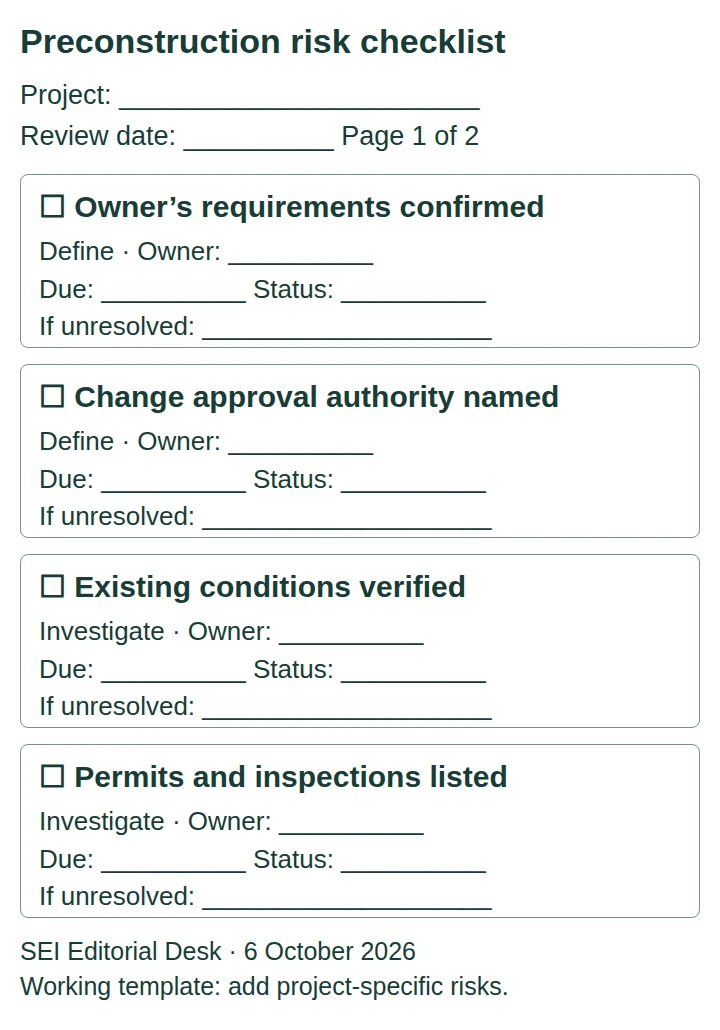
Read or download the existing printable checklist (PDF, 2 pages). It is for owners and project teams planning building or renovation work; it does not grant approval to start.
- Define: fix the owner’s requirements, decision rights, and open decisions.
- Investigate: confirm site conditions, approvals, and constraints.
- Price and procure: reconcile the estimate with the design and secure long-lead items.
- Schedule and control quality: link decisions, approvals, and inspections to the programme.
- Prepare handover: plan commissioning, records, and closeout before work starts.
A phased preconstruction planning framework
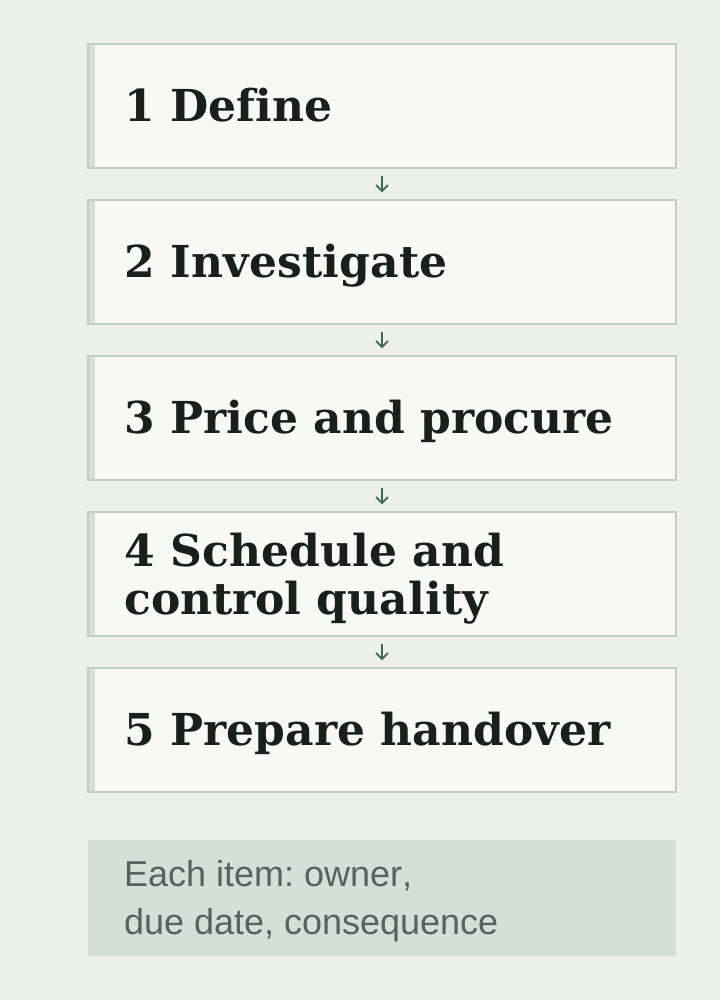
Work through the modules roughly in order, because later modules depend on decisions recorded in earlier ones. Pricing is only as reliable as the scope it prices, and a programme is only as reliable as the approvals and lead times it assumes.
The sections and worksheet below follow these same five modules.
Define: scope and information
- Confirm the owner’s requirements and success criteria
- Record inclusions, exclusions, allowances, and unresolved decisions
- Coordinate drawings, specifications, surveys, and consultant information
- Establish who can approve scope, cost, and programme changes
Investigate: site and approvals
- Verify existing conditions and access constraints
- Confirm planning, permit, utility, and inspection requirements
- Identify hazardous materials, temporary works, and protection needs
- Record neighbour, occupancy, noise, and working-hour constraints
Price and procure: cost and procurement
- Reconcile the current estimate with the current design; use the early budget alignment guide to track scope, allowances, and estimate changes
- Test long-lead materials and specialist trade availability
- Define substitution, sample, and submittal approval procedures
- Separate contingency from known but unpriced scope
Schedule and control quality
- Link design decisions and approvals to the construction programme
- Define hold points, inspections, testing, and quality records
Prepare handover
- Plan commissioning, training, warranties, and closeout documents
- Agree how defects and incomplete work will be tracked
Planning documents that support the checklist
A checklist works best when each item points to a record that someone maintains. These document types are common across delivery methods; a spreadsheet or any project management tool can hold them.
Scroll horizontally to see all columns.
| Document | What it answers | Typical owner |
|---|---|---|
| Responsibility matrix | Who decides, advises, prices, and accepts each item | Owner or project manager |
| Decision log | Which design and material choices are open, and when they must close | Owner with the design lead |
| Risk register | Which uncertainties remain, their consequence, and the response | Project manager |
| Permit and approval tracker | Which approvals are needed, submitted, and granted | Design lead or contractor |
| Procurement schedule | Which items have long lead times and when they must be ordered | Contractor |
| Submittal register | Which samples, shop drawings, and data need approval | Contractor with the design lead |
| Baseline programme | How approvals, procurement, and hold points drive the sequence | Contractor |
The “typical owner” column is a starting point; your contract decides who actually holds each record.
Printable pre-construction checklist template
The PDF linked above has space for an owner, due date, status and consequence for each item. Print at A4 or fit to US Letter, and add project-specific items on a separate sheet.
You can also copy the table below into a document or spreadsheet. Use one row per item and add rows for project-specific risks.
Scroll horizontally to see all columns.
| Module | Item | Owner | Due date | Status | Consequence if unresolved |
|---|---|---|---|---|---|
| Define | Owner’s requirements confirmed | ||||
| Define | Change approval authority named | ||||
| Investigate | Existing conditions verified | ||||
| Investigate | Permits and inspections listed | ||||
| Price and procure | Estimate reconciled with current design | ||||
| Price and procure | Long-lead items identified | ||||
| Schedule and control quality | Hold points and inspections in programme | ||||
| Prepare handover | Commissioning and closeout documents agreed |
A hypothetical example of one checklist item
This example is hypothetical and illustrates the method only; it does not describe a real project.
An owner plans an interior renovation of an older office floor. The drawings assume the ceiling void is clear, but no one has opened it. On the checklist, “Existing conditions verified” is marked open. The team names someone to coordinate the investigation and any qualified specialists needed, sets a date before the estimate is reconciled, and records the consequence: if services or hazardous materials are found, ceiling heights, the electrical scope, and the programme may change. The budget records the uncertainty as contingency; known investigation work is priced separately.
The point is not the scenario but the pattern: a named owner, a date tied to a dependent decision, and a stated consequence.
What should I expect at a preconstruction meeting?
Confirm who maintains the open-item list, responsibility matrix, decision log, permit tracker and submittal register. Agree change approval routes and review dates. Revisit an item when design, site information or procurement changes; close it against a recorded decision or evidence, rather than leaving the old status in place.
As an editorial escalation rule, raise unresolved approvals, hazardous-material questions, safety constraints or assumptions affecting the next work package with the responsible professional or authority before releasing that work. Other open items need an agreed response and a date tied to the dependent decision. A ticked checklist does not replace permits, inspections or contract approvals.
For how delivery arrangements affect responsibilities, use the design-build vs design-bid-build comparison.
Method and sources
The five modules and blank worksheet are SEI’s editorial organisation of planning tasks, not an official approval checklist. Adapt approvals and hazardous-material investigation to local requirements and professional responsibilities. EPA’s asbestos guidance explains inspection and notification requirements for covered demolition and renovation; do not treat every project as having identical obligations.
- CMAA, Owner’s Guide to Project Delivery Methods, August 2012, section 2.1, printed pp. 5–6: budget, schedule, risk and owner resources.
- US EPA, overview of asbestos NESHAP, “Renovation and Demolition of Buildings.” Sources checked October 8, 2026.
Related guides
Preconstruction Manager: Role and Deliverables
The preconstruction manager's job is the running set of estimates, value-engineering records, and bid-package boundaries, not the meeting agenda.
Read guide
Pre Construction Meeting: Agenda and Log
A pre construction meeting agenda and action log: topic, responsible person, record, deadline, and what is still open.
Read guide
What Is Preconstruction? Phase, Activities and Services
What the preconstruction phase covers, its activities and services, how design, estimates and procurement loop back, and who decides before work starts.
Read guide