
Construction Budget Guide: Class the Estimate First
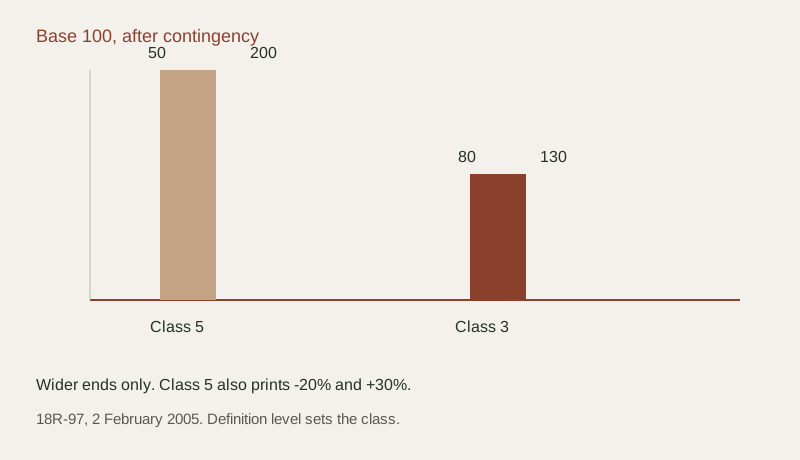
A construction budget fails when a screening figure is treated as authorization. On a base of 100, the wider Class 5 ends are 50 and 200. The wider Class 3 ends are 80 and 130.

A construction budget fails when a screening figure is used as the authorization number. The low side is too thin, the high side blows the funding, and the bid comparison is wasted.
This page classes the estimate before anyone fills a template. SEI Design Build is an independent publication. It does not estimate projects or solicit bids.
The class is the definition level
AACE International Recommended Practice No. 18R-97, Cost Estimate Classification System as applied in engineering, procurement, and construction for the process industries, is dated 2 February 2005 in the copy used here. That text says only the level of project definition determines the estimate class. The level is expressed as a percent of complete definition. For these process industries, the text says that percent correlates with the percent of engineering and design complete.
End use, estimating method, accuracy range, and preparation effort are secondary. The matrix says those characteristics are typical and that they vary from application to application.
The named scope is chemicals, petrochemicals, and hydrocarbon processing. The same 2005 text says it does not address estimate classification for commercial building construction, and it leaves significant building construction inside a process plant to a separate addendum. A house budget does not pick up a class from this sheet.
Scroll horizontally to see all columns.
| Class | Definition | Typical end use | Low side | High side |
|---|---|---|---|---|
| 5 | 0% to 2% | Concept screening | -20% to -50% | +30% to +100% |
| 4 | 1% to 15% | Study or feasibility | -15% to -30% | +20% to +50% |
| 3 | 10% to 40% | Budget, authorization, or control | -10% to -20% | +10% to +30% |
| 2 | 30% to 70% | Control or bid/tender | -5% to -15% | +5% to +20% |
| 1 | 50% to 100% | Check estimate or bid/tender | -3% to -10% | +3% to +15% |
The low and high columns are the ranges printed in Figure 1 of that 2005 text. Note [a] says the plus or minus value is the typical percentage variation of actual cost from the estimate after contingency, for a given scope, with contingency typically set at a 50% level of confidence. The class descriptions say that, typically, this produces a 90% confidence that actual cost falls inside the low and high bounds. The same descriptions say unusual circumstances push the range past the printed bounds. A later revision of 18R-97 can print different ranges. These figures are the 2 February 2005 text only.
On a base of 100, the wider Class 5 ends are 50 and 200. The narrower Class 5 ends are 80 and 130. The wider Class 3 ends are also 80 and 130. The same base, two classes. Picking the narrow accuracy number does not turn a screening estimate into a Class 3 budget. The definition level does that.
What has to exist before the number is a Class 3 budget
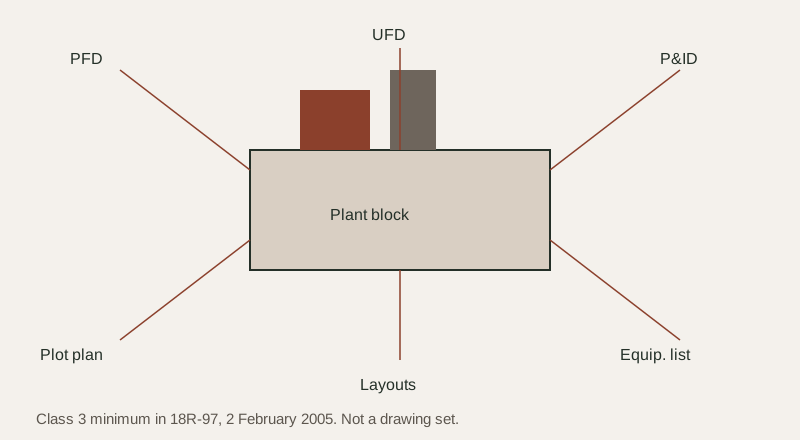
The 2005 Class 3 description says these estimates are generally prepared to form the basis for budget authorization, appropriation, or funding, and that they typically form the first control estimate. It says engineering is typically 10% to 40% complete and, at a minimum, includes process flow diagrams, utility flow diagrams, preliminary piping and instrument diagrams, a plot plan, developed layout drawings, and essentially complete engineered process and utility equipment lists. The estimating method is semi-detailed unit costs with assembly-level line items.
Class 4, in the same text, is the study or feasibility class. Its minimum inputs are plant capacity, block schematics, an indicated layout, process flow diagrams for the main process systems, and preliminary engineered process and utility equipment lists. Engineering at that class is from 1% to 15% complete. If the Class 3 documents are missing and only those Class 4 inputs exist, the estimate remains Class 4 even when someone types the total into a budget column.
Class 5 is the concept-screening class. The text says that often little more than proposed plant type, location, and capacity are known, and that the methods are stochastic: capacity factors, scale factors, and other parametric models.

Keep this class off the house-survey shares
The NAHB construction-cost breakdown reads a 2024 single-family survey. Those shares use a sales-price denominator and a construction-cost denominator for houses. They are not 18R-97 classes. The early budget alignment guide separates construction work, owner costs, allowances, and uncertainty on a building record. Neither page supplies a process-plant class.
When this does not apply
- The project is a house, a commercial building, or other nonprocess work. The 2005 practice says it does not classify those estimates.
- The sheet in hand is a later edition of 18R-97. Use that edition’s ranges. Do not mix them with the 2005 table above.
- The contingency is not yet applied. The printed range is the variation of actual cost from the estimate after contingency.
Release the class with the sheet
The handoff names the edition, the class, the deliverables that exist, the base, and which end of the printed range you will manage. A later drawing set can move the class. It does not rewrite the old screening total into an authorization. The costs and planning collection holds the related cost guides.
Related guides

Construction Cost Breakdown: Reading the NAHB Residential Survey
Read the NAHB 2024 survey by denominator: sales price versus construction cost, fees already inside site work, and a blank cell for the quote.
Read guide
Why Early Budget Alignment Matters
What a construction budget should include, how estimates mature with design, and how to manage cost at each design checkpoint before commitments are made.
Read guide