
Building a House Checklist: From Brief to Handover
Record the stage, the professional to ask, the document, the status, and the next step from the brief through handover.
A missing stage record costs you the file you need when a disagreement starts. Write five fields for the stage you are in: the stage, the professional to ask, the record, the status, and the next step. The worksheet below is for the owner of a new house, from the brief through handover. Print this page and fill the blank cells here. SEI Design Build is an independent publication and does not design or build houses.
A building a house checklist records the stage you are in, the professional you will ask, the document you keep, and whether that item is open, waiting, or closed, plus the next step. Use it when you own a new house and you are moving from a brief toward handover. The stage names below are an editorial sequence so the rows stay in one order. Your building office and your contract can use other names, and they decide permits, inspections, licenses, and warranty wording. Leave a cell blank until the person or office named in that row gives you the document. The table is the worksheet. Fill the status and the next step on this page.
This guide is part of the project planning collection.
Fill the stage worksheet
Work one row at a time. Status uses three words. Closed means the document named in that row is in your file, with a title and a date. Waiting means you have asked the named professional and you have written the date you asked. Open means the document is missing, or no professional is named yet.
The next step follows the status. On an open or waiting row, write the person and the document still missing. On a closed row, move to the next row that is still open. Leave a later row open until the earlier document is in the file.
A row closes when the document named in that row is in your file, with a title and a date.
Scroll horizontally to see all columns.
| Current stage | Professional to ask | What to record | Status | Next step |
|---|---|---|---|---|
| Site, before you commit | The office that regulates building on that parcel, and the person offering the parcel | The document that describes the parcel, by title and date. Any written reply from that office. | ||
| Brief | The designer, once you have engaged one | A written list of what the house has to do, and who may change that list. | ||
| Design | The designer of the drawings. The builder only after one is engaged. | Drawing or model name, and its date. | ||
| Approvals, before work | The office that issues the building permit for the address | The application or permit identifier that office gave you, and the date. | ||
| Contract, before work | The person who will sign the construction contract for the builder | Contract title and date. What it includes. What it excludes. Who may authorize a change. | ||
| Construction | The person the contract names for owner questions. For a required inspection, the inspector that authority assigns. | Visit date. What was walked. What was not walked. The inspection record the authority issued, by title and date. | ||
| Handover | The person the contract names for closeout | Each document the contract says you receive, by title and date. The warranty wording in the contract. Items still open. |
Common mistake: Marking a row closed after a conversation, while the named document is still missing.
What do you record before you commit to a site?
Record the document that describes the parcel, and any written reply from the office that regulates building there. If either one is missing, the site row stays open. The next step names the person or office you will ask, and the date you will ask.
Two wood stakes stand in an empty dirt lot under an overcast sky.
The stakes mark a patch of ground in the picture. On your parcel, ask the office which document it wants before you commit, and file the reply with its date. Where the parcel would use a well, a septic system, or a shared road, ask that office what it needs for those items. Leave those cells blank until the reply is in the file.
Takeaway: The site row stays open until the parcel document and the office reply are both filed, each with a date.
What belongs in the brief and the design?
The brief is the written list of what the house has to do, and the name of the person allowed to change it. The design record is the drawing or model, named and dated. A floor, a door swing, or an outlet location belongs inside the brief. Those choices sit in the brief row. They leave the design row open until the drawing itself has a title and a date.
Ask the designer you have engaged. If none is engaged, write “not engaged” in the professional cell and leave the status open. Ask a builder about the drawings after a builder is engaged. Until then, leave the builder cell blank.
Which approvals and which contract items come before work?
File two records before work starts. First, the application or permit identifier from the office that issues building permits for the address, with the date that office gave it to you. Second, the construction contract: its title, its date, what it includes, what it excludes, and who may authorize a change.
Ask that office which license or insurance document it wants from the builder for this address, and file the written answer. If the office has not answered, the cell stays blank. The identifier, the license answer, and the contract wording come from that office and that contract.
Common mistake: Using a spoken start date in place of the permit identifier and the signed contract.
What do you confirm during construction?
Write the date of each visit, what was walked, what was not walked, and the inspection record the authority issued. The person named in the contract answers your questions about the work. The inspector the authority assigns performs the inspections that authority requires. Your own walk fills the visit notes. The authority’s document fills the inspection cell.
Two white hard hats, a rolled blank sheet, and a closed notebook sit on a wood table.
The hats and the paper are objects on a table. File the authority’s record, with its title and date, in the construction row. If that record is absent, the status stays open and the next step names the inspector’s office.
Takeaway: Keep the owner walk-through and the authority inspection as separate lines in the same row.
What do you collect at handover?
List each document the contract says you will receive. Write the title and the date of each one. Copy the warranty wording from the contract, including the start point the contract states. List items still open, and the person who owes each one.
A key ring and a closed folder rest on a stone counter.
The keys and the folder are objects on a counter. The handover row closes when the documents named in the contract are in the file. If the contract states no warranty period, leave that part of the cell blank.
Takeaway: The handover row stays open until each document named in the contract has a title and a date.
When this does not apply
Use another record in these cases.
- The items you need to track belong to the planning phase before a package of work is authorized, with an owner, a due date, and a consequence on each item. Use the preconstruction risk checklist.
- The project is work on an existing house, and there is no new parcel to commit to. Keep the brief, design, approval, contract, construction, and handover rows that your contract names. Leave the site row blank.
- You need a price, a reading of a code section, or legal advice. Ask the professional and the office for your address.
- You need an installation size, a fastener pattern, or a pass-fail test for a trade. Those belong in the specifications and in the inspector’s record.
Method and sources
The seven stage names and the five columns are an editorial organization for this page, so an owner can keep one record from the brief through handover. No code body publishes this table as a standard. No price, duration, survey result, or project file is used. Room lists and installation steps from other public checklists stay off this worksheet. Permit, license, inspection, and warranty cells stay blank until the office or the contract for your address states them. There is no separate download. The table on this page is the worksheet.
Checked October 13, 2026.
Related guides
Pre Construction Meeting: Agenda and Log
A pre construction meeting agenda and action log: topic, responsible person, record, deadline, and what is still open.
Read guide
What Is Preconstruction? Phase, Activities and Services
What the preconstruction phase covers, its activities and services, how design, estimates and procurement loop back, and who decides before work starts.
Read guide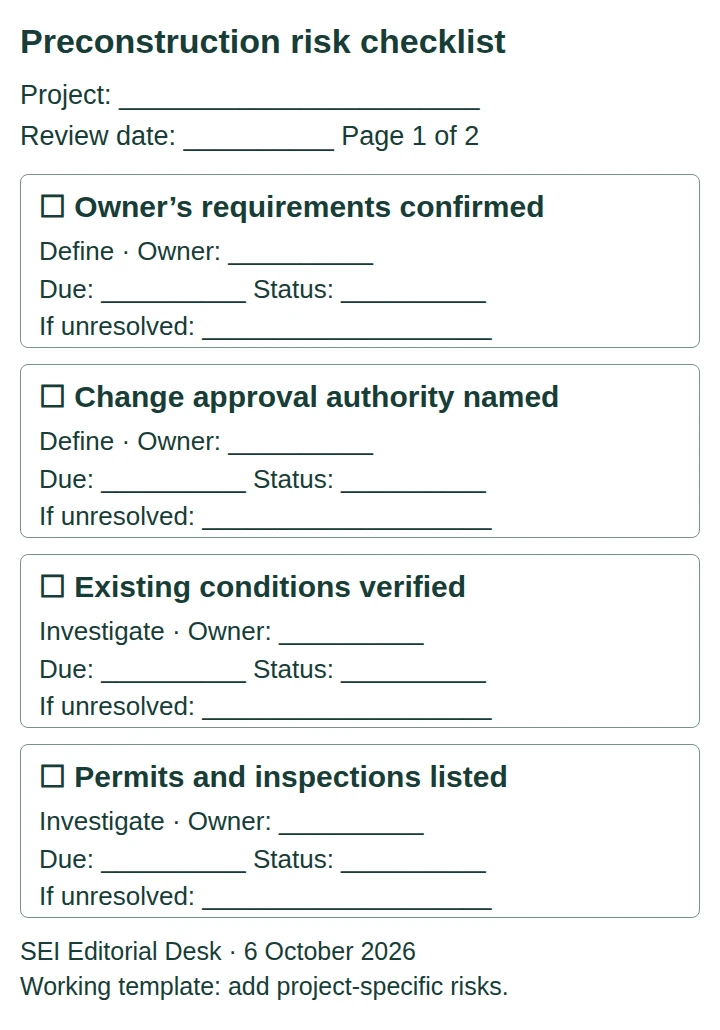
A Preconstruction Risk Checklist
A phased preconstruction checklist and planning framework for scope, approvals, existing conditions, procurement, schedule, and handover before work starts.
Read guide