
Stipulated Sum Contract: Cash Allowances, Alternates, and Contingency Accounting
Review stipulated sum allowances and contingency, accepted alternates, allowance reconciliation, and the questions to ask before approving a budget.

A stipulated sum contract uses a fixed price as its basis of payment.
An allowance is for a known item whose final cost has not yet been determined.
A contingency is a reserve for unexpected costs that may or may not occur.
Start your review by marking the allowance lines, the accepted alternates and the contingency provisions separately. Then follow the allowance adjustment through to the contract sum. Use this guide alongside our costs and planning collection.
What is a stipulated sum construction contract?
The price can be established in advance through bidding or negotiation.
AIA A101–2017 is an owner–contractor agreement for a stipulated sum, or fixed price.
It adopts A201–2017 general conditions by reference.
Use the AIA allowance rules below when reviewing that contract framework. For the wider choice of payment arrangements, see construction contract types.
Mark allowances and alternates before signing
Work through the agreement with the proposed contract-sum schedule beside it. Record the following entries in your agreement review:
-
Identify the alternates accepted by the owner and included in the contract sum.
-
List alternates eligible for later acceptance, including each price and its acceptance conditions.
-
Identify each allowance and state its amount within the contract sum.
-
Identify unit prices and any quantity limits on their application.
Ask the project team to mark each proposed alternate as accepted or available for later acceptance. Beside each allowance, record the item and amount. Keep those questions distinct from the reserve discussion.
What belongs inside the cash allowance?
Under the AIA general conditions, the contractor must include all allowances stated in the contract documents in the contract sum.
The following allowance cost rules apply unless the contract documents provide otherwise.
The allowance covers the contractor’s cost of materials and equipment delivered to the site, required taxes, and the deduction of applicable trade discounts.
Unloading, handling at the site, labor, installation, overhead, profit and other expenses contemplated for the stated allowance belong in the contract sum outside the allowance.
Ask for the proposed allowance scope beside the corresponding installation scope. Check the inclusion language before comparing the selection price with the allowance amount.


Check the project-specific allowance wording
The University of Southern California stipulated-sum contract includes applicable direct and indirect costs and contractor markup within the allowance.
Under that contract, the owner will not reimburse allowance overruns unless a change order approves them before the expenditure is committed.
For your review, highlight the allowance inclusion language and the approval requirement together. Ask for approval before committing to a selection that exceeds the allowance.
Reconcile the allowance through a change order
Under the default AIA allowance rules, costs above or below the allowance require a corresponding adjustment to the contract sum by change order.
The change-order amount reflects the difference between actual covered costs and the allowance, plus changes in the related contractor costs.
Use these fields in your reconciliation worksheet:
| Review field | Question to resolve |
|---|---|
| Original allowance | What amount and scope were included? |
| Actual covered cost | What is the delivered cost, including required taxes and applicable trade discounts? |
| Related contractor costs | What changed in unloading, handling, labor, installation, overhead, profit or other contemplated expenses? |
| Contract adjustment | What increase or credit is recorded in the change order? |
| Reserve authorization | Which negotiated contingency provision authorizes any proposed reserve use? |
Complete the allowance reconciliation before considering a proposed contingency draw. Ask for the allowance adjustment and the reserve authorization as distinct records.
Under the AIA general conditions, a change order is prepared by the architect and signed by the owner, contractor and architect.
It records any adjustment to the contract sum.
It also records any adjustment to contract time.

Keep contingency control separate
Contingency management depends on the contract type and the terms the parties negotiate.
The use of contingency for contractor needs varies with the delivery method.
There is no universal owner-contingency amount.
Ask for a written answer to each of these questions before approving the budget:
- Is the reserve an owner contingency or a contractor contingency?
- Where is it recorded in relation to the contract sum?
- What expenditure is eligible, and who may authorize it?
- How will an approved draw be documented?
- What happens to the unused balance?
An owner contingency allowance inside the contract
In the EJCDC construction-document commentary, an owner contingency allowance functions as a prefunded change-order account.
Additional work paid from that contingency allowance is typically priced through negotiation in the same manner as a change proposal.
Such contract-price contingency allowances typically permit invoicing the full work price, including contractor overhead and profit.
The contingency allowance can be part of a larger lump-sum payment item or a separate payment item.
For a proposed reserve draw, request the work description, agreed price and authorization. Then ask the team to identify the corresponding payment item.
Carry the adjustment into payment and closeout
For a stipulated-sum contract under the AIA general conditions, the contractor submits a schedule of values to the architect before the first payment application, allocating the entire contract sum among portions of the work.
Changes to that schedule must be submitted to the architect with supporting data as the architect requires.
The University of Southern California contract requires allowances, allowance disbursement authorizations and change orders to appear as separate schedule-of-values line items.
That contract also requires allowance expenditures to be separately itemized in each payment application and approved by the architect and owner.
At closeout, revisit the allowance reconciliation and the contingency disposition language as separate review items.
The EJCDC construction-document commentary provides for unused allowance funds to be credited to the owner by change order at contract closeout.
The University of Southern California contract permits a change order to credit unused allowances at substantial completion or another time designated by the owner.
Ask the project team: “Which lines in this stipulated sum are allowances, which are contingencies, and how will each be authorized and settled?” Keep the marked-up answer with the budget. Continue with the construction cost breakdown guide.
Sources
- AIA Contract Documents — Stipulated Sum Agreement Summary
- AIA Contract Documents — Stipulated Sum Agreement Instructions
- AIA Contract Documents — General Conditions of the Contract for Construction, preview
- AIA Contract Documents — Construction Allowances: What They Are and How AIA Defines Them
- American Institute of Architects — Managing the contingency allowance
- EJCDC / ASCE — Commentary on the Construction Documents
- University of Southern California — Stipulated Sum Contract
Related guides
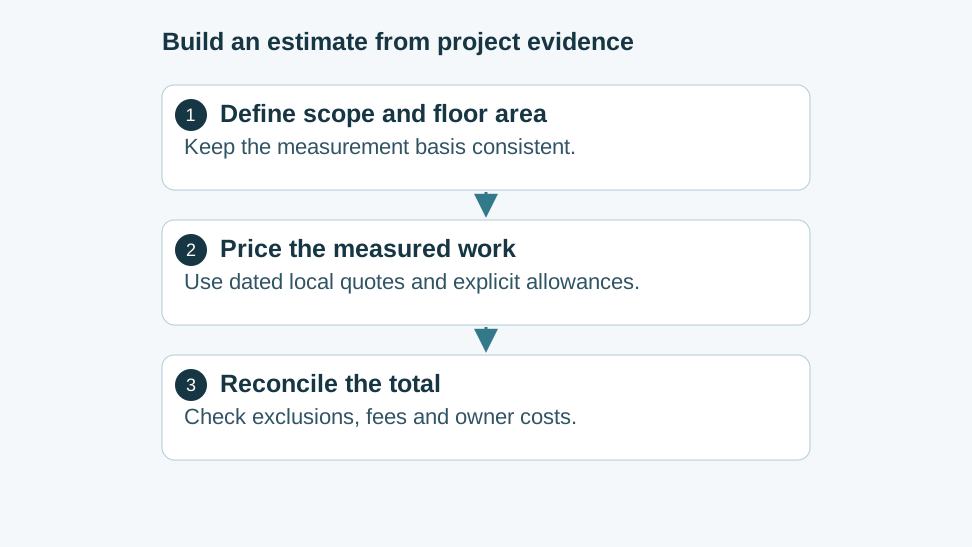
Residential Construction Cost per Square Foot: Local Inputs, Cost Drivers and Estimate Worksheet
Build a residential cost-per-square-foot estimate from dated local prices, measured quantities and explicit scope. Includes a copyable estimate worksheet.
Read guide
Construction Budget Guide: Class the Estimate First
A construction budget fails when a screening figure is treated as authorization. On a base of 100, the wider Class 5 ends are 50 and 200. The wider Class 3 ends are 80 and 130.
Read guide
Construction Cost Breakdown: Reading the NAHB Residential Survey
Read the NAHB 2024 survey by denominator: sales price versus construction cost, fees already inside site work, and a blank cell for the quote.
Read guide