
Preconstruction Manager: Role and Deliverables
The preconstruction manager's job is the running set of estimates, value-engineering records, and bid-package boundaries, not the meeting agenda.

A preconstruction manager’s file fails the next design phase when the only record is the meeting agenda. The missing value-engineering options and the unwritten package boundary cost a redesign and a scope gap at award.
SEI Design Build is an independent publication. It does not staff a preconstruction manager or solicit a bid. The deliverable list below is the University of Michigan Architecture, Engineering and Construction checklist dated August 2025. That sheet says it tracks submittals required by that owner’s construction-management agreement and general conditions. It also says the list does not alter the contract and is not inclusive. Use it as a worked public checklist, then match the names to the agreement on the project in front of you.
Scroll horizontally to see all columns.
| Deliverable on that checklist | When it is due in the list | Dominant failure mode | Prevention |
|---|---|---|---|
| Preliminary evaluation of the fixed limit of construction cost | Initial meeting, no later than 14 days after notice to proceed or execution | Treating the meeting notes as the cost model | Keep a numbered estimate that names the limit |
| SD, DD, and CD estimates, including 95% CD in CSI format, plus a CCCS breakdown by bid package | Each design phase | Copying the schematic total forward and calling it the CD estimate | Store three estimates, and keep 95% CD as its own line |
| Value engineering: costs and benefits of alternative solutions, systems, materials, or techniques | With the design-phase estimates | A cut that removes a requirement the owner still holds | Record the requirement that changed, not only the delta |
| Constructability review for each design phase | Each design phase | A review that redesigns the documents | The designer of record keeps the documents; the review records buildability |
| Construction bid package list, then a manual, release recommendation, and schedule | Before trade bidding | Packages that both claim, or both omit, the same work | Write a boundary for every pair that shares an edge |
| Award recommendation with bid tab and justification | After bids | Awarding on price while a boundary is still open | Hold the recommendation until the tab and the narrative name the gaps |
The preconstruction phase guide defines the phase. The pre-construction meeting guide is the agenda and the log. This page is the manager’s running file between those events.
The role is the file, not the job title
On the Michigan checklist, the construction manager owes the owner a sequence of submittals. The first cluster is an initial pre-construction meeting no later than 14 days after notice to proceed or execution of the agreement. That meeting’s listed outputs include an outline of goals, a preliminary evaluation of the fixed limit of construction cost against the program, a design-phase meeting schedule, a preliminary site logistics plan, and a preliminary project schedule.
Within 30 days of that first meeting, the same checklist asks for an administrative management plan. The named pieces include a quality control plan, a materials procurement and handling plan, a site logistics plan, a change and budget management plan, a schedule analysis of alternate phasing, a construction bid package list, a health and safety plan, trade-contractor prequalification criteria, and a project directory.
A person can hold the title and still miss the file. The test is whether each of those named items exists as a document with a date, not whether a meeting occurred. Construction manager at risk is one delivery route in which this file sits inside a services agreement before a construction price is committed. Other routes assign the same work to a cost consultant or to the design team. The agreement, not the title, assigns it.
Each design phase keeps its own estimate
The checklist’s design-phase block asks for SD, DD, and CD cost estimates. It splits the estimate lines into SD, DD, and 95% CD in CSI format, and into SD, DD, and CD in CCCS format broken down by bid package. It also asks for value engineering, stated as the costs and benefits of alternative solutions, systems, materials, or techniques, and for a constructability review at each design phase. A design-release phasing review is listed where the project uses phased release. A risk analysis is on the same block.
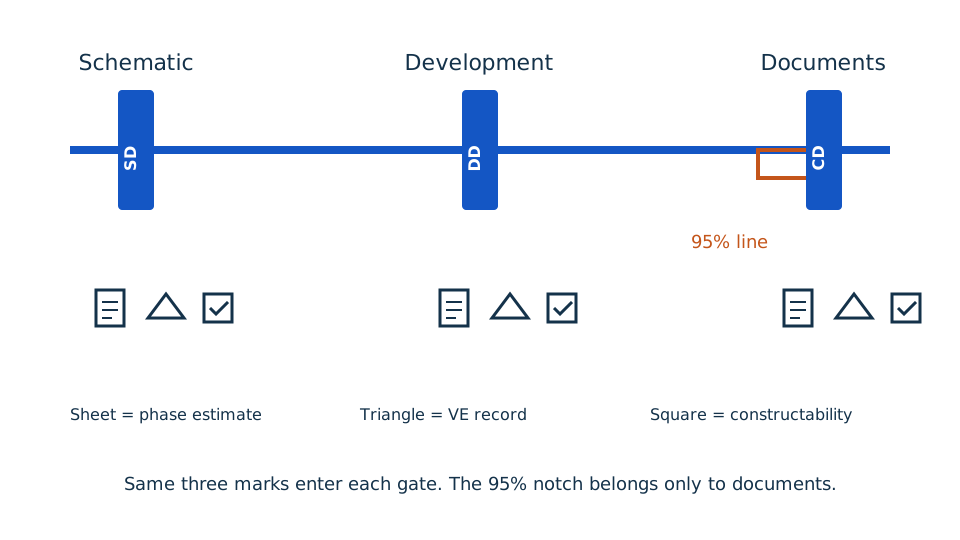
The gap against the owner’s limit is not the same number as the estimate’s accuracy class. Track the limit like this:
G = L − E
G is the gap, L is the fixed limit, and E is the current phase estimate, in the same units.
Worked example, labeled as arithmetic, not a bid. L = 92 and E = 100.
G = 92 − 100 = −8
The negative 8 is the amount the value-engineering record has to document as a scope or cost change, or the amount the limit has to move, before the next phase is released on the same scope. Closing it by silently dropping a requirement is the failure mode in the table. The class of E, and whether 8 units sits inside an accuracy band, is a different question. Read that on the construction budget guide, which keeps the process-industry class table in the edition it cites and says that table does not classify a commercial building estimate.
Rule of thumb: if the sheet in hand is still the screening class described in that budget guide, do not issue trade-package pricing as if the documents were a bid set. Keep the SD, DD, and 95% CD lines separate until the definition level changes.
Bid packages need a boundary count
The checklist moves from a construction bid package list into trade-contract steps: a bid list and a labor-availability review for each package, a high-risk operations review, a bid-release recommendation, a bid-package manual, a package schedule, and an award recommendation with a bid tab and a justification narrative. A GMP proposal, where the agreement uses one, is a further list: drawings and specifications including addenda, allowances, clarifications and assumptions, a construction cost statement, a schedule, and permit and test costs.
Two packages fail when they both include the same work or when neither does. Count the boundaries before the manual is called complete.
For packages that touch only in a release line:
B = n − 1
For packages that can share an edge with any other package:
P = n(n − 1) / 2
Worked example with n = 6.
B = 6 − 1 = 5
P = 6 × 5 / 2 = 15
Five is the right count only for a chain. Fifteen is the right count when any pair can omit the same scope. A room that two non-adjacent packages both pass through is a pair, even if the release order never puts those packages next to each other.
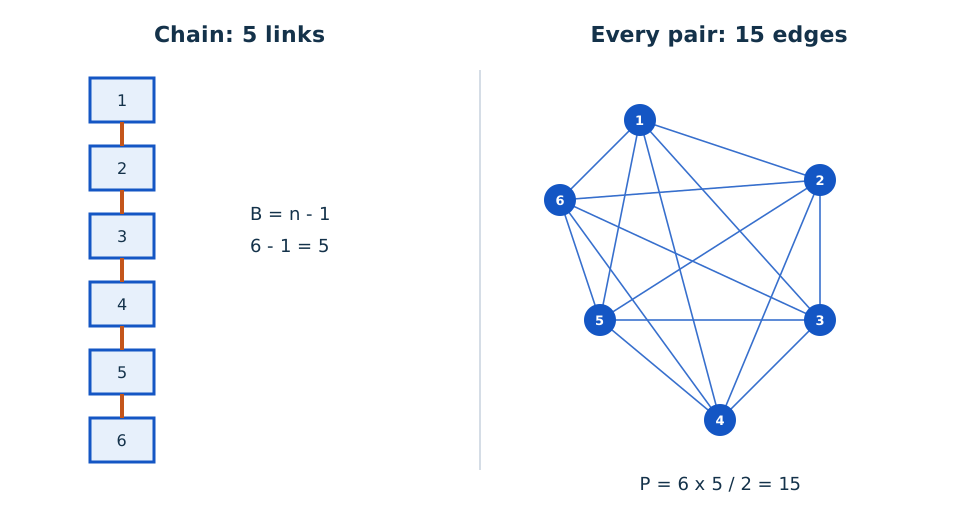
Rule of thumb: if the package count exceeds 4 and two packages can occupy the same space, use P = n(n − 1) / 2 before accepting a chain of n − 1 boundaries. At n = 6 that is 15 written boundaries, not 5.
What a thin file costs
The hidden account is a second pricing round and redesign time, not a fee quote.
An estimate copied from SD into the CD column makes the DD and 95% CD reviews look finished. The Michigan list keeps those as separate checkboxes because the fixed limit is re-tested as the documents change. Skipping a line does not save the estimator’s hours. It moves the surprise to bid day, when the tab no longer matches the limit and the award narrative has nothing to justify.
A chain count of 5 on a project that needed 15 boundaries leaves 10 edges unwritten. Each unwritten edge is a scope gap or a double-up at award. The checklist’s prevention is the bid-package manual and the award recommendation before the trade contract is copied. The preconstruction risk checklist is where those edges get an owner and a date. The project planning collection holds the phase guide and the meeting guide beside this file.
Method and sources
The named deliverables and the 14-day and 30-day marks are taken from the University of Michigan Architecture, Engineering and Construction document “Construction Manager Deliverables,” dated August 2025, saved from https://umaec.umich.edu/wp-content/uploads/2024/10/CM-Deliverables.pdf on 20 October 2026. The gap formula and the boundary counts are arithmetic on stated inputs. They are not prices, not a contingency percentage, and not that university’s project. Estimate class stays on the budget guide so this page does not mix editions. Photographs show a table and separated blank sheets. They are not a campus project and not a bid opening.
Related guides

Pre Construction Meeting: Agenda and Log
A pre construction meeting agenda and action log: topic, responsible person, record, deadline, and what is still open.
Read guide
What Is Preconstruction? Phase, Activities and Services
What the preconstruction phase covers, its activities and services, how design, estimates and procurement loop back, and who decides before work starts.
Read guide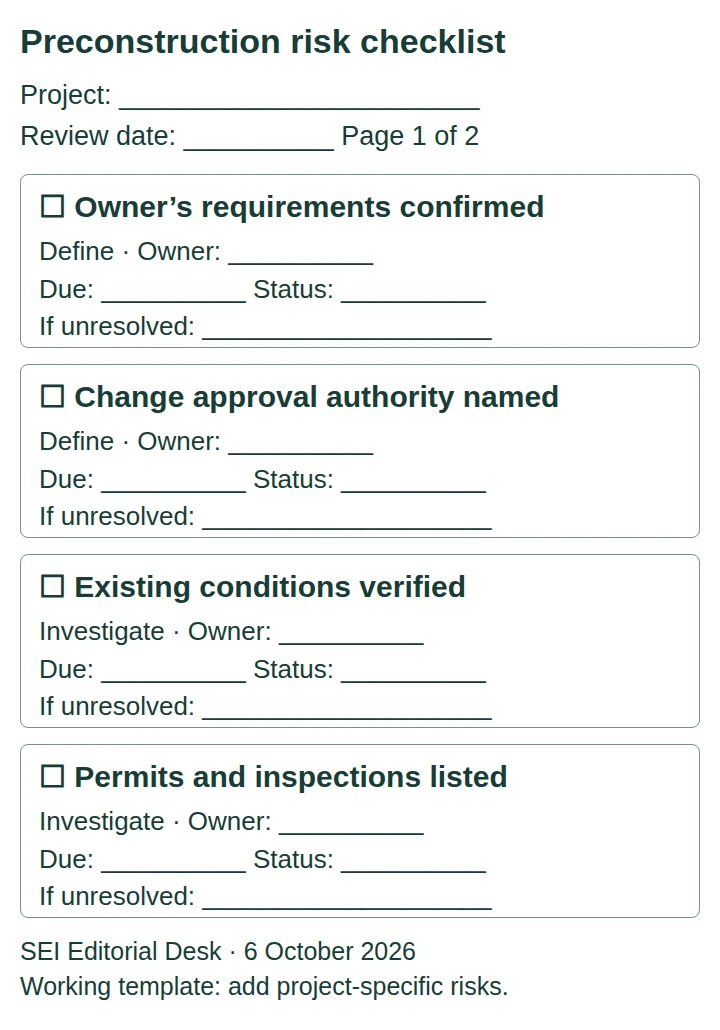
A Preconstruction Risk Checklist
A phased preconstruction checklist and planning framework for scope, approvals, existing conditions, procurement, schedule, and handover before work starts.
Read guide