
Construction Manager at Risk: CMAR, GMP and Alternatives
An unclear GMP can leave costly scope disputes. CMAR brings a builder into design while the owner keeps a separate design contract.
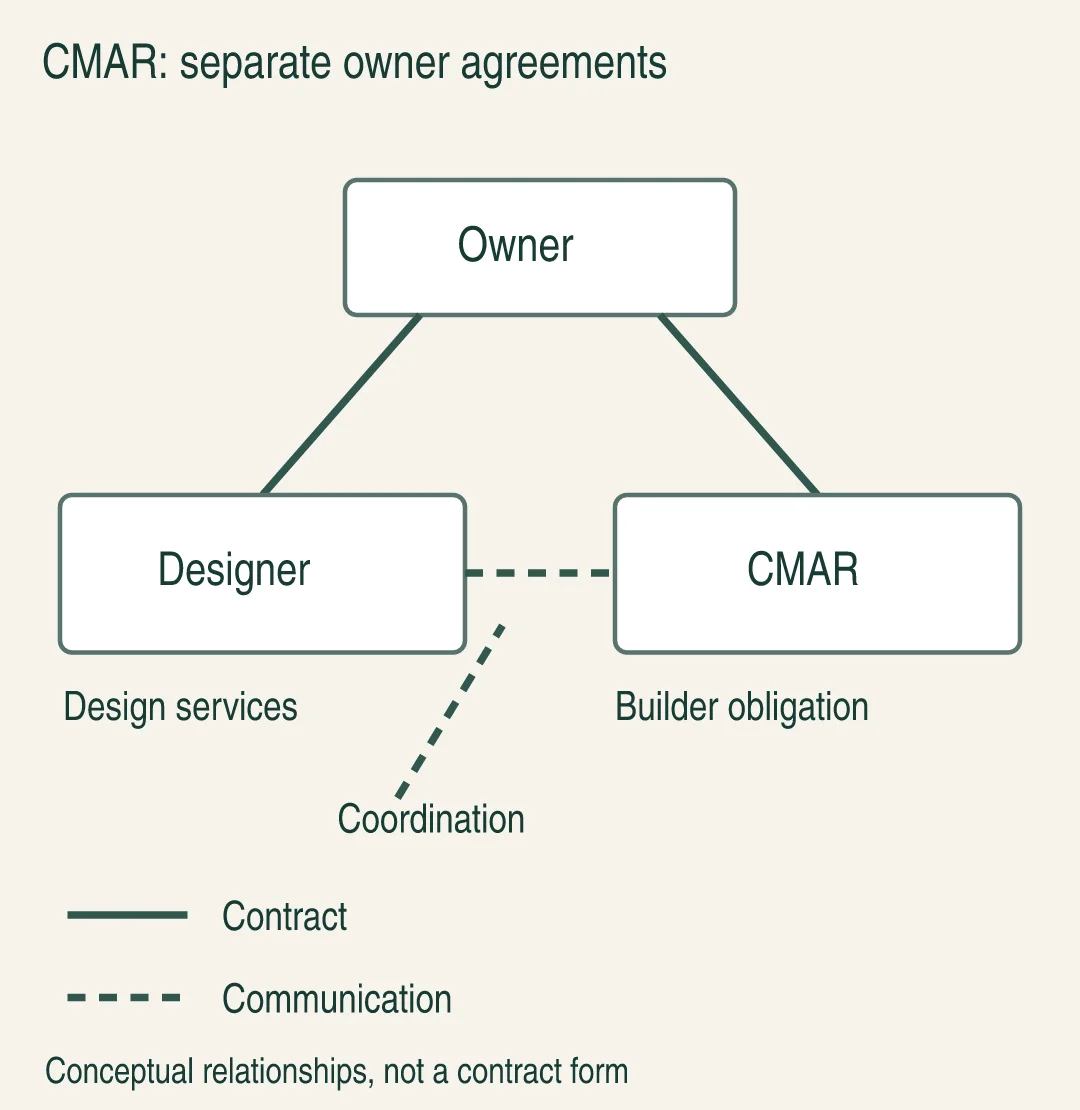
The diagram shows contractual relationships, not reporting authority for every project role. Solid lines indicate owner agreements; the dashed line indicates coordination.
Construction manager at risk, or CMAR, combines early construction advice with responsibility for carrying out the agreed construction work. The owner normally contracts separately with the designer and the CMAR. A guaranteed maximum price, or GMP, is common, but its scope, assumptions and adjustment rules matter as much as the amount. This guide explains that transition, compares delivery methods and gives owners a record to review before committing to construction. It belongs to our project delivery collection.
Quick comparison inputs
Decide which relationships and decisions the owner wants to retain before selecting a delivery label. The following inputs affect both the choice of method and the terms that make it workable. They are information to collect, not a scoring system that selects a method automatically.
Scroll horizontally to see all columns.
| Input or item | Typical value or source | Why it matters |
|---|---|---|
| Design responsibility | Proposed contract diagram | Distinguishes separate design from integrated design-build |
| Design maturity | Identified drawing and specification issue | Establishes the basis for pricing |
| Owner decisions | Decision register with dates | Shows what remains unresolved at commitment |
| Construction advice | Defined preconstruction services | Specifies what the early builder appointment actually buys |
| Pricing basis | GMP proposal, qualifications and exclusions | Defines the work covered by the price |
| Project constraints | Site, approvals, operations and procurement records | Identifies interfaces requiring coordination |
| Owner resources | Named decision-makers and advisors | Establishes capacity to review estimates and changes |
| Procurement authority | Applicable rules and contract advice | Determines whether the proposed method and selection process are available |
The preconstruction risk checklist provides a practical place to assign those inputs to people. Start with what is known and what needs investigation, then set dates for decisions.
Takeaway: Select the relationships and controls first; use the delivery name to describe them.
What makes CMAR different from an advisory construction manager?
The CMAR has a construction obligation as well as an early advisory role. An agency construction manager provides services in a defined relationship to the owner; the title alone does not make that advisor the builder. CMAA’s 2025 delivery-method guide distinguishes these roles explicitly.
AGC’s public definition describes CM at-risk with separate design and construction contracts and selection criteria extending beyond the lowest total construction cost. That is why a CMAR appointment should not be confused with hiring the lowest bidder after all design decisions have been completed. It also differs from design-build’s combined design and construction responsibility.
During preconstruction, the CMAR may contribute estimates, sequencing, constructability reviews and procurement information. Those services must be defined. “Involve the contractor early” is too vague if no one has agreed which estimates are due, what drawings they use or how recommendations will be resolved.
During construction, the CMAR performs the builder role under the construction agreement. The owner still needs a defined relationship with the designer. A coordination meeting between designer and CMAR does not silently replace those contracts.
Common mistake: Calling an owner’s advisor “at risk” without identifying a construction contract or responsibility for delivering the work.
Takeaway: Ask who holds the construction obligation, not just who chairs the meetings.
How does the CMAR process move into construction?
The early appointment and the construction commitment are different decisions. The team develops the design and construction plan, reconciles estimates, and establishes the scope for the construction agreement. The exact sequence follows the project contracts and procurement rules.
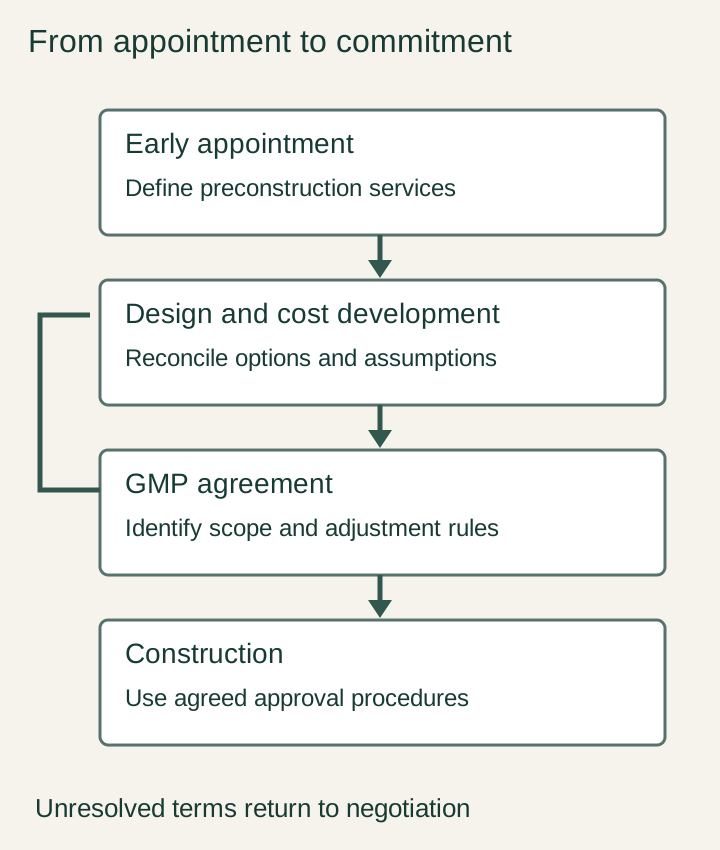
- Define the owner’s requirements. Record intended use, scope boundaries, funding constraints and required decisions. Identify the people who can approve changes.
- Appoint the design and construction participants. Establish the separate agreements, selection process and preconstruction deliverables. Confirm that the chosen route is authorized for the project.
- Develop design and cost information together. Compare options using the same assumptions. Record decisions about access, sequencing, long-lead items and unresolved site information.
- Reconcile the construction proposal. Check the design issue, inclusions, exclusions, allowances, contingency treatment, schedule and approval process. Resolve gaps between the estimate and the written scope.
- Authorize and manage construction. Use the agreed change and reporting procedures. Keep the decision record connected to the documents used in the field.
The owner’s early budget alignment process should continue throughout this sequence. An updated estimate is useful only when the team can explain which scope or assumptions changed since the previous one.
The process can support early coordination, but it does not create a schedule saving by itself. Permits, decisions and procurement still take time. An early package also needs a defined interface with later work; starting it does not settle unfinished design elsewhere.
Takeaway: Treat construction authorization as a documented commitment, not an automatic consequence of hiring the CMAR.
When is the GMP set, and what does it cover?
There is no universal design percentage at which every CMAR GMP becomes valid. CMAA’s public CMAR risk discussion describes agreement as design nears completion, sometimes before final design. Its broader delivery guide recognizes variations in CMAR agreements. The timing must match a sufficiently defined pricing basis and the parties’ accepted treatment of unresolved work.
A GMP is a contractual price limit for the defined work under the agreement’s terms. It is not automatically the owner’s entire project budget, and it does not mean that every later event leaves the payable amount unchanged. The documents must establish which changes can adjust the agreement and who bears each category of uncertainty.
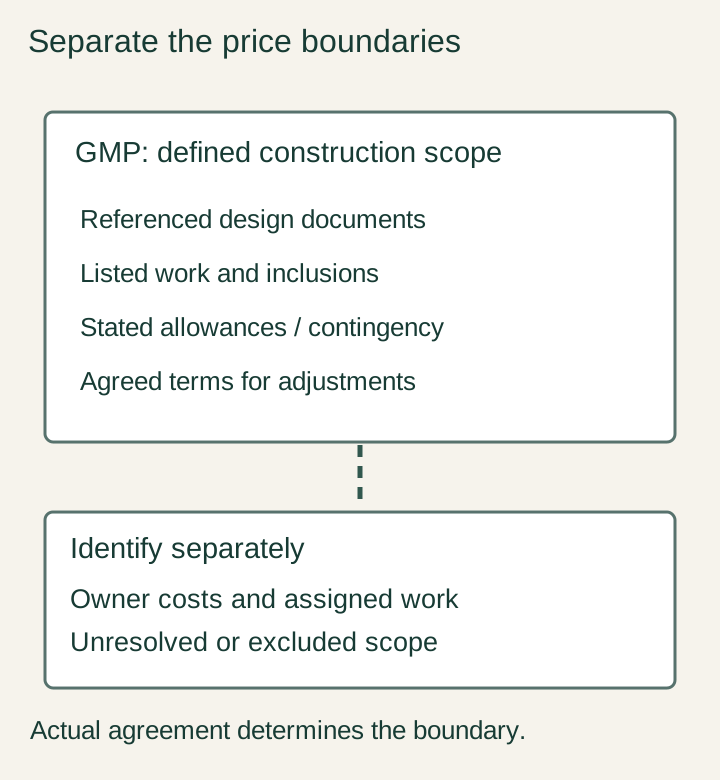
Use this editorial review record before accepting a proposal:
Scroll horizontally to see all columns.
| Record to reconcile | Question to resolve | Evidence to retain |
|---|---|---|
| Design basis | Which drawings and specifications were priced? | Dated issue list and referenced documents |
| Scope | What is included, excluded or assigned to others? | Scope narrative and responsibility matrix |
| Allowances | What selection or quantity remains provisional? | Description and adjustment procedure |
| Contingency | Who controls it and what may use it? | Contract provisions and reporting format |
| Schedule | What sequence and access assumptions support the price? | Accepted schedule basis |
| Changes | Who may authorize work and price adjustments? | Written approval procedure |
| Closeout | How will costs and any savings be reconciled? | Agreed accounting and closeout requirements |
Keep the contract price distinct from the wider construction budget. Owner-held costs should remain visible even when they are outside the CMAR’s construction agreement. Do not remove them from planning merely because a headline GMP has been accepted.
Common mistake: Treating a contractor allowance, contractor contingency and owner reserve as interchangeable money. Ask who controls each item and how a draw or change is documented.
Takeaway: Accept a price together with its scope and adjustment rules, rather than accepting the number alone.
CMAR, design-build and design-bid-build compared
The biggest distinction is who contracts for design and when construction expertise joins the process. CMAR retains a separate owner-designer relationship while bringing the builder into preconstruction. Design-build places design and construction with the design-builder. Design-bid-build usually develops the design before soliciting the construction price.
Scroll horizontally to see all columns.
| Method | Owner’s principal design/build relationships | Builder’s involvement | Pricing question to resolve |
|---|---|---|---|
| CMAR | Separate designer and CMAR agreements | During design/preconstruction | What scope supports the negotiated construction commitment? |
| Design-bid-build | Separate designer and contractor agreements | Generally after design for construction procurement | Do bidders price the same completed documents? |
| Best-value design-build | Design and construction with a design-builder | Integrated team through procurement and delivery | What design basis and price are committed at award? |
| Progressive design-build | Design and construction with a design-builder | Early team appointment, followed by design/price development | What is agreed before authorizing the next phase? |
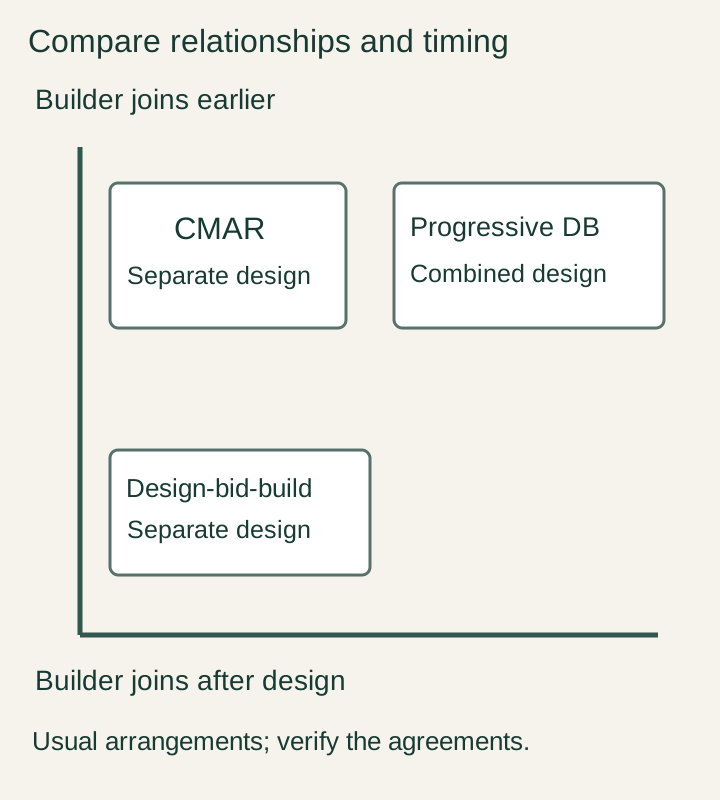
For a detailed comparison of the traditional sequence and integrated delivery, use design-build versus design-bid-build. CMAR is useful to investigate when the owner wants early construction input and intends to retain its own designer. That benefit comes with a continuing need to manage the interface between the two agreements.
Progressive design-build is not CMAR with a different name. Both may develop price through early collaboration, but the design responsibility is arranged differently. DBIA explains that progressive design-build retains the design-builder early and develops the design and contract price afterward. Our progressive design-build guide expands on that separate decision path.
No method in this table guarantees a lower total cost, better quality or fewer disputes for an individual project. Ask which arrangement fits the owner’s resources and the uncertainty the project actually has.
Takeaway: Similar early collaboration does not make separate-contract and design-build methods equivalent.
Is CM/GC the same as CMAR?
CM/GC, or construction manager/general contractor, is closely related terminology, particularly in transportation work. FHWA states that some state laws call its CM/GC method construction manager at-risk. The names alone do not establish identical procedures, pricing terms or procurement authority across agencies.
FHWA describes two phases: the contractor provides construction advice during design, then becomes the general contractor if the construction price is accepted. Its highway guidance discusses owner, designer and independent-estimator participation in evaluating that price. This is evidence of a documented agency process, not a requirement imposed here on every private building project.
When a solicitation uses CMGC, CM/GC, CMR or CMAR, ask for its definition and documents. Check the preconstruction scope, who holds the design contract, the construction-pricing procedure, and what happens if the parties do not agree. Those answers are more useful than deciding from the acronym.
Takeaway: Translate the local term into relationships, deliverables and decision rights before comparing it with another method.
What should an owner settle before selecting CMAR?
The owner needs capacity to participate in cost and scope decisions. Early advice has limited value if decisions remain unanswered or no one can reconcile the design, estimate and procurement plan. Use the questions below as an editorial planning checklist with the owner’s procurement and contract advisors.
- Who can approve scope, budget and schedule changes?
- Which preconstruction deliverables are required, and when?
- How will the owner assess cost information and unresolved assumptions?
- Who resolves an interface between designer and builder?
- What work can proceed before the overall construction commitment?
- What records and rights are needed if the next phase is not agreed?
Use the preconstruction meeting preparation section to assign owners and dates. Then compare that capacity with the controls to consider when choosing a delivery method.
Takeaway: Choose CMAR with a plan for the owner’s decisions, not just a plan for the contractor’s tasks.
When this comparison does not apply
This guide explains delivery concepts; it does not interpret a particular contract or establish a public body’s authority to use CMAR. Public procurement, funding conditions and local law can constrain selection, subcontracting and pricing. Obtain project-specific procurement and legal advice before issuing or accepting terms.
The comparison also does not transfer design liability, establish insurance coverage or determine entitlement to a change order. Those questions require the actual agreements and circumstances. It offers no contractor ranking, fee percentage or project-performance guarantee.
Takeaway: Use the comparison to frame the decision, then check the applicable documents and authority.
Frequently asked questions
These questions adapt the Water Collaborative Delivery Association’s published owner FAQ. Its water-sector context is retained as the source of the questions; answers below are general review prompts, not statutory rules for other sectors.
Can small firms participate in CMAR projects?
They may participate through project teams or trade packages. Check the actual solicitation and qualification requirements rather than assuming that CMAR excludes small firms.
When might the owner need an advisor?
Consider an advisor when internal procurement, technical or delivery experience is insufficient. Define the advisor’s scope and decisions clearly; appointing one does not remove the owner’s responsibilities.
Should the procurement documents disclose the project budget?
Discuss budget disclosure with the procurement team. Identify the budget’s date, scope and confidence so proposers can understand it; a disclosed budget is not a construction price commitment.
Can an owner request fees during CMAR selection?
The permitted process depends on applicable procurement rules. Where allowed, identify which early-service fees or later construction fee components are requested and how they will be evaluated.
Is a GMP the same as a lump sum?
No. Cost reporting and treatment of savings can differ. Read the agreement’s payment, audit, adjustment and closeout provisions before assuming how either pricing approach works.
Can collaborative delivery eliminate change orders?
No. It does not remove changing scope or unforeseen conditions. Agree on reporting and approval procedures before construction, and distinguish a requested change from an accepted price adjustment.
Takeaway: Verify the procurement and contract details behind each general answer.
Methods and sources
This article compiles public association and government guidance. The diagrams and review tables are original explanations, not contract forms or reports of projects managed by this publication.
- AGC, CM at-risk definition: separate design and construction contracts and selection characteristics.
- CMAA, Understanding Your Role by Project Delivery Method, 2025: CMAR and agency-CM distinctions, particularly printed page 3.
- CMAA, Construction Management at-Risk: Who Is Really at Risk?: GMP timing, assumptions and risk discussions. This is an authored industry article, not a universal contract rule.
- FHWA, CM/GC delivery and Construction Program Guide: agency process and the terminology used in some states.
- DBIA, Progressive and Best-Value Design-Build: the distinction between early team selection and price development.
- WCDA owner FAQ: original questions 12, 13, 17, 18, 19 and 21, adapted above without transferring water-project rules to every building project.
Editorial review: October 8, 2026. Sources were selected for the questions they address: AGC and CMAA for delivery roles, FHWA for its CM/GC agency process, DBIA for the design-build comparison, and WCDA for water-sector owner questions. Use each within its stated scope and check project-specific terms against the applicable agreements.
Takeaway: Check the source’s role and sector before applying its terminology to a project.
Related guides
EPC Contracts: EPCM and Design-Build
Confusing delivery with management can leave scope gaps. Compare EPC, EPCM and design-build by who signs, supplies, builds and accepts the work.
Read guide
Progressive Design-Build vs Traditional Design-Build
How progressive design-build works: two-phase contracting, open-book pricing, what the owner can do if the Phase 2 price is rejected, and who owns the design work product.
Read guide
Design-Build vs Design-Bid-Build
A practical comparison of contracts, pricing, programme, design control, risk, and published performance research for design-build and design-bid-build.
Read guide