
Value Engineering in Construction: Phases
Learn what value engineering in construction means, its 7-phase job plan, ASTM timing gates, worked value matrix, and how it beats late cost cuts.
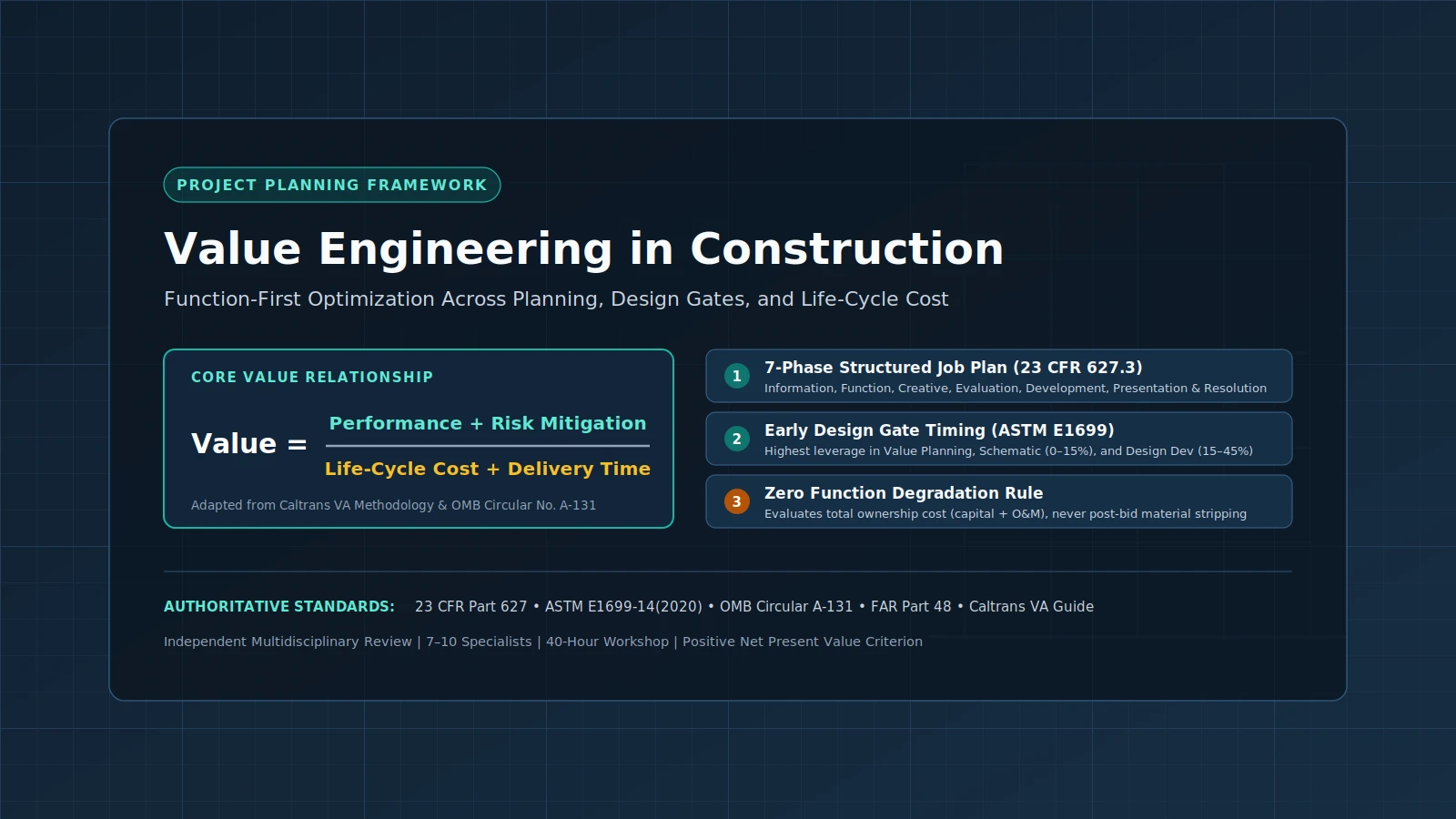
Value engineering in construction is an organized, multidisciplinary review that analyzes required project functions to achieve them at the lowest life-cycle cost consistent with required performance, reliability, quality, and safety. Unlike reactive late cost cutting after bids exceed budget, structured value engineering starts during predesign and early design before drawings lock in costly rework.
Explore this methodology alongside the project planning collection, review how early cost loops fit inside what preconstruction covers, and pair study milestones with why early budget alignment matters.
What does value engineering mean in construction?
In construction, value engineering means analyzing what every building system, material, or project element must functionally accomplish and finding design alternatives that deliver those essential functions at the lowest total ownership cost without degrading performance, reliability, quality, or safety. Under OMB Circular No. A-131, best value is achieved when an item or process consistently performs its required basic function at the lowest total cost.
Public construction standards reinforce that value is a ratio rather than a bare price reduction. Under 23 CFR 627.3(e), Value Engineering (VE) analysis is a systematic review conducted by a multidisciplinary team not directly involved in planning and developing the project, following the VE Job Plan to provide needed functions while considering community and environmental commitments, safety, reliability, efficiency, overall life-cycle cost (as defined in 23 U.S.C. 106(f)(2)), project quality, and delivery time. ASTM E1699 applies this same function-based practice to commercial and residential buildings and other engineered systems, converting stakeholder constraints, needs, and desires into function descriptions linked directly to project resources.
Caltrans summarizes this relationship in its Value Analysis guidance as Value equals Performance divided by Cost plus Delivery, and expands the numerator in its Value Analysis FAQs to Performance plus Risk divided by Cost plus Delivery. Crucially, Caltrans specifies that project costs encompass total cost of ownership—both original construction cost and subsequent operation and maintenance costs—and states that value analysis recommendations should not reduce cost at the expense of project functions.
Why structured value engineering differs from late cost cutting
Owners and project teams frequently mislabel emergency post-bid scope trimming as value engineering. When bids arrive over budget on completed construction documents, hasty substitutions strip finish durability, defer equipment reliability, and trigger redesign fees that undermine long-term performance. In Caltrans’s Idea Evaluation Rating Index (Table 2-1), a concept that reduces cost while creating an unacceptable degradation to performance is scored as Moderate Value Degradation (rating 2), and an alternative that is not technically feasible or fails project need and purpose is scored as Major Value Degradation (rating 1).
Scroll horizontally to see all columns.
| Comparison dimension | Structured value engineering | Reactive late cost cutting |
|---|---|---|
| Analytical anchor | Converts stakeholder needs into required functions and tests alternative ways to deliver them (ASTM E1699; 23 CFR 627.3(e)) | Deletes line items or downgrades specified materials solely to reduce initial bid price |
| Cost boundary evaluated | Total life-cycle cost over a designated study period, including design, construction, operation, maintenance, repair, replacement, and disposal (ASTM E1699 Section 1.3) | First-cost construction total only, overlooking higher future energy, maintenance, and replacement outlays |
| Timing in delivery | Conducted early in predesign, schematic design, and design development before extensive redesign accumulates (ASTM E1699 Section 5.2; OMB Circular No. A-131) | Triggered after final drawings go to bid and pricing exceeds the available capital budget |
| Performance safeguard | Must maintain required performance, reliability, quality, and safety; concepts causing unacceptable performance loss rate 2 (Moderate Value Degradation) on Caltrans Table 2-1 | Accepts degraded reliability, shorter service life, or reduced functional capacity to close a funding gap |
| Economic decision test | Requires positive net present value discounted under OMB Circular No. A-94 section 8.c and distinguishes immediate cost savings from future cost avoidance | Measures short-term bid reduction without discounting redesign rework, schedule delay, or ownership penalties |
OMB Circular No. A-131 also draws a practical distinction that late cost cutting misses: immediate cost savings (reducing actual expenditures below projected levels) versus cost avoidance (taking an immediate engineering action that decreases future expenditures, such as improving component reliability to increase mean time between failures and lower operation and maintenance costs). In facilities construction, OMB Circular No. A-131 notes that incorporating environmentally-sound and energy-efficient practices and materials can yield better overall value over the building’s useful life.
What are the phases of a value engineering job plan?
A standard value engineering job plan follows seven structured phases codified in 23 CFR 627.3(f)—Information, Function Analysis, Creative, Evaluation, Development, Presentation, and Resolution—that move an independent team from understanding baseline project constraints to formally implementing approved design improvements. While every VE study must address all seven phases, federal rules allow teams to scale the depth of effort to each project’s complexity.
Caltrans operationalizes this sequence across 15 activities grouped into three stages: Pre-Study Preparation (8 hours), the multidisciplinary Study Workshop (40 hours, spanning six working days across two to three weeks), and Post-Study Activities (8 hours). In Caltrans terminology, the Creative Phase is called the Speculation Phase and the Resolution Phase is called the Implementation Phase, but the analytical discipline across all seven phases matches federal 23 CFR 627.3(f) requirements.
Scroll horizontally to see all columns.
| Job plan phase | 23 CFR 627.3(f) & Caltrans focus | Primary workshop outputs |
|---|---|---|
| 1. Information Phase | Gather project baseline data, commitments, constraints, performance requirements, and baseline performance evaluation | Shared understanding of project scope, cost model, and baseline performance scores |
| 2. Function Analysis Phase | Analyze project elements in terms of required functions and relate functions to cost, performance, time, and risk | Function inventory identifying high-cost or low-value elements relative to project need and purpose |
| 3. Creative (Speculation) Phase | Brainstorm as many alternative ways as possible to accomplish required functions while improving performance, enhancing quality, and lowering costs; judgment of ideas is not permitted | Unfiltered master idea list preserved for team screening and later design review |
| 4. Evaluation Phase | Rate each idea on Caltrans Table 2-1 (scale 1 to 7) for impacts on performance, cost, time, and risk; advance ratings 4 to 7 and document rationale for unadvanced high-rated ideas | Shortlisted feasible concepts separated from value-degrading cuts (ratings 1 to 3) |
| 5. Development Phase | Expand top-rated ideas into fully supported VA Alternatives with baseline descriptions, proposed changes, technical discussion, sketches, calculations, initial and life-cycle cost comparisons, schedule analysis, and risk review | Documented, technically defensible VE recommendations ready for stakeholder preview |
| 6. Presentation Phase | Conclude the workshop by briefing the owner, design team, and stakeholders on rationale and trade-offs; designed as a preview rather than a decision-making meeting | Preliminary VA Study Report and stakeholder review forms |
| 7. Resolution (Implementation) Phase | Conduct a formal decision-making meeting to mark each alternative Accepted or Rejected, issue a signed Implementation Plan Authorization, and incorporate approved changes into plans | Final VA Study Report archived for at least 3 years after project completion (23 CFR 627.9(e)(3)(vii)) |
Evaluation scoring and workshop duration guardrails
Two governance rules keep the Job Plan from collapsing into an informal cost-cutting huddle. First, separating the Presentation Phase from the Resolution Phase gives project stakeholders time to verify engineering assumptions before signing off. Under Caltrans procedures, once management signs an Implementation Plan Authorization, changing an Accepted alternative to Rejected later requires a signed amended authorization preserved for federal audit.
Second, compressing the workshop schedule destroys the function-analysis and development steps. Caltrans specifies a standard six-day (40-hour) workshop and requires a formal Modified Job Plan justification even for simpler projects requesting a shortened workshop, with an absolute minimum workshop length of 24 hours (3 days). One-day studies do not satisfy FHWA requirements, and Caltrans explicitly warns that being late in the design phase is not a justifiable reason to shorten a VE study.
How does value engineering apply during architectural design and preconstruction?
Value engineering delivers its highest return during predesign, schematic design (up to 15% design completion), and design development (up to 45% design completion), when architectural layouts, structural systems, and building services can still be redirected without extensive redrawing or schedule disruption. As design approaches 90 to 100% construction documents, the focus shifts away from fundamental layout changes toward construction methods, phasing, procurement, and claims prevention.
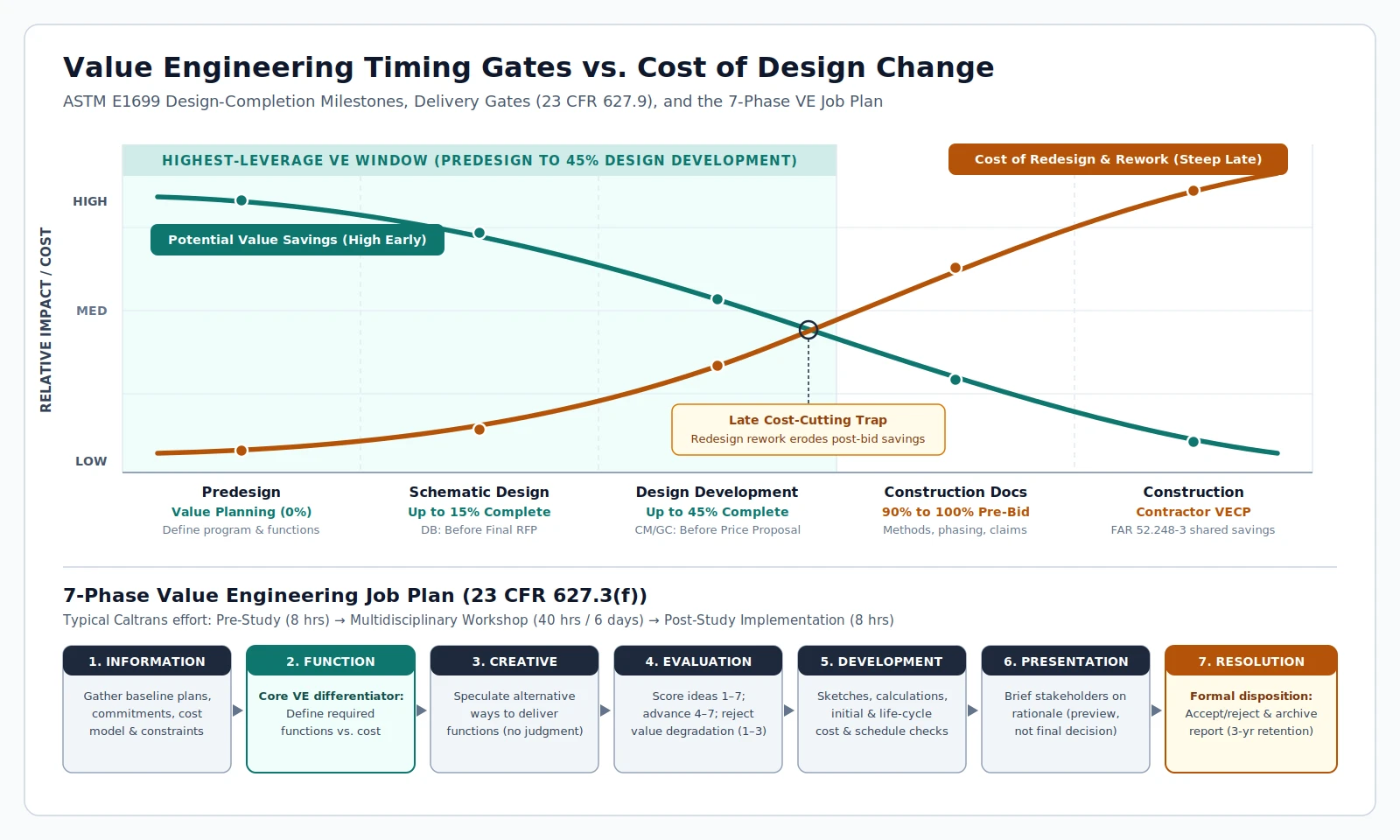
OMB Circular No. A-131 directs agencies to structure their VE guidelines around the reality that potential savings are greatest during planning, design, and other early project phases. Similarly, 23 CFR 627.9(a) states that a VE analysis should be conducted as early as practicable—preferably before completing preliminary design—and at a minimum prior to completing final design so approved recommendations enter plans, specifications, and estimates before construction authorization. Before scheduling a study, owners can pair conceptual cost screening from our ROM estimate guide with the stage-by-stage ASTM E1699 gates below.
Scroll horizontally to see all columns.
| Project phase (ASTM E1699) | Design completion | VE label & primary focus | Delivery & contract alignment |
|---|---|---|---|
| Predesign | Program & space planning | Value planning: define project functions and build consensus among owner, designer, user, and construction manager before miscommunication causes redesign | Ideal baseline gate before schematic drawings commit building geometry |
| Schematic design | Up to 15% complete | Confirm core functions, test major architectural and engineering systems, and review drawings and specifications across technical disciplines | Under 23 CFR 627.9(c), design-build VE should finish prior to releasing the final Request for Proposals |
| Design development | Up to 45% complete | Verify technical and management approaches, evaluate equipment and material selections, and verify life-cycle economics concurrently with owner design reviews | Under 23 CFR 627.9(d), CM/GC VE must be completed and incorporated into plans before requesting a construction price proposal |
| Construction documents | 90% to 100% pre-bid | Concentrate on economics, technical feasibility, construction methods, phasing, procurement, management, and minimizing claims | Last window before bid solicitation; major layout changes now trigger heavy redesign rework |
| Construction | Post-award execution | Review contractor Value Engineering Change Proposals (VECPs / VACPs) that lower cost or duration or propose alternative methods without reducing performance or acceptance | Governed by contract clauses such as FAR 52.248-3 with structured savings sharing and 45-day review turnaround |
For complex, expensive, or repeatable building designs, ASTM E1699 Section 5.6 recommends conducting a minimum of two VE/VA studies: one before the design is developed and a second during design development. Notice also how delivery method dictates the exact contractual cutoff: for projects using construction manager at risk (CM/GC), 23 CFR 627.9(d) allows releasing the CM/GC RFP first but requires completing the VE analysis and incorporating approved recommendations into plans before requesting the construction price proposal.
Post-award contractor VECPs under FAR Part 48
Once construction begins, formal value engineering continues through Value Engineering Change Proposals (VECPs)—also referred to in ASTM E1699 Section 5.3.4 as Value Analysis Change Proposals (VACPs). Under Federal Acquisition Regulation (FAR) Part 48 (48.101(b)), federal contracts use either a voluntary incentive approach (where the contractor invests its own resources and receives allowable development costs plus a savings share only if accepted) or a mandatory separately priced VE program requirement.
For construction contracts governed by FAR 48.104-2(b) and clause 52.248-3, sharing applies only to net instant contract savings and collateral savings, and does not apply to incentive construction contracts. On accepted construction VECPs, the Government’s share of net instant savings (after subtracting Government costs) is 45 percent on fixed-price construction contracts and 75 percent on cost-reimbursement contracts. For measurable collateral savings—agency reductions in operation, maintenance, and logistic support costs—FAR 48.104-3 allows a contractor share ranging from 20 to 100 percent of estimated savings in a typical year of use, provided the contracting officer verifies there is no degradation of performance, service life, or capability.
Contracting officers are responsible for accepting or rejecting a submitted VECP within 45 days of receipt under FAR 48.103(b), and the contractor must continue performing under the existing contract until a formal modification takes effect. Importantly, 23 CFR 627.9(i) specifies that post-award proposals solely to accelerate construction do not qualify as VECPs on Federal-aid highway projects; acceleration belongs in bid-stage incentive or disincentive clauses so all bidders price the schedule on equal terms.
What is an example of value engineering in construction?
A concrete example of value engineering in construction is the worked Value Matrix published in Caltrans’s Value Analysis Team Leader Guide (Figures A1-8 through A1-10), which compares a 65-month Baseline Concept against three alternative track-height strategies using equal 50% weighting for normalized cost and schedule. The matrix demonstrates why lowest initial cost does not automatically equal highest value: VA Strategy 2 (Full Raising of Track Height) achieved a 94% Value Index gain despite carrying a slightly higher normalized cost score than VA Strategy 3 (Partial Raising of Track Height).
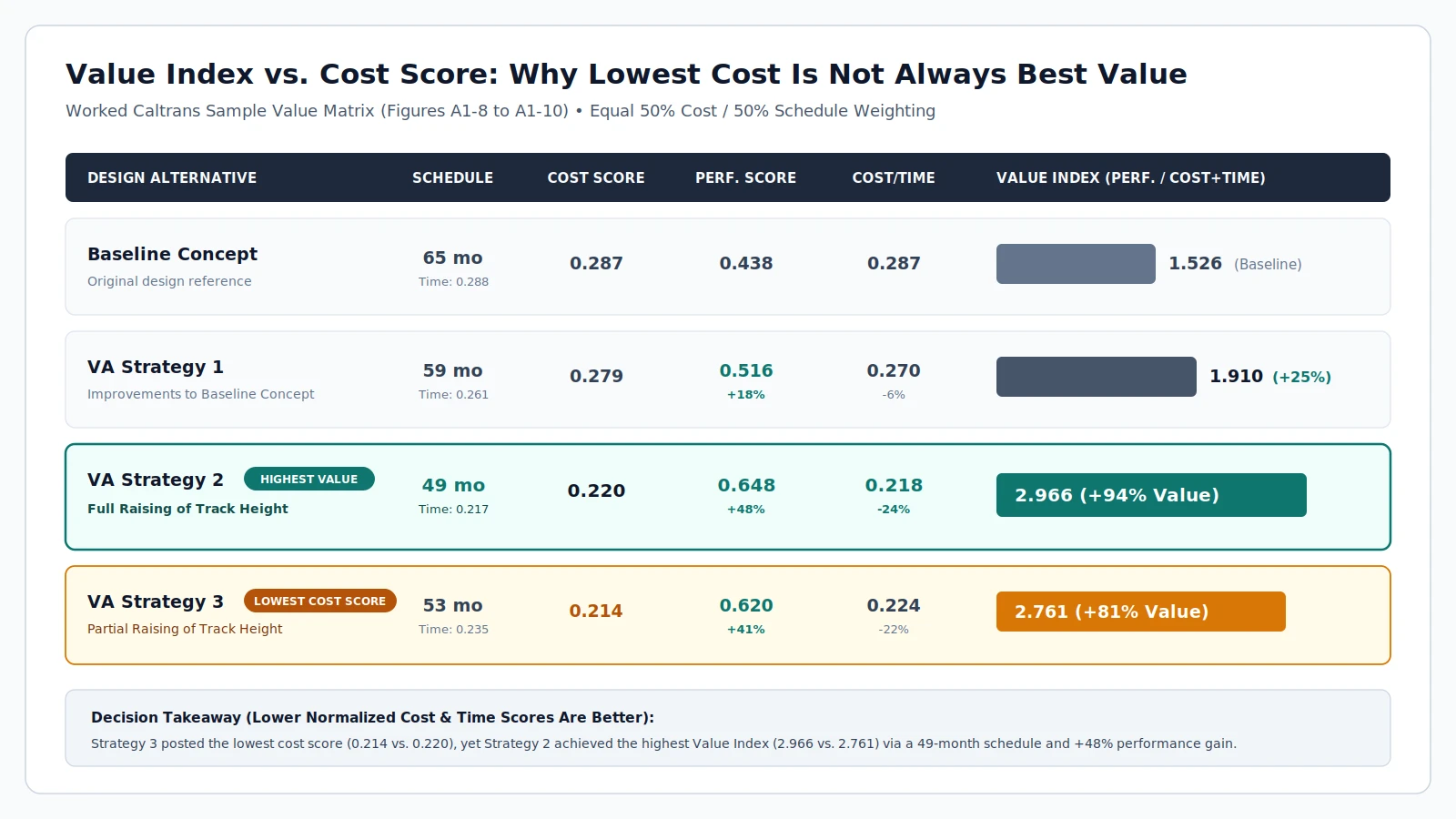
In the Caltrans Value Metrics method, lower normalized cost and schedule scores are better because each option’s cost or duration is divided by the sum of all compared options (with the four schedule durations summing to 226 months). With equal 50% weights on cost and time, VA Strategy 1’s combined cost/time score is computed as (0.279 × 0.5) + (0.261 × 0.5) = 0.270. Dividing each strategy’s performance score by its combined cost/time score yields the Value Index below.
Scroll horizontally to see all columns.
| Alternative (Caltrans Figures A1-8 to A1-10) | Schedule (time score) | Normalized cost score | Combined cost/time score (change) | Performance score (change) | Value Index (change) |
|---|---|---|---|---|---|
| Baseline Concept | 65 months (0.288) | 0.287 | 0.287 (baseline) | 0.438 (baseline) | 1.526 (baseline) |
| VA Strategy 1: Improvements to Baseline Concept | 59 months (0.261) | 0.279 | 0.270 (-6%) | 0.516 (+18%) | 1.910 (+25%) |
| VA Strategy 2: Full Raising of Track Height | 49 months (0.217) | 0.220 | 0.218 (-24%) | 0.648 (+48%) | 2.966 (+94%) |
| VA Strategy 3: Partial Raising of Track Height | 53 months (0.235) | 0.214 | 0.224 (-22%) | 0.620 (+41%) | 2.761 (+81%) |
Notice the decision lesson inside those numbers. A conventional cost-cutting review looking solely at normalized cost score would pick VA Strategy 3 (0.214 versus 0.220). By quantifying performance and delivery time alongside cost, the Value Matrix reveals that VA Strategy 2 delivers a 49-month schedule (four months faster than Strategy 3) and a +48% performance gain (0.648 versus 0.620), producing the highest overall Value Index (2.966, or +94% above baseline).
Additional documented construction VE applications and program benchmarks
Beyond geometric staging alternatives like the Caltrans matrix, federal regulations and guidance document two further everyday categories of construction value engineering:
- Bridge structural system and material analysis: Under 23 CFR 627.9(f), bridge VE studies must explicitly evaluate both substructure and superstructure requirements while testing alternative construction materials, acceptable bridge designs, overall life-cycle costs, and construction duration.
- Equipment reliability and O&M cost avoidance: OMB Circular No. A-131 cites an engineering improvement that increases mean time between failures—reducing future operation and maintenance costs—as a classic cost-avoidance VE action that lowers total ownership cost even when immediate first cost does not fall.
- Program-level return benchmarks: Across its stewardship agreement with FHWA, Caltrans’s Value Analysis program tracks four institutional performance goals: 5% project savings, a 100:1 return on investment (ROI), a 50% alternative implementation rate, and 100% compliance on mandated projects at Ready-to-List (RTL).
What is the role of a value engineer and an independent VE team?
A value engineer—such as a nationally recognized Certified Value Specialist (CVS) serving as VE Team Leader—facilitates an independent multidisciplinary team of roughly 7 to 10 specialists who were not directly involved in planning or designing the project, guiding them through Pre-Study cost modeling, the seven-phase Job Plan workshop, and formal Implementation Meeting disposition. Independence is structural: 23 CFR 627.9(e) and (g) require a team separate from the project’s planners and designers and bar consultants with any conflict of interest under 23 CFR 1.33.
Why do public agencies require an outside team rather than letting the original design team audit itself? Caltrans documents ten detrimental design influences that routinely creep into complex projects: lack of information, time pressures, wrong beliefs, negative attitudes, habitual thinking, rapidly changing technology, risk of personal loss, strict adherence to requirements, reluctance to ask for advice, and poor human relations. Convening an objective, multidisciplinary team in a controlled workshop environment breaks habitual assumptions without turning the review into an adversarial critique.
Under Caltrans’s Project Manager Quick Reference Guide, a standard study commits 7 to 10 multidisciplinary experts across six working days over a two-to-three-week window—resourced at approximately 500 team-member hours across Pre-Study, the 40-hour workshop, and Post-Study disposition. During Pre-Study, the Team Leader meets with stakeholders, structures technical specialists, reviews project data, and prepares a cost model before the workshop opens. Caltrans highlights three stages as critical to realizing actual savings: forming the right team, formally approving alternatives, and implementing approved changes into design documents. On private and public projects alike, tracking VE logs alongside milestone estimates and bid packages often interfaces with the preconstruction manager role.
Notice an important contractual boundary for design professionals under federal procurement: FAR 48.102(h) requires architect-engineer service contracts to include a mandatory value engineering program under FAR 48.101(b)(2) aimed at reducing total ownership cost, while explicitly prohibiting any sharing of value engineering savings with the architect-engineer firm. That separation keeps the designer of record’s fee independent of cost-reduction incentives while still embedding life-cycle review into design delivery.
Proposal screening checklist for function and life-cycle maintenance
Before accepting any VE recommendation or contractor VECP into project drawings, owners and project managers can screen each proposal against the six criteria drawn from ASTM E1699, Caltrans Table 2-1, OMB Circular No. A-131, and 23 CFR 627.9(e):
Scroll horizontally to see all columns.
| Evaluation criterion | Verification question before approval | Governing standard basis |
|---|---|---|
| Essential function integrity | Does the alternative preserve every required basic function, safety standard, code commitment, and performance attribute without rating 1 to 3 (value degradation)? | OMB Circular No. A-131; Caltrans Table 2-1; 23 CFR 627.3(e) |
| Full life-cycle cost scope | Does the cost comparison include design, installation, energy, operation, maintenance, repair, replacement, and disposal over the study period? | ASTM E1699 Section 1.3; OMB Circular No. A-131 |
| Positive net present value | Does the investment yield a positive net present value after subtracting study, redesign, and implementation costs? | OMB Circular No. A-131 Sections 8 & 11 (OMB Circular No. A-94 section 8.c) |
| Schedule & rework impact | Have redrawing effort, permitting delays, and construction duration changes been quantified alongside capital cost? | ASTM E1699 Section 5.2; Caltrans Value Matrix |
| Service life & maintainability | Does the proposal maintain or improve mean time between failures and avoid collateral degradation of service life or capability? | OMB Circular No. A-131 (cost avoidance); FAR 48.104-3(d) |
| Audit & disposition record | Are acceptance or rejection rationale, responsible implementation owner, and signed authorization archived for at least 3 years post-completion? | 23 CFR 627.9(e)(3)(vii); Caltrans Implementation Plan Authorization |
What is another name for value engineering?
Value analysis (VA), value management (VM), and value control are the primary official synonyms for value engineering, explicitly recognized as interchangeable in OMB Circular No. A-131, while ASTM E1699 uses value planning for predesign studies and Value Engineering Change Proposal (VECP) or Value Analysis Change Proposal (VACP) for contractor-initiated proposals during construction.
Although agencies and contracts often swap these labels, checking which term appears in a project’s solicitation or manual clarifies both timing and contractual authority:
Scroll horizontally to see all columns.
| Term | Where it is used | Practical distinction |
|---|---|---|
| Value Engineering (VE) | 23 CFR Part 627; FAR Part 48; OMB Circular No. A-131; ASTM E1699 | Standard U.S. federal construction and infrastructure term covering design-phase studies and post-award contract clauses |
| Value Analysis (VA) | Caltrans VA Program; ASTM E1699; OMB Circular No. A-131 | Function-oriented synonym used interchangeably with VE across transportation agencies and standards |
| Value Management (VM) / Value Control | OMB Circular No. A-131 Section 4 | Official federal synonyms emphasizing ongoing program governance and total-ownership optimization |
| Value Planning | ASTM E1699 Section 5.3.1 | Stage-specific label for VE/VA applied during predesign to program and space-planning documents |
| Value Engineering Proposal (VEP) | OMB Circular No. A-131; FAR Part 48 | Design-phase proposal developed by in-house agency personnel or a contracted VE study team |
| Value Engineering Change Proposal (VECP / VACP) | 23 CFR 627.3(g); FAR Part 48; ASTM E1699 Section 5.3.4 | Post-award construction contract change proposal submitted by the construction contractor, eligible for shared savings when permitted by contract |
Frequently Asked Questions
What are the seven phases of a value engineering job plan?
Under 23 CFR 627.3(f), the Value Engineering Job Plan includes seven documented phases: Information, Function Analysis, Creative, Evaluation, Development, Presentation, and Resolution. Caltrans applies the same seven-phase structure—naming phase three Speculation and phase seven Implementation—inside a 40-hour multidisciplinary workshop flanked by 8 hours of Pre-Study preparation and 8 hours of Post-Study disposition.
When is the best time to conduct value engineering on a building project?
According to ASTM E1699 Sections 5.2 and 5.3 and OMB Circular No. A-131, the most effective window is predesign (value planning), schematic design (up to 15% completion), and design development (up to 45% completion), when design redirection avoids extensive redrawing. Complex, expensive, or repeatable designs warrant at least two studies—one before design develops and one during design development.
Can a project team shorten a value engineering workshop to one day if drawings are already late?
No under federal highway rules. Caltrans states that one-day studies do not satisfy FHWA requirements, sets a minimum shortened workshop duration of 24 hours (3 days) only through an approved Modified Job Plan for simpler scopes, and explicitly notes that being late in the design phase is not a justifiable reason to shorten a VE study.
How does savings sharing work on a construction Value Engineering Change Proposal (VECP)?
Under FAR 48.104-2(b) and clause 52.248-3, construction VECP sharing applies to net instant contract savings and collateral operation-and-maintenance savings, with the Government retaining 45 percent of net instant savings on fixed-price construction contracts and 75 percent on cost-reimbursement contracts. Sharing does not apply to incentive construction contracts or architect-engineer service contracts (FAR 48.102(h)), and contracting officers have 45 days to accept or reject a submitted VECP.
Does value engineering always pick the lowest-cost construction alternative?
No. Value engineering optimizes the ratio of performance and risk reduction to total life-cycle cost and delivery time. In the worked Caltrans Sample Value Matrix (Figures A1-8 through A1-10), VA Strategy 3 posted the lowest normalized cost score (0.214 versus 0.220), yet VA Strategy 2 achieved the highest Value Index (2.966 versus 2.761) because it shortened construction to 49 months and raised project performance by +48%.
Sources
- Electronic Code of Federal Regulations (eCFR) — 23 CFR Part 627: Value Engineering
- ASTM International — ASTM E1699 Standard Practice for Performing Value Engineering (VE)/Value Analysis (VA) of Projects, Products and Processes
- Office of Management and Budget — OMB Circular No. A-131: Value Engineering
- Acquisition.gov — Federal Acquisition Regulation (FAR) Part 48: Value Engineering
- California Department of Transportation (Caltrans) — Value Analysis Team Leader Guide (April 2013)
- California Department of Transportation (Caltrans) — Value Analysis Frequently Asked Questions (February 2019)
- California Department of Transportation (Caltrans) — Value Analysis Quick Reference Guide for Project Managers (July 2016)
- California Department of Transportation (Caltrans) — Why Use Value Analysis?
Related guides

Preconstruction Manager: Role and Deliverables
The preconstruction manager's job is the running set of estimates, value-engineering records, and bid-package boundaries, not the meeting agenda.
Read guide
What Is Preconstruction? Phase, Activities and Services
What the preconstruction phase covers, its activities and services, how design, estimates and procurement loop back, and who decides before work starts.
Read guide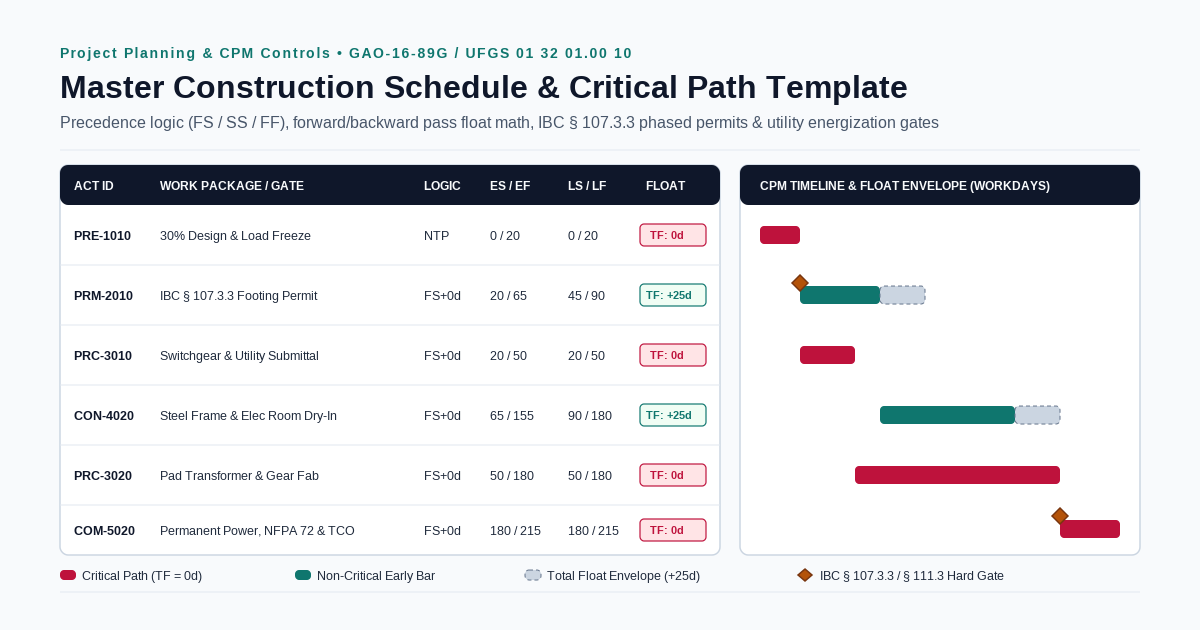
Construction Schedule Excel Template: Master Schedule, CPM Logic and Fast-Track Bottlenecks
Build a master construction schedule in Excel that tracks CPM logic, total float, IBC 107.3.3 phased permits, utility transformer lead times, and TCO gates.
Read guide