
AIA Contract Document Families Versus Project Delivery Methods
Match AIA contract documents to conventional delivery, CMc, CMa and design-build. Compare A201, A133 and A141, architect agreements and pricing choices.
AIA contract document families follow the project’s design and construction relationships; pricing then helps select the agreement within that family. A201 is general conditions, A133 is an owner–construction manager as constructor agreement, and A141 is an owner–design-builder agreement. Use the map below to match the owner, architect and construction roles before comparing document numbers.
Match the family to the project relationships
Start with who contracts for design and who commits to construction. An AIA document family is a coordinated set of agreements and related documents for a project type or delivery method. For the four structures below, the architect’s client and the construction manager’s role distinguish the sets. A guaranteed maximum price (GMP) is a pricing feature that appears in more than one family.
Scroll horizontally to see all columns.
| Delivery structure | Principal owner-side agreement(s) | Architect’s client and agreement | Conditions or coordinated set |
|---|---|---|---|
| Conventional, including design-bid-build | A101–2017, A102–2017 or A103–2017, selected by payment basis | Owner; B101–2017 is a representative companion | A201–2017 general conditions |
| Construction manager as constructor (CMc) | A133–2019 with GMP, or A134–2019 without GMP | Owner; B133–2019 | A201–2017 general conditions |
| Construction manager as adviser (CMa) | C132–2019 for the adviser, plus A132–2019 for the construction contractor(s) | Owner; B132–2019 | A232–2019, the CMa general conditions |
| Traditional design-build | A141–2024 for the design-builder | Design-builder; B141–2024 | Coordinated design-build family, including A441–2024 for subcontracting |
Source: AIA Contract Documents, List: Document Synopses by Family; Construction Manager as Constructor Family FAQ; and Design-Build Guide (2025), pages 2–3 and 16.
Read across a row as a set. The owner retains the project architect separately in the conventional, CMc and CMa arrangements shown here. In the traditional design-build arrangement, the design-builder engages the architect through B141. An owner may also retain a separate consultant.
If you are still choosing the delivery structure, compare design-build and design-bid-build. The project delivery collection provides the wider context for organizing design, procurement and construction.
Conventional delivery: choose the agreement by payment basis
The conventional A201 family supports separate owner contracts for design and construction. Within that structure, A101, A102 and A103 distinguish how the contractor is paid.
Scroll horizontally to see all columns.
| Owner–contractor agreement | Payment basis | Coordinated conditions |
|---|---|---|
| A101–2017 | Stipulated sum, or fixed price | A201–2017 |
| A102–2017 | Cost of the work plus a fee, with a GMP | A201–2017 |
| A103–2017 | Cost of the work plus a fee, without a GMP | A201–2017 |
AIA’s family synopses identify these pairings and describe B101–2017 as an owner–architect agreement in the conventional family. Review the design agreement alongside the construction documents so the architect’s construction-phase duties are coordinated.
The family name also needs care when discussing procurement. AIA places these forms in its conventional/design-bid-build family, but expressly says A103–2017 is not intended for competitive bidding. Check the proposed selection process as well as the payment clause; the family label alone does not settle both.
CMc: A133 or A134 works with A201
A construction manager as constructor contributes during preconstruction and also provides construction. AIA’s CMc FAQ pairs A133–2019 or A134–2019 with B133–2019 and A201–2017. The architect remains under a separate agreement with the owner.
The payment distinction is straightforward: A133 uses cost of the work plus a fee with a GMP; A134 uses cost plus a fee without a GMP. Both belong to the CMc family. A133’s construction commitment and GMP documentation need to be read with its phase provisions and amendment.
Finding A201 in a proposed package does not identify the delivery method. Both the conventional agreements above and the CMc agreements use it. Read the owner agreement and the construction manager’s promised services to distinguish the arrangement.
CMa: the adviser has a different document set
A construction manager as adviser coordinates and advises while the owner contracts separately for construction. AIA identifies a coordinated CMa set: C132–2019 for the owner and adviser, A132–2019 for the owner and contractor, B132–2019 for the owner and architect, and A232–2019 for general conditions.
Multiple prime contractors are typical in this arrangement, although AIA’s CMc FAQ notes that a CMa project can have one construction contractor. The decisive question is whether the construction manager undertakes construction or provides advisory services.
A132 allows stipulated sum or cost plus a fee, with or without a GMP. That is another reason to identify the delivery structure before using pricing to select a form.
Keep the adviser and constructor sets separate. AIA’s family synopses expressly say that A232–2019 should not be used with A133–2019 or A134–2019. They also say C132 is not coordinated with documents in which the construction manager acts as constructor. If a proposed package mixes those forms, resolve the role and coordination issue before signing.
Traditional design-build: use the A141 family
A141–2024 connects the owner to the entity providing design and construction. The coordinated architect relationship is design-builder to architect under B141–2024; A441–2024 addresses the design-builder’s subcontractor relationship. C141–2024 is available for a separate owner–consultant agreement where that role is needed.
AIA’s A141–2024 summary and Design-Build Guide (2025) identify these relationships. The guide also identifies B141–2024 as the replacement for B143–2014. Keep the edition beside each form number when comparing an older reference with a proposed package.
The A141–2024 Design-Build Amendment records the agreed contract sum and the information supporting it. Pricing remains a separate review step within the design-build structure. For the amendment and other package details, use the design-build contract forms and review checklist.
Progressive design-build has distinct forms: A141PDB–2024 and B141PDB–2024. Confirm which approach the proposed package names before matching its companion documents.
AIA A201 vs A133 vs A141: what is the actual difference?
The comparison is between document functions. A201 supplies general conditions; A133 and A141 establish different owner-side agreements. A133 and A201 work together in the publisher’s coordinated CMc set.
Scroll horizontally to see all columns.
| Document | Function | What to check beside it |
|---|---|---|
| A201–2017 | General conditions describing rights, responsibilities and relationships in construction | The agreement incorporating it and the coordinated architect agreement |
| A133–2019 | Owner–CMc agreement using cost plus a fee with a GMP | A201–2017, B133–2019, applicable exhibits and GMP documentation |
| A141–2024 | Owner–design-builder agreement for traditional design-build | B141–2024, applicable downstream agreements and the Design-Build Amendment |
For example, if a proposed A133 package includes A201 and leaves the architect under B133 with the owner, those relationships match AIA’s CMc set. If the proposal instead puts both design and construction under the owner’s design-builder agreement, compare it with the A141 family. A GMP heading by itself cannot answer that relationship question.
Check the proposed set before signing
Assemble the agreements and their referenced documents into one review package. Check these items together so a correct form number does not conceal a mismatch elsewhere:
- Parties and roles. Record who signs for design, construction and any advisory services. Match the signature blocks to the intended delivery structure.
- Identifiers and editions. Keep the full number and year for each agreement and conditions document. Trace any references to older forms through the proposed set.
- Payment basis. Identify stipulated sum or cost plus a fee, whether a GMP applies, and any amendment needed to establish the agreed amount.
- Coordination. Compare the referenced conditions, architect agreement and downstream contracts. Resolve adviser/constructor mismatches and inconsistent role descriptions.
- Attachments and changes. Gather the listed exhibits, requirements, drawings, schedules and modifications. Include the documents that establish what the parties are agreeing to deliver.
Have construction counsel assess the coordinated set, proposed changes and requirements in the project’s jurisdiction before signature. The signed documents and applicable law determine the parties’ obligations.
Finish with a short self-check: Which delivery method are you using, and is the owner preparing a design-build agreement, a conventional design-bid-build agreement, or a construction-management arrangement? Write that answer beside the proposed owner agreement, then use the family map to check the remaining relationships.
Source documents
- AIA Contract Documents, List: Document Synopses by Family. Conventional, CMc and CMa entries for the 2017 and 2019 forms identified above.
- AIA Contract Documents, FAQs: Construction Manager as Constructor Family (CMc). Constructor/adviser roles, A133/A134 payment choices and A201 coordination.
- AIA Contract Documents, Summary: A141–2024, Agreement Between Owner and Design-Builder for a Traditional Design-Build Project. Owner/design-builder relationship, amendment and companion forms.
- AIA Contract Documents, Design-Build Guide (2025), pages 2–3 and 16–17. Revised traditional and progressive design-build families.
Related guides
Lump Sum Construction Contracts: Types, Risk and Documents
Compare lump sum, cost-plus, GMP, unit-price and time-and-materials contracts by cost risk, and identify the documents included in a construction contract.
Read guide
EPC Contractor: Match the Test to the Plant
An EPC contractor selection fails when a 300 MW test is copied onto the wrong plant, or left blank. The 2017 Rupsha invitation prints 325 million USD and two 300 MW contracts.
Read guide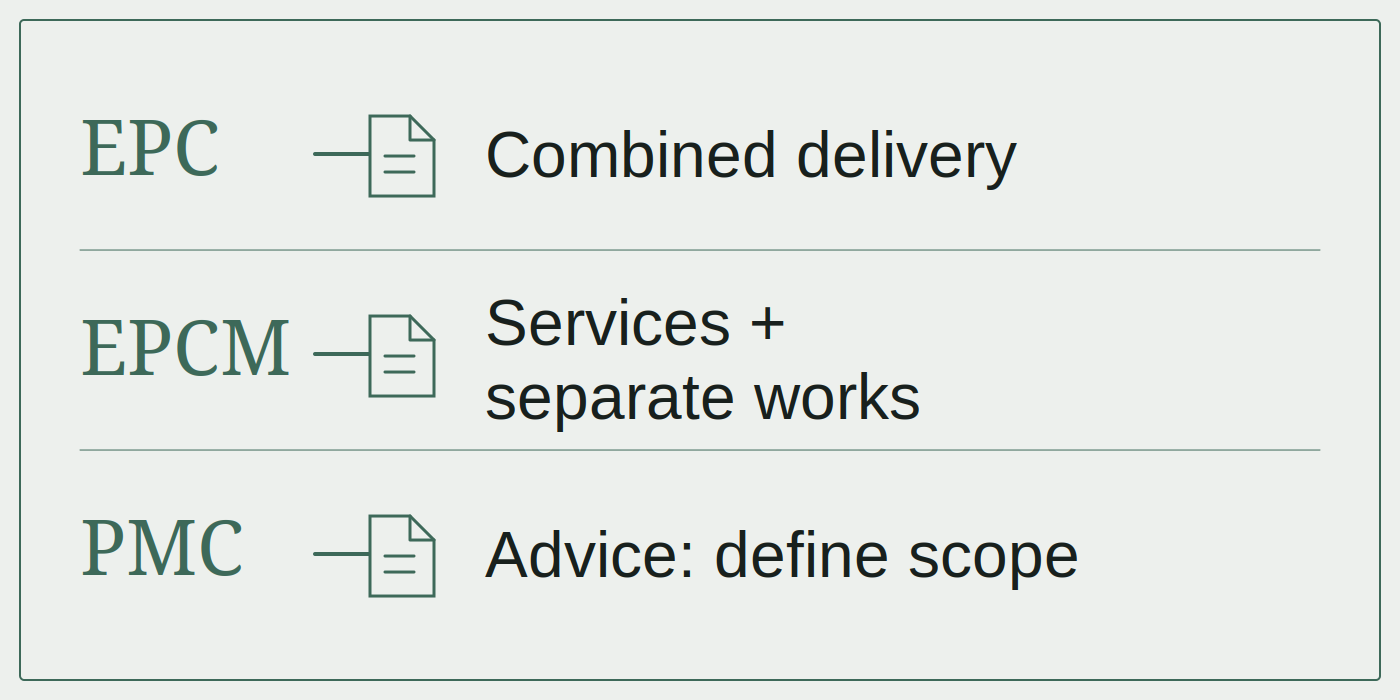
EPC Contracts: EPCM and Design-Build
Confusing delivery with management can leave scope gaps. Compare EPC, EPCM and design-build by who signs, supplies, builds and accepts the work.
Read guide