
Design-Build Contracts: Forms and Checklist
Match AIA, DBIA and ConsensusDocs design-build forms to the right parties, check older document numbers, and prepare a contract review record before signing.
Using the wrong contract form can leave design duties, payment assumptions and exit arrangements unclear. A design-build contract places the owner’s design and construction delivery under one agreement with a design-builder; choose the document package by its parties, delivery approach, pricing basis and edition.
For a US owner preparing to review a design-build agreement, start with a map of who signs each contract and the documents that define the work. AIA, DBIA and ConsensusDocs publish different families of forms, and a familiar number does not identify every agreement you need. Older AIA references such as A142–2014 and B143–2014 also need an edition check against the revised family. This guide gives you a form crosswalk and a record of questions to take to project counsel. It explains public publisher descriptions; the proposed agreement, its changes and applicable law determine your project’s obligations.
Quick Specs: inputs for choosing the contract package
Scroll horizontally to see all columns.
| Input or item | Typical value or source | Why it matters |
|---|---|---|
| Signing parties | Legal names and signature blocks in the proposed agreements | Separates the owner agreement from downstream design and construction agreements |
| Form and edition | Publisher identifier, year and list of modifications | Identifies the actual document family being proposed |
| Owner’s requirements | Project brief, criteria and referenced drawings | Defines what the design-builder is being asked to deliver |
| Delivery approach | Procurement plan and proposed service phases | Distinguishes traditional from progressive arrangements |
| Pricing basis | Compensation provisions and proposed price amendment | Shows what is priced now and what remains to be agreed |
| Approval and exit arrangements | Decision schedule, termination terms and design-use provisions | Identifies decisions and permissions needing review before commitment |
The design-build topic collection provides the wider context. Use the table above to assemble the actual files for this narrower contract review.
Who contracts with whom?
The owner normally signs the main design-build agreement with the entity responsible for the combined delivery. That entity may engage an architect, design consultants and construction trades under separate downstream agreements. An owner may also retain an advisor directly. These are different relationships, even when everyone attends the same design meeting.
For the basic distinction, read what design-build means for an owner.
Scroll horizontally to see all columns.
| Relationship | What the agreement addresses | Owner’s review question |
|---|---|---|
| Owner → design-builder | Combined design and construction delivery within the agreed scope | Is the named entity responsible for both parts of the work being purchased? |
| Design-builder → architect or design professional | Design services and the designer’s responsibilities | Who provides each design service, and where are its boundaries recorded? |
| Design-builder → construction participant | Construction or trade work; some packages also include design | Which interfaces remain with the design-builder, and which packages include delegated design? |
| Owner → retained advisor or consultant | The owner’s separate advisory or criteria-development services | Is this advisor acting for the owner rather than as the design-builder’s project architect? |
The arrows describe contracting relationships, not reporting lines or a promise that every project uses an identical team. A design-builder with in-house capabilities may organize services differently.

The CMAR guide compares a construction commitment alongside a separate project design agreement.
Takeaway: Identify each signing relationship before comparing document numbers or commercial terms.
Which AIA forms belong together?
A141 is the owner/design-builder agreement, not the architect’s downstream agreement. The edition matters: AIA’s 2025 guide to its revised family identifies A141–2024 for traditional design-build and A141PDB–2024 for progressive design-build. It also explains changes to the older A142 and B143 relationships. Keep the year beside each identifier during review.
The following is a crosswalk from AIA’s official Design-Build Guide, pages 2–3 and 16–17, checked October 9, 2026. It helps identify documents; it does not authorize replacing a signed agreement with another form.
Scroll horizontally to see all columns.
| Number a reader may encounter | Relationship or purpose | Edition check for the revised family |
|---|---|---|
| A141–2014 | Owner and design-builder | AIA identifies A141–2024 as its replacement for traditional design-build |
| A141PDB–2024 | Owner and design-builder on a progressive project | A separate progressive variant; pair it with the appropriate downstream documents |
| A142–2014 | Design-builder and construction contractor in the older structure | AIA’s revised family eliminates this separate general-contractor agreement; A441–2024 addresses design-builder/subcontractor contracting |
| B143–2014 | Design-builder and architect | B141–2024 replaces it for traditional design-build; B141PDB–2024 is the progressive counterpart |
| C141–2024 | Owner and retained consultant | Defines the owner’s selected advisory services, rather than the design-builder’s architect services |
The A142 change is a change in the family structure. Treating A441 as a simple renumbering of the same agreement would miss the different contracting relationship. AIA’s guide describes the revised design-builder engaging necessary subcontractors directly, rather than using the previous separate general-contractor layer.
Check the amendment and insurance exhibit by name
Under A141–2024, Exhibit A is Insurance and Bonds, Exhibit B is the Design-Build Amendment, and Exhibit C is the Sustainable Projects Exhibit where applicable. The guide explains that the insurance exhibit was previously Exhibit B and that the revised Design-Build Amendment is Exhibit B. See pages 26–27 of the official guide.
This matters when someone says, “The price will be agreed in Exhibit A.” Ask them to identify the edition and the attachment’s full name. In the revised package, the Design-Build Amendment records commitments such as price and time, together with the information on which those commitments rest. A blank or missing attachment is therefore a review issue, not a formatting detail.
Common mistake: Combining an older agreement number, newer exhibit labels and a downstream form from another family without checking their compatibility.
The design-build versus design-bid-build comparison explains the structure in which the owner holds separate main agreements for project design and construction. An owner-retained architect providing advisory or bridging services can still participate in design-build, as AIA describes under C141–2024. A direct owner/architect agreement alone does not identify the delivery method: check the services it covers. Likewise, a conventional owner/contractor form’s title does not establish a combined design scope.
Takeaway: Compare identifiers, years, attachment names and contracting parties together; do not substitute forms by number alone.
How do DBIA and ConsensusDocs compare?
DBIA and ConsensusDocs also distinguish preliminary services, the main owner agreement and downstream professional services. Their identifiers describe different choices within their own families. Compare those functions on the same basis as AIA, then have counsel check the complete proposed package. A catalog description is useful for selection, but does not show every negotiated term.
DBIA: preliminary, price-specific and progressive forms
DBIA’s official complete-set catalog lists the following roles. The descriptions below summarize that catalog, checked October 9, 2026.
Scroll horizontally to see all columns.
| DBIA document | Catalog role | What to confirm in the proposed package |
|---|---|---|
| 520 | Preliminary owner/design-builder agreement | Authorized preliminary services and the next commitment point |
| 525 | Owner/design-builder agreement, lump sum | Scope and assumptions supporting the stated sum |
| 530 | Owner/design-builder agreement, cost plus fee with an option for a GMP | Whether the GMP option is selected and how the price basis is recorded |
| 535 | General conditions between owner and design-builder | Which conditions accompany the agreement and what has been changed |
| 540 | Design-builder/design-consultant agreement | Downstream design responsibilities and services |
| 544 | Progressive design-build agreement | Service phases, price development and the decision to proceed |
DBIA 535 supplies general conditions; 540 covers the design-consultant relationship. They are not interchangeable.
DBIA’s 544 product description describes selecting the team and then progressing toward a design and construction price. The progressive design-build guide develops that timing and owner-decision context without treating it as a universal price formula.
ConsensusDocs: preliminary work and the main agreement
The ConsensusDocs 400 catalog entry describes preliminary owner/design-builder services. The official descriptions of 410 and 415 specify 400 for developing the owner’s program and some schematic design documents. This is a pairing described by the publisher, not a rule that every design-build project must use these forms.
Scroll horizontally to see all columns.
| ConsensusDocs document | Catalog role | What to confirm in the proposed package |
|---|---|---|
| 400 | Owner/design-builder preliminary agreement | Preliminary responsibilities, compensation and document-use arrangements |
| 410 | Owner/design-builder agreement, cost of work plus fee with GMP | Preliminary development under 400; GMP and completion dates established through 410.1 |
| 410.1 | GMP and completion-dates document referenced in the 410 description | The agreed price and dates at the relevant development point |
| 415 | Owner/design-builder lump-sum agreement | Preliminary development under 400; 420 for the downstream design-professional appointment described in the catalog |
| 420 | Design-builder/design-professional agreement | Design services, professional responsibilities and interfaces |
The 415 description assumes the design-builder will engage a design professional and identifies 420 for that relationship. Confirm that this assumption matches the proposed team.
These descriptions do not make 410 equivalent to DBIA 530 in every respect: one catalog describes a GMP agreement, while the other specifies an option for a GMP. Record that difference before reviewing commercial terms. Likewise, 420 is downstream of the design-builder rather than a replacement for the owner’s main agreement.
Takeaway: Compare the relationship and pricing function of each form, then review the complete family and its modifications.
Which contract types change the document choice?
When selecting a design-build form, separate the payment basis from the delivery process. Lump sum and cost plus describe compensation arrangements; a GMP adds an agreed price boundary whose operation depends on the contract. Progressive design-build describes how the team and price develop over time. It can therefore coexist with a pricing arrangement rather than replace it.
Scroll horizontally to see all columns.
| Choice in the proposed design-build package | Selection question | Record needed before comparison |
|---|---|---|
| Lump sum | What identified scope and assumptions does the sum cover? | Priced drawings, requirements, exclusions and qualifications |
| Cost plus fee | Which costs are reimbursable, and how is the fee determined? | Cost definitions, fee basis and supporting-record requirements |
| Cost plus with GMP | How is the maximum established, and what changes it? | Price amendment, allowances, contingencies, exclusions and change provisions |
| Progressive arrangement | Which services are authorized before the construction-price decision? | Preliminary scope, compensation, price-development process and proceed/exit decision |
A progressive sequence: AIA A141PDB–2024
AIA’s official guide, pages 13 and 20–23, describes the following sequence. The review actions are an editorial aid; check the actual agreement’s authorizations and exit provisions.
Scroll horizontally to see all columns.
| Stage in this AIA example | Price position and document to check | Owner’s review action |
|---|---|---|
| Authorize work before the amendment | Agreed preliminary/design services and their compensation basis | Identify the services being purchased now, rather than assuming construction is authorized |
| Evaluate criteria and develop design | Evaluation/report and design documents before Exhibit B | Review feasibility and criteria; locate the agreement’s decision and exit arrangements |
| Review the price proposal | Proposed GMP, fee, drawings and schedule; the guide places the proposal no earlier than completion of design development | Check scope and price assumptions, then decide whether to proceed or review the available exit procedure |
| Execute the Design-Build Amendment | Exhibit B records the agreed GMP, time and supporting documents | Confirm the agreed documents and commitments are included |
| Perform work after the amendment | Cost of the Work plus fee with GMP under this form | Review payment and change provisions against that recorded basis |
The guide allows a stipulated sum or another agreed compensation method before the amendment. Its post-amendment comparison specifies cost of the work with a GMP for A141PDB–2024; the fee is included in that GMP. Those are different questions from how the preliminary/design services are paid. Separately authorized early-release work needs its own scope and compensation check.
DBIA lists separate lump-sum and cost-plus/GMP-option owner agreements. Do not transfer this AIA sequence or its post-amendment pricing basis to every publisher’s progressive form.
Use the early budget alignment guide to distinguish the owner’s budget assumptions from the proposed contractual price.
Common mistake: Treating “progressive” as a fourth payment formula or reading “GMP” as a cap on every possible project expenditure.
Takeaway: Record both the delivery sequence and the compensation basis; neither label supplies the missing scope.
What should the contract package define?
The package needs an identifiable statement of the owner’s requirements and the information supporting the proposed services, price and time. AIA’s guide discusses the Owner’s Criteria and the documents supporting the Design-Build Amendment. The practical task is to make those inputs findable and distinguish agreed requirements from unresolved preferences.
Start a document index with the agreement, general conditions where separately provided, amendments, drawings, specifications, criteria, insurance exhibits and any referenced schedules. Record each title and revision. Then compare the index against the references inside the proposed agreement: a document mentioned in the text but absent from the package leaves a question to resolve.
For the owner, scope review should address these distinctions:
- Required result: intended use, functions and stated quality requirements, expressed in the project criteria.
- Design information: which drawings or studies are a requirement, a reference, or material the design-builder is to evaluate.
- Included services: design stages, procurement, construction, testing and handover activities actually proposed.
- Boundaries: existing conditions, owner-supplied items, separate contractors and exclusions needing coordination.
- Open decisions: selections or approvals still needed, who makes them and when the price or schedule will be revisited.
Use the preconstruction risk checklist to organize site and information uncertainties. Bring those issues into the scope discussion rather than expecting the words “design-build” to allocate them automatically.
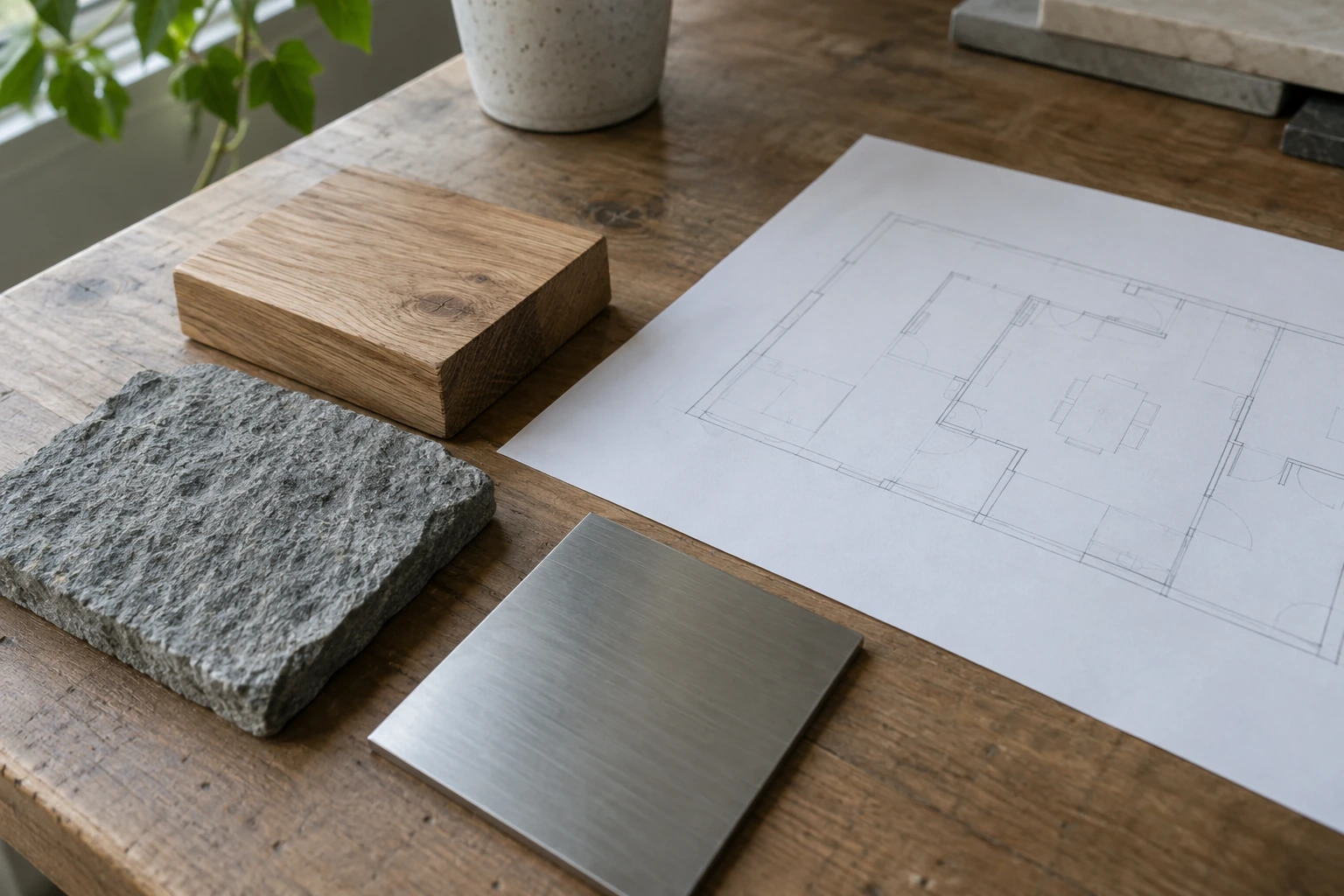
Illustrative review problem: a finish selection remains open, but the proposal references a specification. Record the open decision and ask how its approval and any adjustment will be handled; a sample on the table does not establish inclusion.
Takeaway: Build a revision-specific document index and a separate list of unresolved selections before signing.
Which decisions need recording before signature?
Record the unresolved point, the document that addresses it, the person responsible for an answer and the action needed before commitment. The following checklist draws on topics described in the publishers’ guides and catalogs. It is an editorial review aid for discussion with project counsel, not a list of mandatory clauses or suggested contract language.
Scroll horizontally to see all columns.
| Review topic | File or information to bring | Question to resolve |
|---|---|---|
| Parties and authority | Legal entity details and proposed signature blocks | Who is making the combined delivery commitment, and who can authorize owner decisions? |
| Scope and document hierarchy | Criteria, drawing index, specifications and qualifications | Which documents define the work, and how are discrepancies addressed? |
| Design duties | Service schedules and downstream design-scope information | Who designs, coordinates and reviews each part of the project? |
| Price and payment | Compensation terms, proposed amendment and payment schedule | What is payable now, what is priced later, and what supports a payment request? |
| Changes and approvals | Change procedure and owner decision schedule | Who approves scope, cost or time changes, and how is that decision recorded? |
| Time and early work | Proposed milestones and early-release scope | What is authorized before the final price commitment, and what depends on owner action? |
| Site information and interfaces | Surveys, existing-condition information and separate-work schedules | Who evaluates the information and coordinates work outside the main scope? |
| Insurance and liability | Completed insurance exhibit and proposed liability provisions | Does the proposed allocation align with the required and available coverage? |
| Notices and disputes | Notice provisions, addresses and dispute process | How does each party preserve and route an issue under this specific agreement? |
| Completion and exit | Handover requirements, termination and design-use provisions | What is due on completion or early exit, and what permissions survive? |
For design approvals, distinguish a review meeting from an authorization. Record who can accept a design development, approve a substitution and commit the owner to a cost or time change. If the same person performs several roles, the record should still identify which authority they are exercising.
Use design-build’s owner decision responsibilities to frame that discussion. For a progressive package, also review the decision to accept the later price before authorizing preliminary work. Those are distinct commitments.
Replace vague entries such as “insurance checked” with the document, revision and unresolved question for the appropriate advisor.
Takeaway: Turn each unresolved issue into a named document, responsible person and pre-signature action.
What happens if the project pauses or ends?
Read termination, payment and design-use arrangements together before work begins. A right to stop a relationship does not by itself settle amounts due, permission to use unfinished design documents, or the responsibility for taking them forward. The specific agreement and its modifications need to answer those questions for the project.
AIA’s official guide discusses termination and licensing fees in its revised owner/design-builder forms. ConsensusDocs’ descriptions also identify termination and ownership/use of project documents as agreement topics. These sources support asking separate questions; they do not establish a universal outcome for an owner’s signed contract.
Prepare a short exit record:
- Identify the event being discussed: a rejected price proposal, suspension, termination for convenience or an alleged failure to perform.
- Locate the applicable procedure, including any notice and payment requirements, for counsel to review.
- List the drawings, models and other work product the owner would need to continue the project.
- Ask what license or other permission allows that use, what conditions apply and whether another professional must review or complete the design.
- Distinguish those arrangements from completion documents and obligations under a project that proceeds to handover.
The progressive design-build exit discussion separates the price decision from work-product permissions; check those against your own agreement.

Takeaway: Resolve the exit procedure, outstanding compensation and permission to use the design as separate review items.
When this does not apply
This crosswalk concerns publicly described US design-build form families. It does not establish the required contract for a particular home, public agency or jurisdiction. AIA’s guide notes jurisdictional differences and discourages using its revised family for designer-led design-build. Project-specific requirements and changes to a form remain outside a catalog comparison.
- Residential work: ask project counsel which local requirements and consumer-facing provisions apply to the proposed agreement; a commercial form’s title is insufficient.
- Public procurement: confirm the owner’s authorized procurement procedure and prescribed documents before selecting a private publisher’s package.
- Projects outside the US: use locally appropriate advice and documents rather than treating this US crosswalk as a legal model.
- Designer-led or bespoke arrangements: check the intended contracting structure and available forms with the publisher and counsel.
- Modified or mixed editions: review the actual changes and referenced documents, including compatibility across the package.
If the procurement instead uses industrial EPC or EPCM terminology, begin with the EPC and EPCM responsibility comparison. A similar combined-delivery description does not make those packages interchangeable with building design-build forms.
Takeaway: Use this guide to organize a review, then verify the proposed package against the project’s structure and jurisdiction.
Frequently asked questions
What contract is used for design and build?
Select an owner/design-builder agreement for the combined delivery being purchased. For an already defined price, compare the publisher’s lump-sum or cost-plus/GMP choices. If design and price will develop after appointment, check the preliminary or progressive arrangement and its later commitment point. Use the form tables above to match that choice to its attachments and downstream appointments.
What are AIA standard construction contracts?
They are publisher-prepared starting documents for specified relationships and delivery methods. “Standard” does not mean the proposed copy is unchanged or suitable for your project. Ask for its identifier, edition and a record of modifications; compare those with the publisher’s document description before counsel reviews the project terms.
How much does an AIA contract cost?
Check the specific document and purchasing option in AIA’s official document library. Keep the publisher’s document or subscription cost separate from project-specific legal review and construction costs. Confirm the option and edition you need before budgeting; no license or lawyer’s fee is assumed here.
Can you provide an example of a design and build contract?
DBIA publishes an official sample of Document 544, Progressive Design-Build Agreement, second edition 2024, linked from its product page. Use it to inspect that form’s structure, then obtain the appropriate authorized documents and project review through the publisher and counsel. A sample is not a completed agreement for your project.
What is a design and construction contract?
The phrase alone is too broad to select a form. Locate the signature blocks and scope schedule: is the agreement purchasing combined delivery, preliminary design services, or a construction package that includes some design? Record which design stages and construction work are included, and which need another authorization, before treating the label as a complete commitment.
What are the key differences between an EPC contract and a design-build contract?
There is no uniform clause difference established by the labels alone. CMAA’s guide, printed page 12, describes EPC as turnkey delivery and explicitly includes design, procurement and handoff. This guide compares building design-build form families whose work is defined by the agreed criteria and documents. Compare procurement boundaries, completion/acceptance requirements and retained owner duties in the actual packages; the EPC comparison guide expands that review.
Related reading
- What is design-build? — understand the combined-delivery relationship before selecting forms.
- Progressive design-build — review price development and the decision to proceed.
- Preconstruction risk checklist — organize missing site and project information for the scope review.
- Early budget alignment — distinguish the owner’s budget from the proposed contractual price.
Method and sources
This crosswalk and its editorial questions use public publisher descriptions, not a comparison of full licensed texts or a project case. They do not establish enforceability or supply contract clauses. Have project counsel review the actual agreement and the appropriate insurance advisor review coverage arrangements.
Sources checked October 9, 2026:
- AIA Contract Documents, Design-Build Guide (2025) — revised family and earlier-form relationships, pages 2–3 and 16–17; compensation and termination, pages 22–23; exhibits and architect services, pages 26–28.
- DBIA, Complete Set of Design-Build Contracts and DBIA 544 product description — numbered document roles and progressive-delivery description.
- DBIA, What Is Design-Build? — single-contract definition and delivery variations.
- ConsensusDocs 400, 410, 415 and 420 — preliminary, pricing, amendment and design-professional roles and review topics.
Related guides
What Is Design-Build? An Owner's Guide
What design-build means, who the architect works for, what drives its cost, when the price becomes firm, and the trade-offs owners should weigh.
Read guide