
Design-Build vs Design-Bid-Build
A practical comparison of contracts, pricing, programme, design control, risk, and published performance research for design-build and design-bid-build.
Choosing a delivery method that does not match the owner’s capacity can increase coordination work and change risk. Choose design-bid-build for direct design control and a construction bid on a completed design; consider design-build for earlier builder input when the owner can define requirements and make timely decisions.
Compare three controls: who directs the designer, when construction pricing becomes a commitment, and who can make the required decisions. This comparison uses public guidance and research, not SEI project tests; it focuses on design-build and design-bid-build.
Scroll horizontally to see all columns.
| Decision | Design-build | Design-bid-build |
|---|---|---|
| Owner contracts | One, with the design-builder | Two, with the designer and the contractor |
| Primary responsibility | More integrated | More divided |
| Contractor input | Begins earlier | Usually follows design |
| Price development | Evolves with design or arrives with a proposal | Often tested at bid stage on completed documents |
| Programme overlap | More opportunity | More sequential |
| Owner design control | Defined through the brief and review gates | Direct relationship with the designer |
For industrial or energy-project terminology, the EPC, EPCM and design-build contract comparison explains how combined delivery differs from management services and separate works contracts.
How the contracts are structured
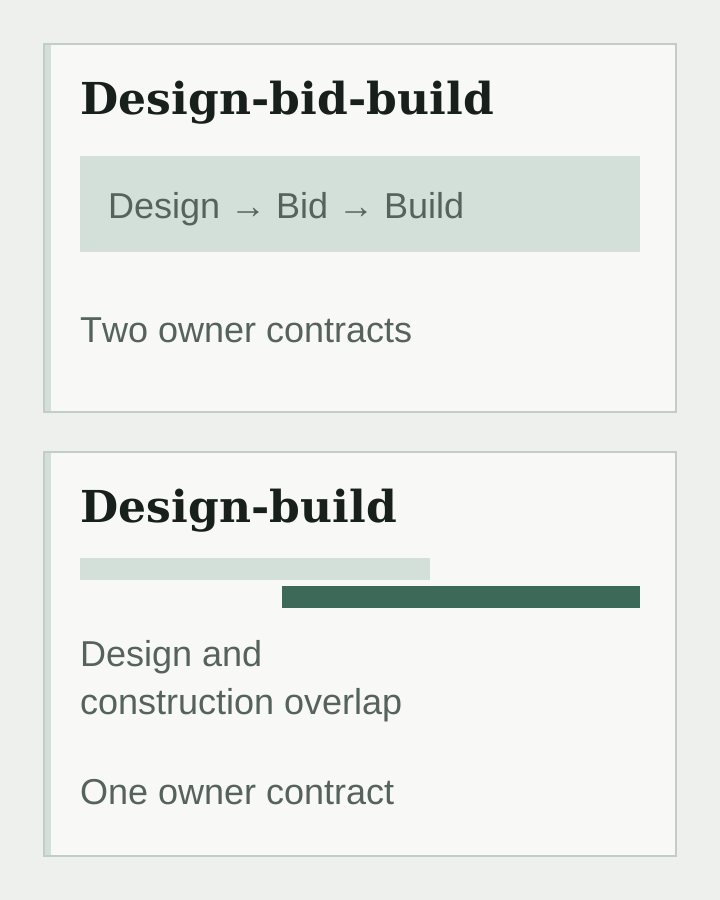
The Construction Management Association of America (CMAA) Owner’s Guide to Project Delivery Methods (August 2012, printed pp. 12–14 and 21–23) describes design-bid-build as three sequential phases: design, when the owner’s designer prepares drawings and specifications; bid, when a contractor is procured; and construction. The owner usually selects the contractor on the lowest responsive and responsible bid for public work, or on a mix of price and technical merit. There is no contract between the contractor and the designer.
In design-build, CMAA describes the owner contracting with one design-build team that performs the design, usually from a preliminary scope or design provided by the owner, and is responsible for construction and for coordination between design and construction. The architect typically works for the design-builder; see What Is Design-Build? for how that relationship is set up. When you are ready to review the proposed agreement, the design-build contract forms and review checklist maps the signing parties, publisher document families and questions to resolve before signature.
The practical consequence is where disputes land. CMAA notes that in design-bid-build the owner generally faces exposure to contractor change orders and claims over design and constructibility, because the owner accepts liability for the design in its contract with the contractor. In design-build, many designer-builder disputes become internal to the team.
Design-bid-build process steps
- Design: the owner’s architect or engineer develops the design and construction documents, sometimes with permitting and approval submissions.
- Bid: the documents and bidder information go to contractors, who price the work. Owners may prequalify bidders where procurement rules allow.
- Award: the owner selects a contractor and signs the construction contract.
- Build: the contractor builds to the contract documents; the designer answers design questions and, if no construction manager is appointed, may help administer the contract.
Is plan-and-spec the same as design-bid-build?
Treat the label as something to clarify: ask whether the work is priced from completed plans and specifications, whether pricing is bid or negotiated, and which party holds the design contract. Use those answers to identify the delivery structure.
Design-bid-build advantages and trade-offs
CMAA lists these advantages of design-bid-build:
- It is widely applicable and well understood, with clearly defined roles.
- It is the most common approach for public owners bound by procurement statutes.
- The owner has significant control over the end product, because the facility is fully specified before the contractor is selected.
Its risk analysis adds that the method gives the owner reliable price information before construction starts.
The trade-offs CMAA lists are a potentially longer duration, because design is completed before the construction contract is solicited; limited ability for the designer to assess schedule and cost consequences during design; and owner exposure to change orders and claims over design and constructibility.
For design-build, CMAA lists a single point of accountability and the possibility of faster delivery and cost efficiency, against less owner design control, the need for fast owner decisions, and the loss of the checks and balances of separate contracts.
What published research says about cost and schedule
A published U.S. benchmark is Revisiting Project Delivery Performance by Keith Molenaar (University of Colorado Boulder) and Bryan Franz (University of Florida), published in 2018 with support from CII and the Charles Pankow Foundation. The summary, updated January 2019, reports 212 U.S. building projects completed between 2008 and 2013 (printed p. 3).
The summary’s Tables 1–2 (printed pp. 4–5) report regression comparisons holding other variables constant:
| Measure | Design-build compared with design-bid-build |
|---|---|
| Unit cost | 0.3% less per square foot |
| Cost growth | 3.8% less |
| Schedule growth | 1.7% less |
| Construction speed | 36% faster |
| Delivery speed, design start to completion | 102% faster |
The final report’s glossary (printed p. 13) defines speed as building area in square feet divided by months: construction speed covers construction; delivery speed covers design initiation through completion. “102% faster” describes a higher area-per-month rate, not a 102% reduction in duration. Read these as model results from one sample, not a project forecast. The cost differences are small, and the same study found that other conditions also explained performance: higher team chemistry among owner, designer, and builder; open-book terms such as cost plus a fee with a GMP; and earlier involvement of the builder. Its case studies linked the worst results to inexperience with the delivery method, poor owner-builder communication, and understaffing or turnover, which can occur under any method.
Compare the controls, not only the labels
Two contracts using the same delivery label can operate very differently. Owners should examine how design quality is reviewed, how estimates are updated, which allowances remain open, and how substitutions or change orders are approved.
Use this blank editorial record to name each role under the proposed agreements:
Scroll horizontally to see all columns.
| Item | Decides | Advises | Prices | Accepts |
|---|---|---|---|---|
| Design review | ||||
| Scope or material change | ||||
| Allowance adjustment | ||||
| Completed work |
Reconcile priced scope, allowances and contingency with the budget alignment guide. Test the agreed responsibilities with the preconstruction risk checklist.
Questions to ask before choosing
- Is schedule overlap important to the project?
- How complete must the design be before cost commitment?
- Is the owner bound by public procurement rules that favour competitive bidding?
- Who will independently review design quality and compliance?
- How will open-book pricing, allowances, and contingencies be handled?
- Does the owner have the time and experience to coordinate separate parties, or to make decisions at design-build speed?
The delivery method should support the project’s real constraints rather than serve as a substitute for a clear scope and capable team.
Two pricing questions
Is design-build more expensive?
The label alone does not establish the price. Compare proposals with the same scope, exclusions and unresolved allowances; a lower total may leave more owner-funded work outside the contract. The budget guide explains how to record that difference.
Is progressive design-build the same as design-build?
It uses the single-contract structure, but selects the team before agreeing the construction price. If early price commitment is your deciding factor, read the progressive design-build guide before treating all design-build proposals alike.
Sources
- CMAA, An Owner’s Guide to Project Delivery Methods, August 2012: sections 3.1 and 3.3, printed pp. 12–14 and 21–23.
- Molenaar and Franz, research summary (2018; updated January 2019): sample p. 3, Tables 1–2 pp. 4–5; final report (December 31, 2018): Tables 3–4 pp. 8–9, glossary p. 13. Sources checked October 8, 2026.
Related guides
Progressive Design-Build vs Traditional Design-Build
How progressive design-build works: two-phase contracting, open-book pricing, what the owner can do if the Phase 2 price is rejected, and who owns the design work product.
Read guide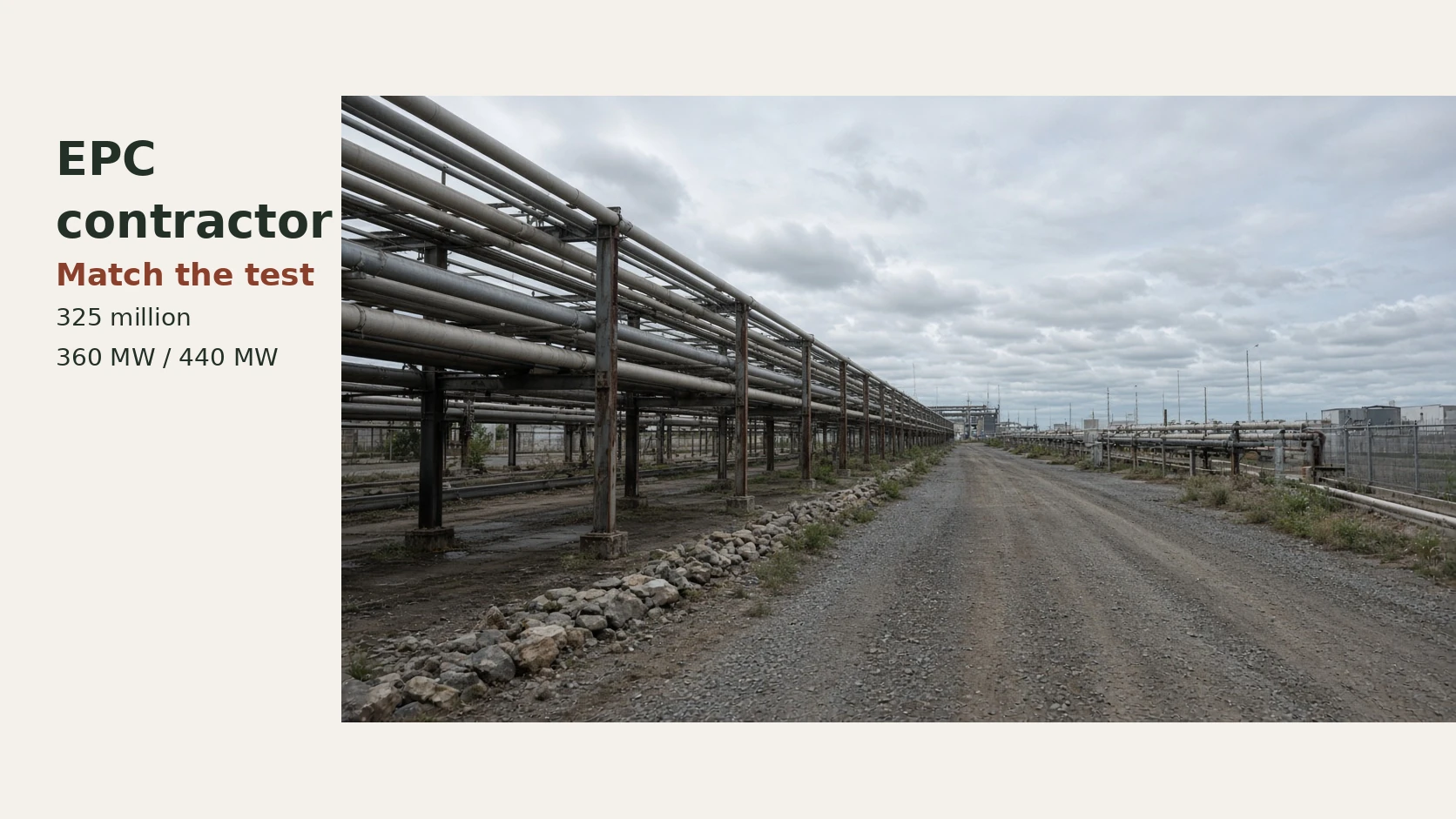
EPC Contractor: Match the Test to the Plant
An EPC contractor selection fails when a 300 MW test is copied onto the wrong plant, or left blank. The 2017 Rupsha invitation prints 325 million USD and two 300 MW contracts.
Read guide
Lump Sum Construction Contracts: Types, Risk and Documents
Compare lump sum, cost-plus, GMP, unit-price and time-and-materials contracts by cost risk, and identify the documents included in a construction contract.
Read guide