
Schedule of Values Construction: Billing
How a construction schedule of values divides the contract sum into auditable line items, prevents front-loading, and governs monthly progress payments.
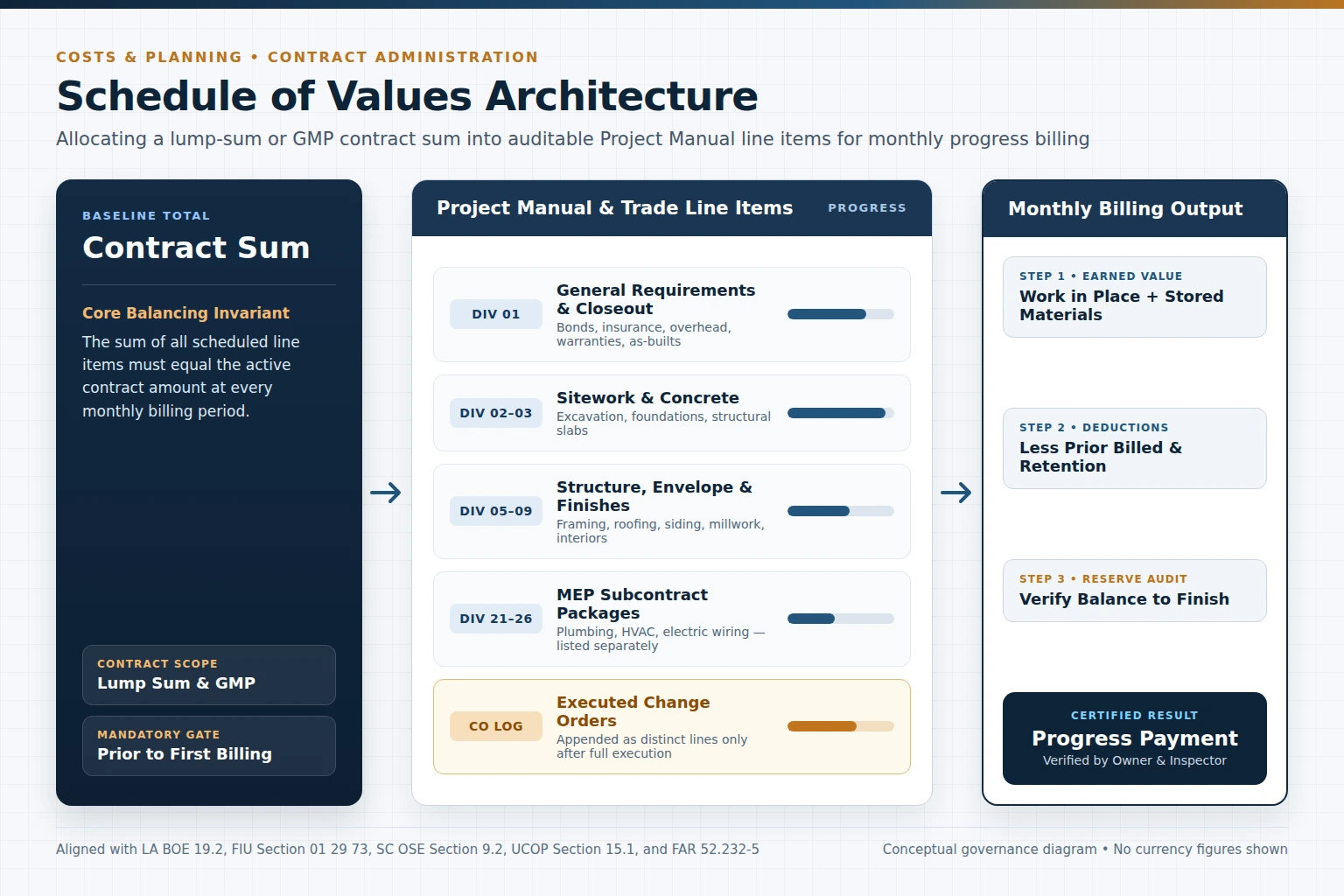
In construction, a schedule of values is a cost-loaded itemization of project activities, major work packages, and subcontracts whose line-item totals equal the active contract sum at every billing cycle. Owners and design teams approve this cost allocation before releasing the first payment to audit percent complete, block front-loading, and certify monthly progress draws.
Review this baseline framework alongside the costs and planning collection before signing off on an initial trade breakdown. To track post-award commitments against actual job costs and final cost forecasts, pair it with the construction budget control guide.
What does a schedule of values mean in construction?
A construction schedule of values means a cost-loaded schedule of work activities totaling the full lump-sum contract price and serving as the approved ledger for calculating monthly progress payments. Under Los Angeles Bureau of Engineering Procedure 19.2, lump-sum contracts use a Schedule of Values while unit-price contracts use a Unit Price Payment Schedule.
Construction contracts normally separate payment mechanisms by pricing structure: a Unit Price Payment Schedule governs unit-price agreements, whereas an approved Schedule of Values establishes the payment basis on lump-sum contracts. Procedure 19.2 requires each construction activity to be encoded to its bid item, the sum of cost-loaded activities within each bid item to match that item’s bid value, and the overall schedule-of-values total to equal the current contract value throughout construction.
Less complex projects with a smaller dollar value may not warrant full activity-level cost loading. Under Los Angeles Bureau of Engineering Procedure 19.2, on less complex projects carrying a smaller dollar value, the construction manager may determine that a cost-loaded schedule is unnecessary. Before billing begins on a fixed-price contract, check how cash allowances and reserves fit inside the contract sum in the stipulated sum allowances and contingency guide.
What columns belong in a construction schedule of values template?
A construction schedule of values template uses a multi-column ledger aligned to Project Manual specification sections, tracking each line item’s fixed scheduled value alongside prior amounts billed, current period progress, stored materials, cumulative earned value, retention, and balance to finish. Florida International University Section 01 29 73 identifies each row by major specification number and title.
South Carolina Office of State Engineer General Conditions Section 9.2.2 requires the trade payment breakdown and updated schedule of values to display the work description with labor and material broken out separately, total value of the work, percent and value completed to date, percent and value of previous amounts billed, and current percent completed and amount billed. Federal Acquisition Regulation 52.232-5 similarly requires progress payment requests to itemize amounts by contract work elements and attach each subcontractor’s current billed work, total subcontract amount, and prior payments.
Scroll horizontally to see all columns.
| Standard SOV column | Data recorded on each row | Measurement unit | Owner audit check |
|---|---|---|---|
| Specification or item number | Project Manual section code, bid item reference, or construction stage code | Alphanumeric section code | Aligns with the Project Manual Table of Contents and contract bid items |
| Work description | Major scope item, separate subcontracted trade, or closeout deliverable with labor and material split | Text scope description | Isolates every subcontracted package and general requirement line |
| Scheduled value | Fixed installed value assigned to the line item upon baseline approval | Whole currency units (nearest dollar) | Column total equals the executed lump-sum or current contract amount |
| Prior amounts billed | Cumulative percentage and value billed on earlier payment applications | Percent (%) and currency units | Reconciles exactly to the previously certified application total |
| Current period work | Percentage and value of work installed during the active billing period | Percent (%) and currency units | Verified during field inspection or the monthly progress payment meeting |
| Stored materials | Eligible materials delivered on-site or stored at a pre-approved off-site facility | Currency units | Supported by proof of owner title, dedication, insurance, and storage |
| Total completed to date | Cumulative percent and value of installed work plus eligible stored materials | Percent (%) and currency units | Tracked against the approved baseline as adjusted by executed change orders |
| Retention and unpaid balance | Contract retainage withheld plus remaining unpaid balance to finish the line | Percent (%) and currency units | Preserves sufficient completion funds for unfinished trades and closeout |
Florida International University Section 01 29 73 instructs contractors to round schedule-of-values amounts to the nearest dollar and list every major work item and every subcontracted work item as its own line. Under University of California Office of the President Facilities Manual Section 15.1, the base activity costs in the approved cost breakdown stay fixed throughout construction so every monthly draw is measured against an unchanging denominator.
What goes into a construction schedule of values example?
A complete construction schedule of values example allocates the entire contract sum across general requirements, direct trade scopes, separate subcontracts, closeout deliverables, phased sub-schedules, and executed change orders without hiding overhead inside early trades. Under University of California Office of the President Section 15.1, warranties, as-built documents, overhead expenses, profit allowance, insurance, and bonds each appear separately.
For Construction Manager Guaranteed Maximum Price contracts governed by Florida International University Section 01 29 73, the builder also tabulates the original GMP Scheduled Value, buyout savings transfers, and contingency transfers, submitting any line-item transfer for owner approval with each payment application. On phased builds, Florida International University requires a separate sub-schedule for each stage of work defined in Section 01 11 00. For how GMP caps, buyout savings, and contingency rules operate across the prime contract, review the guaranteed maximum price contract guide.
Scroll horizontally to see all columns.
| Schedule-of-values category | Typical line-item entries | Breakdown rule | Pre-approval review priority |
|---|---|---|---|
| General requirements and overhead | Bonds, insurance, overhead expenses, and total allowance for profit | Dedicated separate line items | Keeps startup overhead and bonding costs transparent rather than buried in early trades |
| Sitework and structural work | Excavation, foundations, framing, and structural shell activities | Encoded by specification section or bid item | Cross-checks early billing weight against physical field quantities |
| Subcontracted trade work | Roofing, plumbing, heating, electric wiring, and major trade subcontracts | Separate row for each subcontracted scope | Matches scheduled value against signed subcontract totals and prior payouts |
| Closeout items | Warranties and as-built documents itemized under Section 15.1 | Standalone line items | Retains financial leverage until closeout documentation and warranties arrive |
| Phased sub-schedules | Dedicated sub-schedules for each separate work stage under Section 01 11 00 | One sub-schedule per construction stage | Isolates progress billing cleanly across multi-stage projects |
| GMP reallocation lines | Original GMP Scheduled Value, buyout savings transfers, and contingency transfers | Owner-approved transfers per application | Preserves an auditable trail from initial GMP baseline to current line weights |
| Executed change orders | Fully executed change orders adjusting the approved agreement breakdown | Appended as distinct lines once signed | Keeps the sum of all lines equal to the active contract value at all times |
Separating bonds, insurance, warranties, and as-built documents into dedicated rows keeps both mobilization and closeout auditable. Under Florida International University Section 01 29 73, the sum of all listed line values must equal the total contract or lump-sum price items before owner sign-off.
How do construction contracts govern and audit a schedule of values?
Construction contracts tie the schedule of values to post-award submittal deadlines, a strict hold on payments before approval, and mandatory rejection of unbalanced or front-loaded cost allocations. Under Florida International University Section 01 29 73, no payment is issued until the owner approves the schedule of values, and the approved schedule also establishes the equitable value of deleted lump-sum work.
Post-award submittal windows across public standards
Public and institutional contract specifications link schedule-of-values delivery to contract award, full execution, notice of selection, or baseline schedule approval. Under Los Angeles Bureau of Engineering Procedure 19.2, the contractor cost-loads activities to build the schedule of values once the baseline construction schedule is approved, and the Lead Inspector retains authority throughout construction to audit cost loading and order revisions.
Scroll horizontally to see all columns.
| Contract standard | Submittal deadline | Retention rule | Audit and revision control |
|---|---|---|---|
| LA BOE Procedure 19.2 | Upon approval of the construction baseline schedule | Contract retention deducted on each progress payment estimate | Lead Inspector may review cost loading and direct revisions at any point during work |
| FIU Section 01 29 73 | Preliminary within 15 days of award; finalized within 10 days of Overall Construction Schedule approval | Per prime contract payment clauses | No payment until owner approval; substantiating backup required for questioned lines |
| SC OSE General Conditions Section 9.2 | Within 10 days after full agreement execution under Section 9.2.1 | Normal retainage plus extra completion reserve if inaccurate | Must reject insufficient detail, unbalanced values, or front-loading under Section 9.2.3 |
| UCOP Facilities Manual Sections 15.1–15.5 | Within 10 days after receipt of Notice of Selection under Section 15.1 | 5 percent held as retention with 95 percent paid monthly under Section 15.2 | Base activity costs stay fixed; adjusted only by fully executed change orders under Section 15.3 |
| FAR 52.232-5 | Submitted with progress payment substantiation required by Contracting Officer | Up to 10 percent retained when satisfactory progress is not achieved | Requires contract work-element itemization plus subcontractor total and prior-payment listings |
If a design professional challenges any proposed line weight, Florida International University Section 01 29 73 requires the contractor to furnish substantiating data justifying the line-item figure. Reviewing signed subcontracts or supplier quotes before approval stops padded line items from entering the billing ledger.
Detecting and correcting front-loading before and after approval
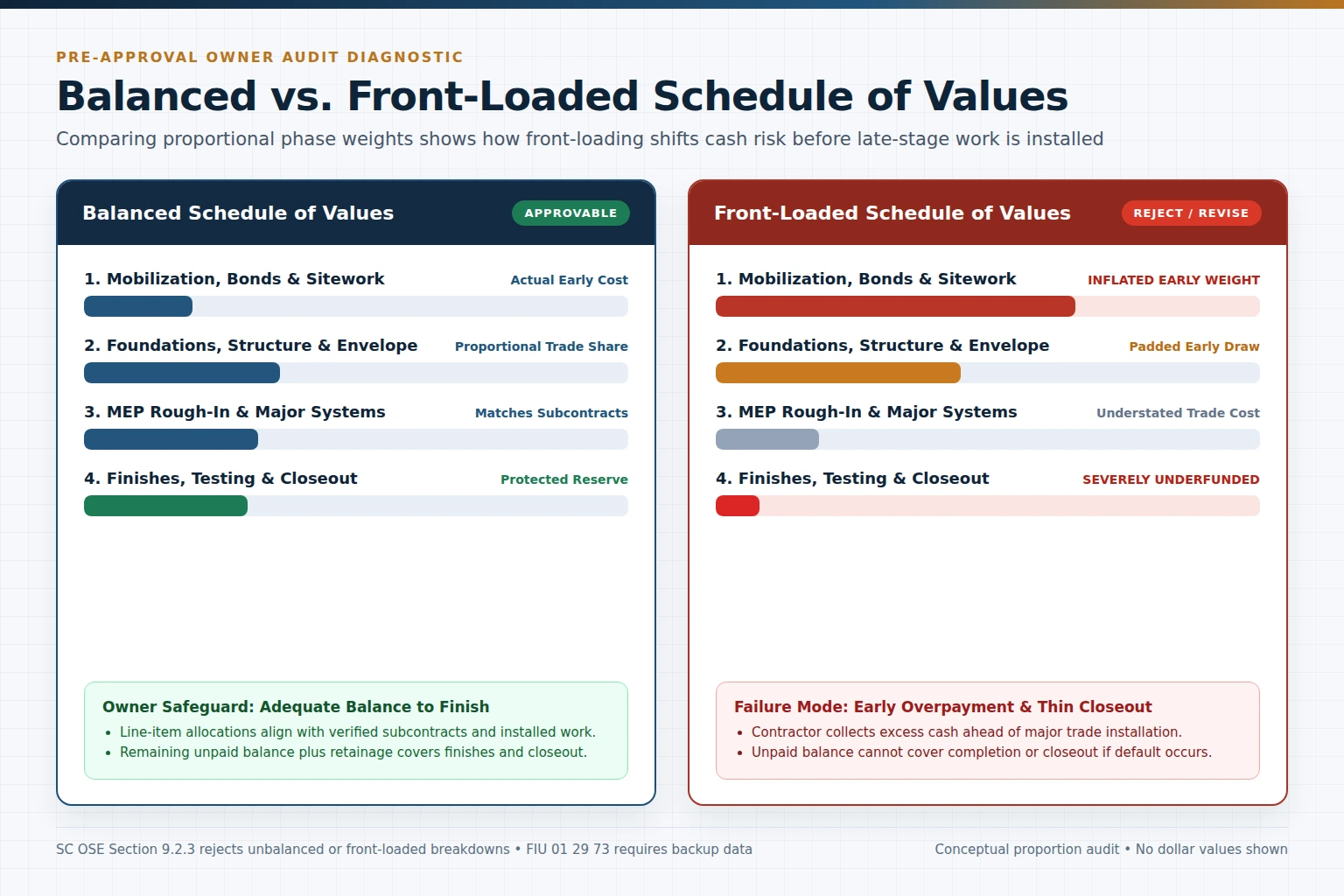
Front-loading happens when early-stage mobilization or sitework lines carry inflated scheduled values while late finishes and closeout lines are starved, exposing the owner to early overpayment and an inadequate balance to finish if the contractor defaults. South Carolina Office of State Engineer General Conditions Section 9.2.3 mandates rejecting any schedule of values or trade breakdown that lacks sufficient detail, is unbalanced, or exhibits front-loading of the value of the work.
Section 9.2.3 also protects owners when an imbalance surfaces after payments start. If a schedule of values or trade breakdown already used for billing proves inaccurate, sufficient funds must be withheld from subsequent Applications for Payment to keep an adequate completion reserve exclusive of normal retainage.
How are monthly progress payments verified against the schedule of values?
Monthly progress payments multiply each fixed baseline line item by its verified completion percentage, add eligible stored materials and completed work under executed change orders, and subtract prior payments, retention, and disputed holds. Under University of California Office of the President Sections 15.1 and 15.3, completion percentages are agreed at a monthly progress payment meeting.
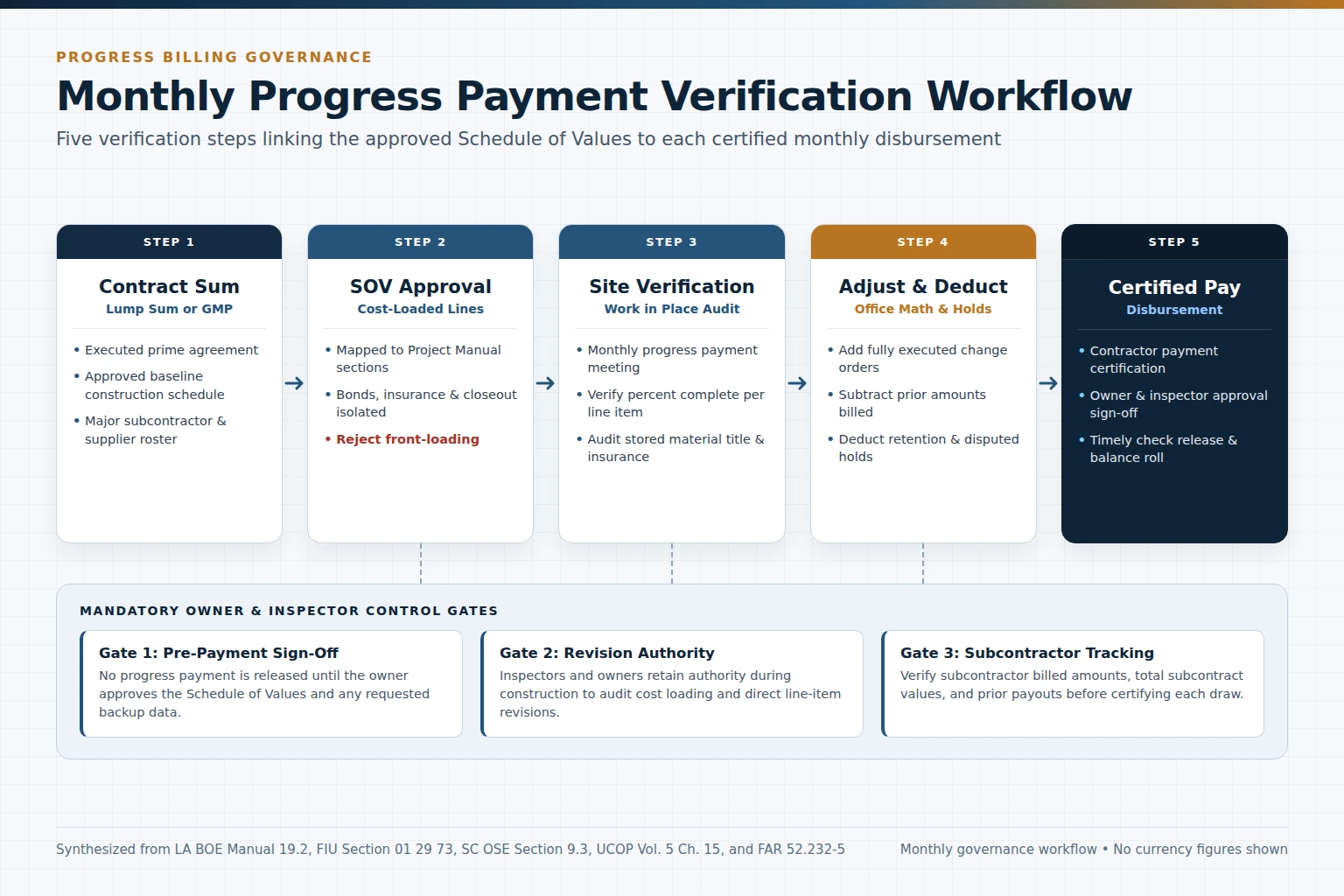
Under Los Angeles Bureau of Engineering Procedure 19.2, the Lead Inspector audits the contractor’s monthly payment request, resolves disputed items, verifies quantities and acceptably completed work, confirms eligible delivered materials or equipment not yet installed, and checks work completed under final change orders. Once the Lead Inspector approves the progress payment estimate, Procedure 19.2 sets a target ceiling of 30 calendar days for total payment processing through check issuance.
Stored materials, subcontractor payment checks, and retainage
Accurate monthly verification enforces three parallel safeguards across material storage, subcontractor pass-through payments, and retention withholding:
- Stored materials on-site and off-site: Under South Carolina OSE Section 9.3.2 and FAR 52.232-5, progress estimates may cover materials and equipment delivered and suitably stored on-site for incorporation into the work. Off-site stored materials qualify only when specifically authorized in advance by the contract or owner, supported by satisfactory evidence of owner title, project dedication, insurance, storage, and transport to the site.
- Subcontractor payment tracking: Under South Carolina OSE Section 9.3.1.2, Applications for Payment must exclude requests for work where the contractor does not intend to pay the responsible subcontractor or supplier. Under FAR 52.232-5, every federal fixed-price progress payment request must itemize each subcontractor’s current billed amount, total subcontract value, and amounts previously paid.
- Retention versus defect withholding: Under UCOP Facilities Manual Sections 15.2 and 15.5, monthly payments equal 95 percent of work in place while 5 percent is retained as completion leverage and subcontractor payment protection, distinct from separate withholding for defective or incomplete work. Under FAR 52.232-5, monthly progress payments reflect approved estimates of quality-compliant work, and if satisfactory progress lags, the Contracting Officer may retain up to 10 percent of the payment until satisfactory progress resumes.
When is a schedule of values used in residential construction?
A schedule of values is used in residential construction whenever a lender, housing agency, or homeowner disburses staged progress draws instead of a single payment at completion. Under 7 CFR 1924.6 for USDA Rural Development residential contracts, the contractor submits a major subcontractor and supplier roster alongside a phase schedule of values before receiving the first partial payment.
The residential phase structure listed in 7 CFR 1924.6 covers excavation, foundations, framing, roofing, siding, mill work, painting, plumbing, heating, and electric wiring, totaling the full contract sum in a format agreed upon by the borrower, agency, and contractor. Every subsequent partial payment request is audited against those agreed phases and inspected physical work in place.
Residential progress draw caps tighten sharply when a contractor lacks a surety bond. Under 7 CFR 1924.6, contractors furnishing a surety bond equal to the full contract amount may receive partial payments equal to 90 percent of work in place and suitably stored site materials, whereas unbonded contractors without a letter of credit or deposit are capped at 60 percent of the value of work in place. To benchmark residential trade shares before approving a builder’s phase weights, consult the construction cost breakdown guide.
Frequently Asked Questions
How does a schedule of values differ from a unit price payment schedule?
Under Los Angeles Bureau of Engineering Procedure 19.2, unit-price contracts use a Unit Price Payment Schedule, whereas lump-sum contracts use a Schedule of Values to divide a fixed contract amount into cost-loaded activities that govern monthly progress payments.
When is a contractor required to submit a schedule of values?
Most public and institutional contracts require submission right after award or execution and before billing begins. South Carolina OSE Section 9.2.1 and UCOP Section 15.1 set a 10-day window after full execution or notice of selection, while Florida International University requires a preliminary schedule within 15 days of award and a finalized version within 10 days of Overall Construction Schedule approval.
Can an owner reject a front-loaded schedule of values?
Yes. South Carolina OSE Section 9.2.3 requires rejecting any schedule of values or trade breakdown that lacks adequate detail, is unbalanced, or shows front-loading, and Florida International University Section 01 29 73 bars payment on any contract item until the owner approves the schedule of values.
How are executed change orders added to an approved schedule of values?
Under UCOP Sections 15.1 and 15.3, baseline activity costs stay unchanged throughout construction, and monthly Applications for Payment reflect the approved breakdown modified only by fully executed change orders. Under Los Angeles Bureau of Engineering Procedure 19.2, the schedule-of-values total must match the current contract value at all times, and FIU Section 01 29 73 uses the approved schedule to value deleted lump-sum work.
Can a contractor bill for stored materials on a schedule of values?
Materials and equipment delivered and suitably stored on-site may be billed when allowed by the contract and confirmed by inspection under LA BOE Procedure 19.2, SC OSE Section 9.3.2, and FAR 52.232-5. Off-site stored materials require prior written owner or contract authorization plus proof of owner title, project dedication, insurance, storage, and transportation.
Sources
- City of Los Angeles Bureau of Engineering — Project Delivery Manual 19.2 Progress Payment Procedures
- Florida International University Facilities Management — Section 01 29 73 Schedule of Values
- South Carolina Office of State Engineer — General Conditions Section 9.2 and Section 9.3
- Federal Acquisition Regulation (FAR) 52.232-5 — Payments under Fixed-Price Construction Contracts
- University of California Office of the President — Facilities Manual Sections 15.1–15.5 Contractor Payments
- 7 CFR 1924.6 — Performing Development Work (Cornell Law School Legal Information Institute)
Related guides
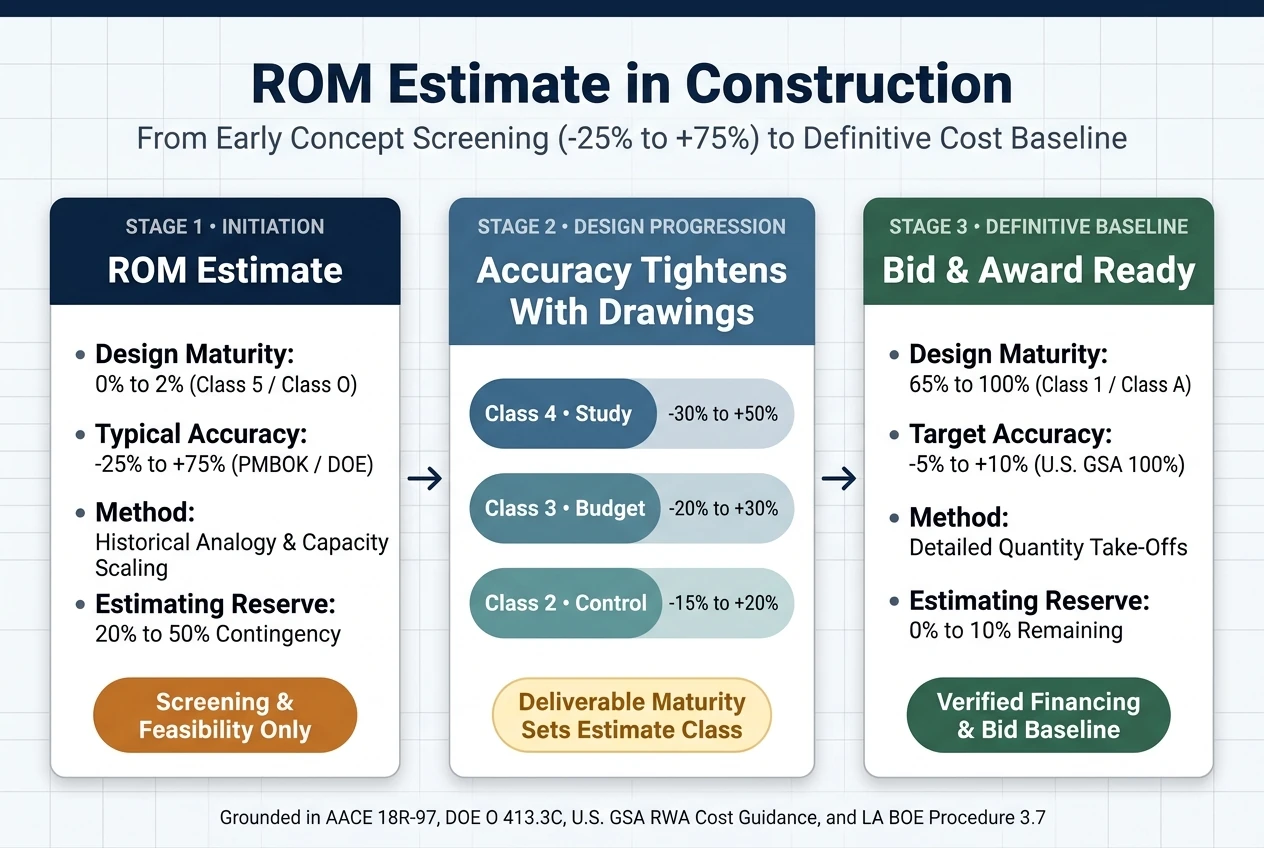
ROM Estimate: Accuracy Range and Classes
Learn what a construction ROM estimate is, its -25% to +75% accuracy range, the five cost estimate classes, historical scaling steps, and when to upgrade.
Read guide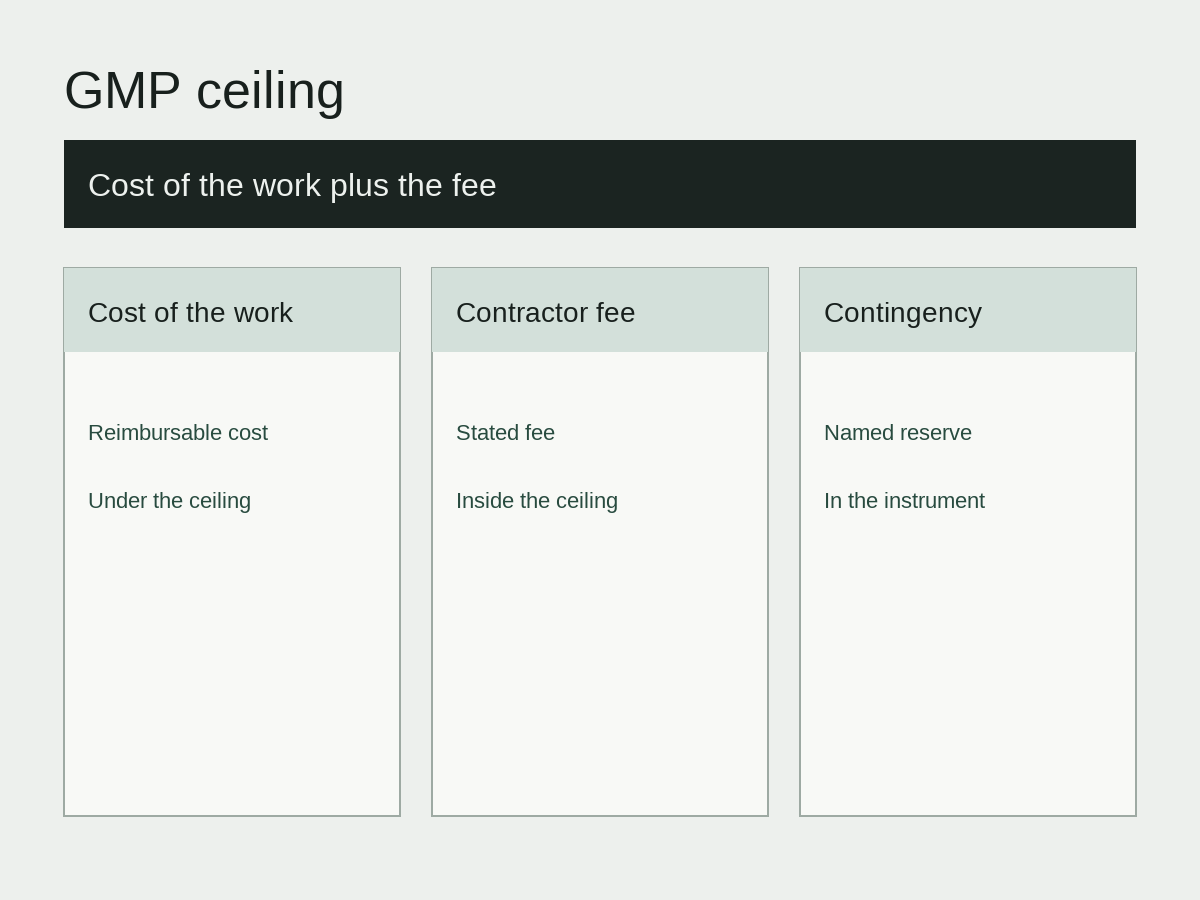
Guaranteed Maximum Price Contract: Contingency
A guaranteed maximum price caps the cost of the work plus the fee. Contingency control and shared savings follow the instrument.
Read guide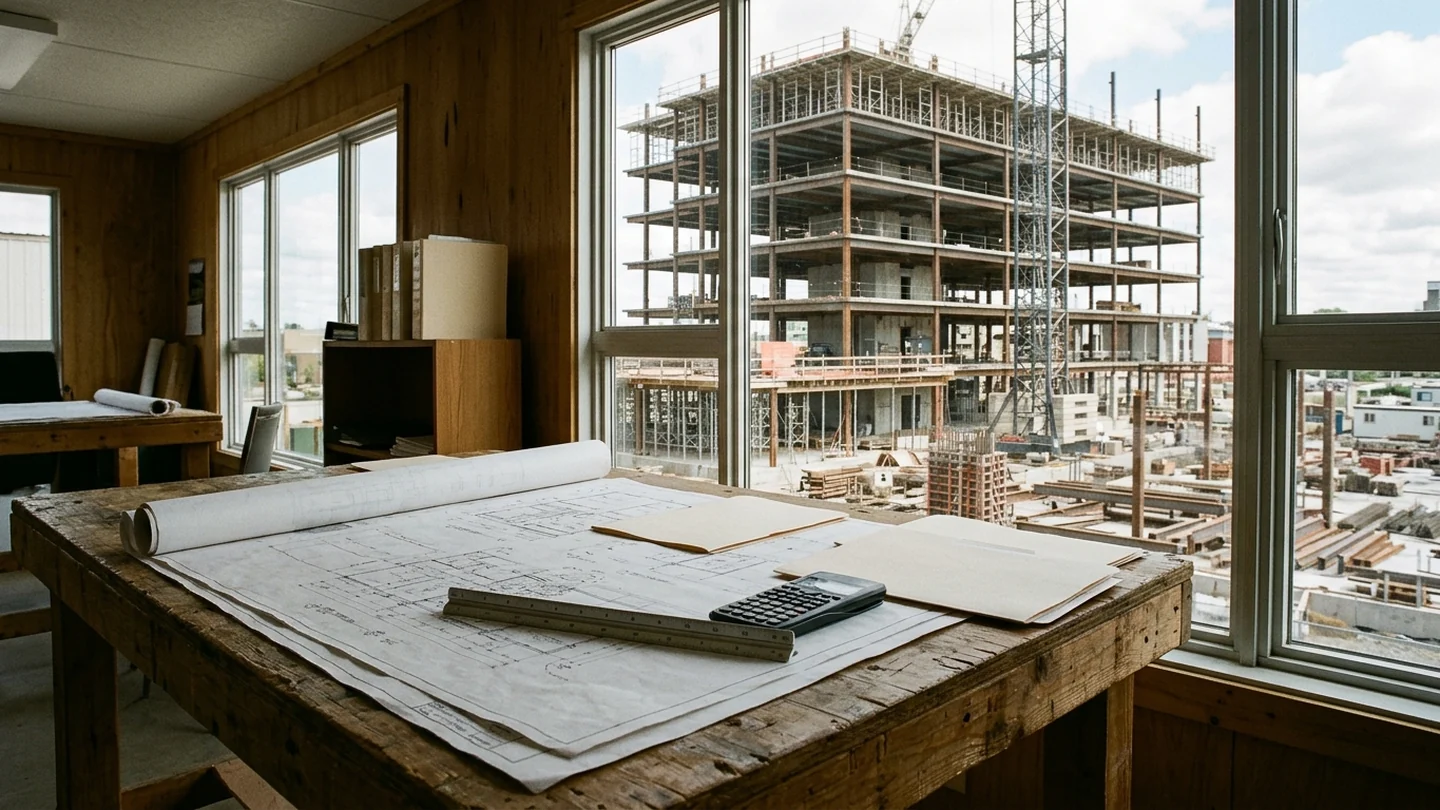
Commercial Building Estimate Inputs: Core/Shell, TI & Site
Structure a commercial building cost estimator worksheet around core and shell, tenant improvement, and sitework scope, area denominators, and location factors.
Read guide