
Guaranteed Maximum Price Contract: Contingency
A guaranteed maximum price caps the cost of the work plus the fee. Contingency control and shared savings follow the instrument.
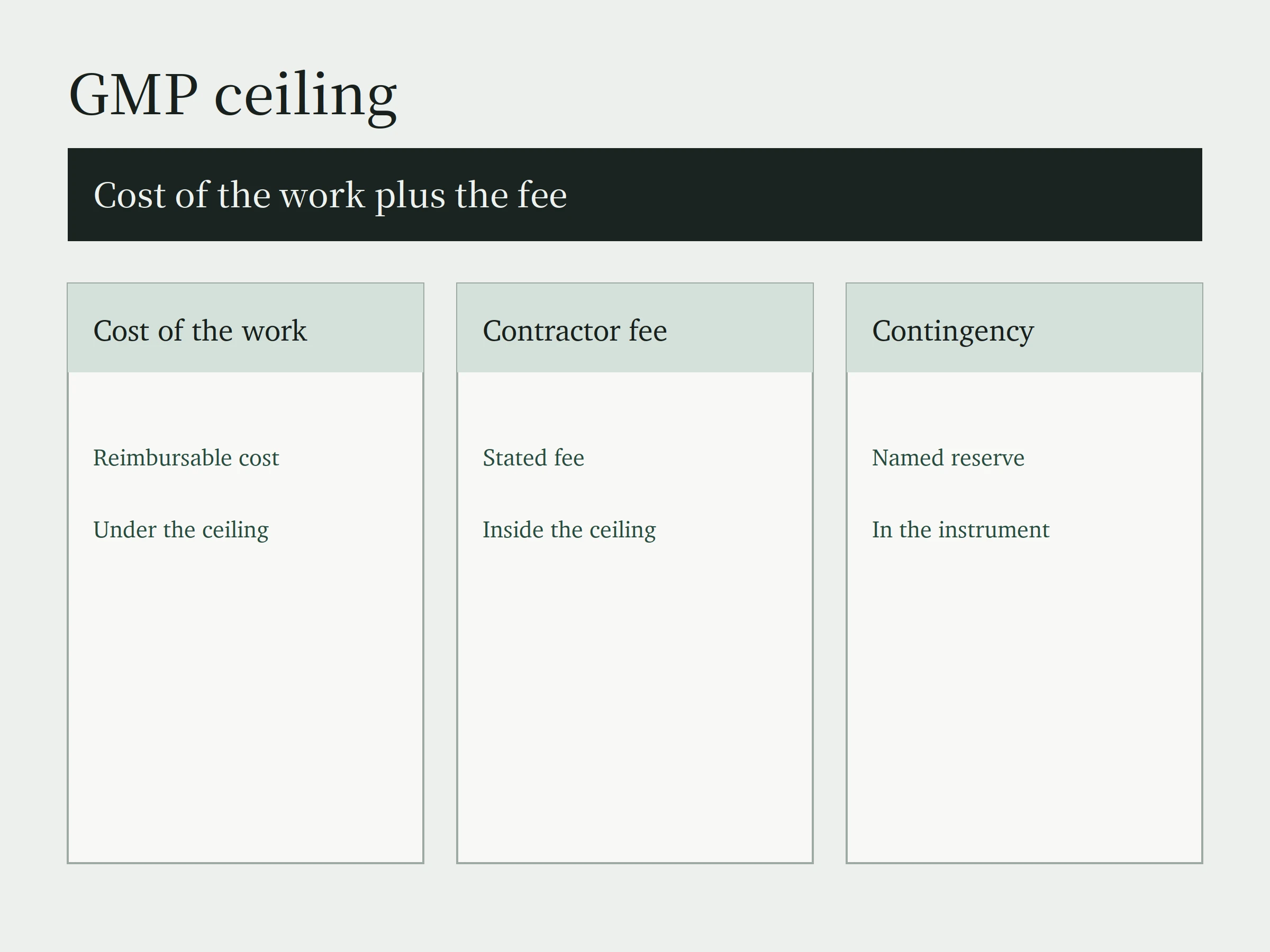
A guaranteed maximum price is a ceiling on the cost of the work plus the fee. Contingency and shared savings are defined by the instrument that sets them. The GSA sum, the University of Houston sum, and the Princeton payment rule are three different compositions.
In the GSA Construction-Manager-as-Constructor clause, Guaranteed Maximum Price means the sum of the ECW, the CCA, and the fee for the construction work. Estimated Cost of the Work means the estimated cost of the construction work, not including home office overhead. Fee for the Construction Work means the amount established for the contractor’s profit and home office overhead costs. The CMc Contingency Allowance is an allowance for the exclusive use of the construction contractor to cover reimbursable costs during construction that are not the basis of a change order. Those costs could include estimating, scheduling, and planning errors in the final Estimated Cost of the Work or other contractor errors. Cost in that clause means allowable costs in accordance with FAR Part 31. Cost of Performance means the final sum of cost of the construction work and fee for the construction work.
In the University of Houston construction manager-at-risk agreement, the GMP includes the Construction Phase Fee, the General Conditions Cost, the Cost of the Work, and any Construction Contingency. In that agreement, Cost of the Work includes only the items in that article and does not include the Pre-Construction Phase Fee, the Construction Phase Fee, or the General Conditions Costs.
Princeton University agrees to pay the Cost of the Work plus the Contractor’s Fee, and the contractor guarantees that the Cost of the Work plus the Contractor’s Fee shall not exceed the Guaranteed Maximum Price, subject to additions and deductions only by change orders signed by Princeton University.
AIA Contract Documents says a GMP contract sets the maximum amount the owner will pay for the cost of the work plus the contractor’s fee, subject to approved changes and the terms of the agreement. That article says not to treat the GMP as the contract price: it establishes a ceiling cost, but the owner pays actual reimbursable costs, which may be less than the GMP. The construction contract types guide already states that the owner pays actual reimbursable costs and fee up to that ceiling, not the ceiling itself, and that the GMP is not a cap on land, financing, owner consultants, or other costs outside that contract. Separate those owner costs in early budget alignment. This page sits in the costs and planning collection.

What does GMP stand for in contracting?
GMP stands for Guaranteed Maximum Price. In the GSA clause, that name means the sum of the ECW, the CCA, and the fee for the construction work. AIA Contract Documents uses the same name for the maximum the owner will pay for the cost of the work plus the contractor’s fee. The instrument that uses the name also states the sum.
The GSA Construction-Manager-as-Constructor clause is dated JAN 2020 and is a deviation from FAR 52.216-17. The proposed ECW incorporated into the contract at award is a target ECW. A final ECW is negotiated during the design phase and is incorporated into the contract prior to exercise of the GMP option.
How does a GMP compare with a lump sum?
A firm-fixed-price contract provides for a price that is not subject to any adjustment on the basis of the contractor’s cost experience in performing the contract. A GMP ceiling does not work that way. The construction contract types guide states that the owner pays actual reimbursable costs and fee up to that ceiling, not the ceiling itself, and that approved changes or other agreed adjustments can move the GMP.
The construction manager at risk guide states that a GMP is not the same as a lump sum, because cost reporting and treatment of savings can differ. That guide also states that a GMP is not automatically the owner’s entire project budget. The five-type comparison stays on the contract-types guide. This page does not repeat that comparison.
How does a GMP differ from cost-plus?
A cost-reimbursement contract provides for payment of allowable incurred costs, to the extent prescribed in the contract. Those contracts establish an estimate of total cost for obligating funds and establishing a ceiling that the contractor may not exceed, except at its own risk, without the approval of the contracting officer. That funds ceiling is a cost-reimbursement limit. It is not the guaranteed maximum price defined for the GSA construction-manager-as-constructor method.
A contracting officer shall use a cost-reimbursement contract only when the agency cannot define its requirements sufficiently for a fixed-price contract, or uncertainties do not permit costs to be estimated with sufficient accuracy to use any type of fixed-price contract.
Under the GSA clause, if the final cost of performance is equal to or greater than the final GMP, the contractor is not entitled to any additional compensation. If the final cost of performance is less than the final GMP, the contractor is entitled to the percentage specified in paragraph (g) of the difference between the final GMP and the final cost of performance. Under the Princeton form, if the actual final Cost of the Work plus the Contractor’s Fee exceeds the adjusted GMP, the excess shall be borne solely by the contractor.
Is a GMP the same as not-to-exceed?
No. Princeton uses not-to-exceed for the general-conditions cost amount inside the GMP. That line is not a second name for the whole GMP. Hourly billing rates in that form are subject to audit, and any increases resulting from adjustments to those rates shall be absorbed within the GMP. The Princeton contractor’s fee is a fixed amount and it shall not fluctuate or be revised upward based on the actual Cost of the Work.
For this GSA CMc method, the GMP is the ceiling price described by FAR 16.403-2. A fixed-price incentive successive-targets contract includes a ceiling price that is the maximum that may be paid to the contractor, except for any adjustment under other contract clauses providing for equitable adjustment or other revision of the contract price under stated circumstances. That FAR ceiling is the one the GSA prescription cites. A private GMP is not automatically either incentive type.
A fixed-price incentive firm-target contract specifies a target cost, a target profit, a price ceiling, and a profit adjustment formula. These elements are all negotiated at the outset. When the final cost is less than the target cost, the formula results in a final profit greater than the target profit. When the final cost is more than the target cost, the formula results in a final profit less than the target profit. If the final negotiated cost exceeds the price ceiling, the contractor absorbs the difference as a loss.
Who controls the contingency?
Control follows the instrument. The allowances on a stipulated-sum contract are a different account, explained in the stipulated sum allowances and contingency guide. That guide states that an allowance is for a known item whose final cost has not yet been determined, and a contingency is a reserve for unexpected costs that may or may not occur. It also states that there is no universal owner-contingency amount, and that an EJCDC owner contingency allowance functions as a prefunded change-order account. That EJCDC account is not the GSA CCA and not the Houston or Princeton construction contingency.
Scroll horizontally to see all columns.
| Instrument | Ceiling composition | Contingency control | Savings treatment |
|---|---|---|---|
| GSA CMc clause | ECW plus CCA plus the fee for the construction work | Exclusive use of the construction contractor, and not a change-order basis | Share inserted in the clause, inside the GSA prescription |
| Houston agreement | Construction Phase Fee, General Conditions Cost, Cost of the Work, and Construction Contingency | Expenditure authorization before use, and written approval before reallocation | Unused balance returned to the owner as savings |
| Princeton contract | Cost of the Work plus the Contractor’s Fee, guaranteed not to exceed the GMP | In-scope costs omitted from the GMP, not additional scope | Underrun called Savings and accrued to the university |
On the GSA clause, the CCA shall be a percent of the ECW that the Contracting Officer inserts. The shared-savings incentive shall be a percent of the difference between the final GMP and the final cost of performance, and the Contracting Officer inserts that percent. The CCA shall not exceed 3 percent of the ECW, unless the HCA approves in writing a higher amount not to exceed 5 percent of the ECW. The CCA type of allowance may only be used as part of the CMc project delivery method and should not be confused with other types of allowances.
For approved CCA uses, the CCA shall be reduced and the ECW shall be adjusted accordingly. Early phase designs usually include less defined scope and may require a higher initial CCA at contract award. Later phase designs may allow a lower CCA at GMP option exercise. That observation is the GSA prescription for this method.
Houston Construction Contingency covers shortfalls in the scope of work as it was known at the time of the GMP Agreement, and use of it shall only be authorized by a fully executed Construction Contingency Expenditure Authorization. The Houston GMP proposal will include a Construction Contingency for costs arising out of the continued development and completion of the Drawings and Specifications which are reasonably inferable, except for material changes in scope. Any re-allocation of Houston Construction Contingency to cover increases in the Direct Construction Cost must be approved by the owner in advance and in writing. That Construction Contingency shall not be used for contractor rework, unforeseen conditions the construction manager could have foreseen with the Standard of Care, cost increases caused by lack of coordination or communication with the project architect or trade subcontractors, errors or omissions in the Work or the Construction Documents, or warranty work. Any balance in that Construction Contingency remaining at the end of the Project shall be returned to the Owner as savings.
The Princeton Construction Contingency is reserved for increased or added costs that are Cost of the Work from circumstances that may not be completely predictable at the time the GMP is established but that can reasonably be assumed to be included in the scope and were omitted from the GMP. That Construction Contingency is not intended to fund additional scope or to fund additional cost of allowances beyond the dollar values included in the GMP. If the Princeton Construction Contingency is exhausted, all costs and expenses that would qualify for reimbursement from it shall be borne by the contractor. Any amount remaining in the Princeton Construction Contingency at final payment shall be counted as Savings.
The construction manager at risk guide says not to treat a contractor allowance, a contractor contingency, and an owner reserve as interchangeable money.

When are shared savings paid?
Payment of savings is also instrument-specific. AIA Contract Documents says that if the final project cost is less than the GMP, the contract should include a savings provision that explains how the remaining amount is distributed. That article does not state a share percentage. If actual reimbursable costs exceed the GMP, and the overrun is not covered by an approved change or other contract adjustment, the contractor is generally responsible for the additional costs.
On the GSA method, the shared savings incentive is a shared portion of the difference between the final GMP and the final cost of performance. Except with HCA approval, the construction contractor’s share ratio shall range from 30 percent to 50 percent and shall not exceed 50 percent. A different share ratio requires written HCA approval documented in the contract file. The final settlement amount shall consist of the cost of performance and the contractor’s shared savings incentive, if any, and in no event shall the final settlement exceed the GMP. If this contract is terminated, the contractor shall not be entitled to a shared savings incentive.
Houston savings credited against the GMP include the savings, if any, between the GMP and the sum of the actual Cost of the Work plus General Conditions Cost plus the Construction Phase Fee. The Houston form credits 100 percent of any unexpended funds categorized as Construction Contingency, allowances, and savings resulting from design or construction changes that reduce the scope of the Work. The Houston form credits 100 percent of any other savings, other than those specifically listed, identified by cost review or audit, whether before or after final payment. The Contract Sum shall not exceed the Pre-Construction Phase Fee plus the accepted Guaranteed Maximum Price Proposal, subject to adjustment for Additional Services or Change Orders, and costs that exceed the Contract Sum shall be borne solely by the Construction Manager.
If the actual final Cost of the Work plus the Contractor’s Fee is less than the adjusted GMP, the Princeton form calls the difference Savings and accrues 100 percent to Princeton University and 0 percent to the contractor. Upon completion of 80 percent by count of the subcontractor buyouts, the Princeton contractor submits a buyout report, and net buyout savings are transferred into the Construction Contingency. Unused allowances shall not for any purpose be transferred into the Construction Contingency and shall remain a credit to Princeton University of 100 percent of such unused allowances.
The ConsensusDocs public article says the GMP, as spelled out by article 7, includes the cost of the work, compensation for Design Phase services, and the Design-Builder’s fee. The ConsensusDocs 410 design-build agreement is the form that article discusses. Absent change orders, that GMP creates a ceiling and the risk for cost overruns shifts to the design-builder rather than the owner. ConsensusDocs 410 section 7.5 leaves the savings percents for the parties to insert: the savings accrue a percent to the owner and a percent to the design-builder, calculated and paid as part of final payment. The ConsensusDocs 500 agreement does not include shared savings language.
How is a target price different from a GMP?
The GSA clause’s ECW at award is a target ECW. The final ECW is negotiated during design, before the GMP option. A target ECW is not the final ECW, and it is not the Houston or Princeton formula.
A firm-target incentive contract negotiates the target cost, the target profit, the price ceiling, and the profit adjustment formula at the outset. When the production point specified in a successive-targets contract is reached, the parties negotiate the firm target cost, giving consideration to cost experience under the contract and other pertinent factors. Those FAR instruments are the comparison. They are not the Houston sum and they are not the Princeton guarantee.
When can the ceiling be locked?
The failure mode is locking the ceiling before the work is described well enough to estimate, and before the price states what further development it already includes.
The GSA contractor’s affirmation must state that the construction work has been sufficiently described to enable it to estimate the cost of the work with reasonable accuracy. The disclosure item is paragraph (e)(1)(vi)(C): the contractor has disclosed to the Contracting Officer all of its actual knowledge relating to design errors and omissions that may affect the cost of the work. The next sentence says the final ECW and time established for completion shall not be adjusted on account of cost or time attributable to known design errors and omissions disclosed pursuant to paragraph (e)(1)(v)(C). Unknown design errors and omissions that form the basis for a change order may still be settled in accordance with GSAR 552.243-71 Equitable Adjustments. The Contracting Officer will not accept a final ECW proposal that does not include the written affirmation, and will not exercise the GMP option for construction work unless the final ECW has been incorporated into the contract.
The final ECW proposal must include a detailed statement of all construction costs, including early work packages in the performance of the construction work to date. On this GSA method, the final ECW should be established prior to completion of the design, that is 100 percent construction documents, generally no earlier than completion of 75 percent construction documents. The GMP option shall not be exercised until the final ECW is established. If the sum of the final ECW, CCA, and fee for construction work is less than the GMP, the contracting officer shall adjust the GMP downward through a bilateral modification to exercise the GMP option. The GMP option shall not be exercised if the final ECW, CCA, and fee for the construction work is greater than the GMP as established at contract award or as adjusted under FAR Part 43.
The Houston form says the construction manager shall submit the GMP proposal by a percentage of completion of Design Development. The Houston form leaves that completion percentage blank. The Houston agreement says reasonably inferable takes into account that not every detail will be shown, and the construction manager shall not be entitled to a GMP increase due to the absence of any detail or specification it may require, or for construction necessary to complete the project.
The Princeton contract says that, where the drawings and specifications are anticipated to require further development by the architect or engineer, the contractor has provided in the GMP for such further development consistent with the Contract Documents and reasonably inferable therefrom. Further development does not include changes in scope, systems, kinds and quality of materials, finishes, or equipment. The construction manager at risk guide states there is no universal design percentage at which every CMAR GMP becomes valid.
AIA Contract Documents says the GMP is typically agreed before the design team has completed the construction documents, and that it should incorporate assumptions, allowances, contingencies, and other pricing qualifications for work not yet fully defined. The ConsensusDocs public article says parties should set the GMP as soon as there is enough design development, and enough price and schedule certainty, that they are comfortable locking those terms.
Under the GSA clause, the ECW and GMP shall be subject to adjustment for changes and any other conditions giving rise to entitlement to an adjustment under this contract. Under that clause, the ECW and GMP may be adjusted down for deletions to the scope of the construction services through a bilateral modification. During the design phase, under the GSA prescription, the GMP may be bilaterally modified upward only for approved additions to the scope of work. Under the GSA clause, the fee for the construction work associated with a change order shall not be driven by a fixed percentage. Under the GSA clause, the fee for the construction work is not increased or decreased based on fluctuations in the actual costs of the work.
What records stay open?
Under the GSA clause, before conversion to firm-fixed-price, the Government and its designated auditors and accountants shall have access to records maintained by the contractor relating to the contract, and the right to attend project meetings. Under the GSA prescription, open book accounting shall be followed for financial tracking of all contract line items that are awarded on a GMP basis. All payments shall be reconciled with the open book accounting records and the schedule of values adjusted as appropriate. Reconciliation shall occur each month. To determine the cost of the construction work, the contractor shall be subject to an audit of the contractor’s records or the contractor’s proposal.
If any portion of the contract is converted to a firm-fixed-price, that portion is no longer subject to open book accounting, a shared savings incentive, or the need for final settlement. A firm-fixed-price negotiated before exercise of the GMP option shall not exceed the GMP. The Contracting Officer has the right, but not the obligation, to exercise the GMP option at that firm-fixed-price within 120 calendar days of the establishment of such price. After a request for a firm-fixed-price proposal, the contractor shall provide the data within 60 calendar days, and the Contracting Officer has 60 calendar days after receipt to convert the contract by bilateral modification. That converted firm-fixed-price, plus any costs incurred in the performance of the construction work, shall not exceed the GMP. The contractor shall submit a final settlement proposal within 120 days of substantial completion.
Value engineering, as that term is used and described in FAR Part 48, shall not apply to the CMc project delivery method described in this subpart.
No subcontract placed under the GSA clause may provide for cost-plus-a-percentage of cost.
Contingency boundary checklist
Use this checklist on the proposed clause before the ceiling is accepted. Mark the contingency boundary in the same pass.
- Which sum is inside the ceiling: the GSA sum of ECW, CCA, and fee, the Houston sum of Construction Phase Fee, General Conditions Cost, Cost of the Work, and Construction Contingency, or the Princeton rule that pays Cost of the Work plus Fee and guarantees that sum will not exceed the GMP.
- Who controls the contingency: the GSA contractor’s exclusive CCA, the Houston authorization, or the Princeton contingency for omitted in-scope costs. Do not swap in the EJCDC prefunded change-order account from the stipulated-sum guide.
- What further development the price already includes, and which changes in scope, systems, or quality still adjust the GMP.
- When shared savings are paid under the GSA prescription, the contractor’s share ranges from 30 percent to 50 percent.
- When shared savings are paid under the Houston form, the listed unexpended balances are credited at 100 percent.
- When shared savings are paid under the Princeton form, the underrun accrues 100 percent to the university and 0 percent to the contractor.
- ConsensusDocs 410 section 7.5 states a percent for the owner and a percent for the design-builder, and the parties insert those percents.
- The ConsensusDocs 500 agreement does not include shared savings language.
- Which live page owns the neighboring rule: construction contract types for the ceiling and the costs it does not cap, stipulated sum allowances and contingency for allowance reconciliation, construction manager at risk for delivery timing and the point that a GMP is not a lump sum, and early budget alignment for land, financing, design, and owner consultants outside the construction price.
Takeaway: Read the instrument’s own sum, its contingency control, and its savings rule before treating every guaranteed maximum price as one formula.
Sources
- GSA Construction-Manager-as-Constructor clause
- GSA guaranteed maximum price prescription
- GSA open-book accounting for a GMP
- GSA value engineering limit for this method
- GSA shared savings incentive
- Cost-reimbursement contracts
- Limits on using cost-reimbursement contracts
- Firm-fixed-price contracts
- Fixed-price incentive contracts with a firm target
- Fixed-price incentive contracts with successive targets
- University of Houston construction manager-at-risk agreement
- Princeton University GMP construction contract
Related guides

Stipulated Sum Contract: Cash Allowances, Alternates, and Contingency Accounting
Review stipulated sum allowances and contingency, accepted alternates, allowance reconciliation, and the questions to ask before approving a budget.
Read guide
Commercial Building Estimate Inputs: Core/Shell, TI & Site
Structure a commercial building cost estimator worksheet around core and shell, tenant improvement, and sitework scope, area denominators, and location factors.
Read guide
Construction Budget Control: Tracking Budget vs. Actual, Committed Costs, and EAC Forecast
Track budget control in construction projects with a budget vs. actual template, commitment reconciliation, and an EAC forecast review.
Read guide